

14 PSD Random Vibration Strength and Fatigue Analysis …
177
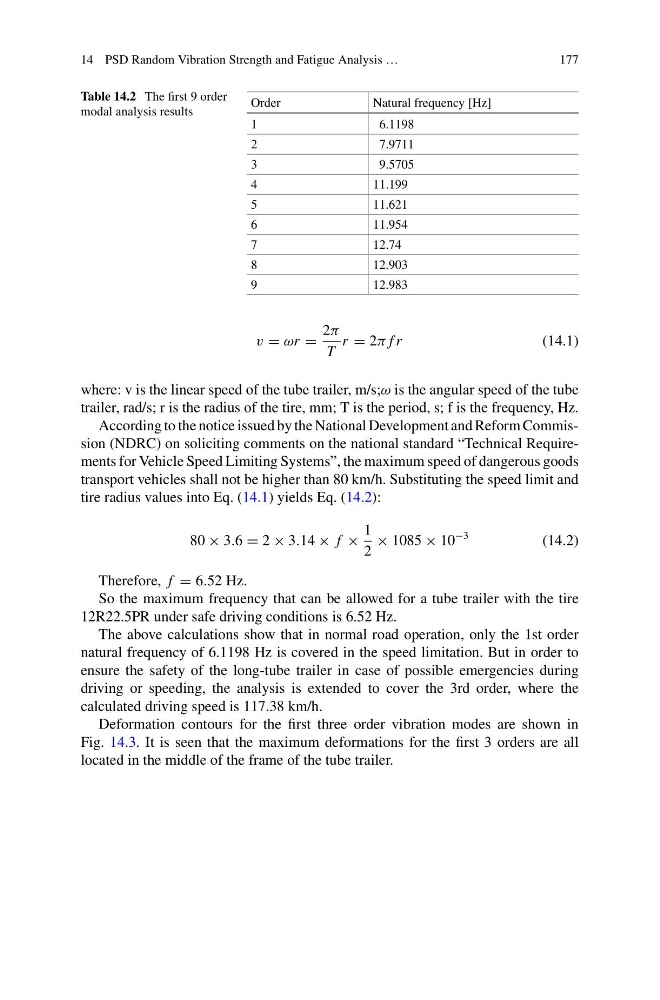
Table 14.2 The first 9 order
modal analysis results
Order
Natural frequency [Hz]
1
6.1198
2
7.9711
3
9.5705
4
11.199
5
11.621
6
11.954
7
12.74
8
12.903
9
12.983
v = ωr =
2π
T
r = 2π f r
(14.1)
where: v is the linear speed of the tube trailer, m/s;ω is the angular speed of the tube
trailer, rad/s; r is the radius of the tire, mm; T is the period, s; f is the frequency, Hz.
According to the notice issued by the National Development and Reform Commission (NDRC) on soliciting comments on the national standard “Technical Requirements for Vehicle Speed Limiting Systems”, the maximum speed of dangerous goods
transport vehicles shall not be higher than 80 km/h. Substituting the speed limit and
tire radius values into Eq. (14.1) yields Eq. (14.2):
80 × 3.6 = 2 × 3.14 × f ×
1
2
× 1085 × 10
−3
(14.2)
Therefore, f = 6.52 Hz.
So the maximum frequency that can be allowed for a tube trailer with the tire
12R22.5PR under safe driving conditions is 6.52 Hz.
The above calculations show that in normal road operation, only the 1st order
natural frequency of 6.1198 Hz is covered in the speed limitation. But in order to
ensure the safety of the long-tube trailer in case of possible emergencies during
driving or speeding, the analysis is extended to cover the 3rd order, where the
calculated driving speed is 117.38 km/h.
Deformation contours for the first three order vibration modes are shown in
Fig. 14.3. It is seen that the maximum deformations for the first 3 orders are all
located in the middle of the frame of the tube trailer.
177
Table 14.2 The first 9 order
modal analysis results
Order
Natural frequency [Hz]
1
6.1198
2
7.9711
3
9.5705
4
11.199
5
11.621
6
11.954
7
12.74
8
12.903
9
12.983
v = ωr =
2π
T
r = 2π f r
(14.1)
where: v is the linear speed of the tube trailer, m/s;ω is the angular speed of the tube
trailer, rad/s; r is the radius of the tire, mm; T is the period, s; f is the frequency, Hz.
According to the notice issued by the National Development and Reform Commission (NDRC) on soliciting comments on the national standard “Technical Requirements for Vehicle Speed Limiting Systems”, the maximum speed of dangerous goods
transport vehicles shall not be higher than 80 km/h. Substituting the speed limit and
tire radius values into Eq. (14.1) yields Eq. (14.2):
80 × 3.6 = 2 × 3.14 × f ×
1
2
× 1085 × 10
−3
(14.2)
Therefore, f = 6.52 Hz.
So the maximum frequency that can be allowed for a tube trailer with the tire
12R22.5PR under safe driving conditions is 6.52 Hz.
The above calculations show that in normal road operation, only the 1st order
natural frequency of 6.1198 Hz is covered in the speed limitation. But in order to
ensure the safety of the long-tube trailer in case of possible emergencies during
driving or speeding, the analysis is extended to cover the 3rd order, where the
calculated driving speed is 117.38 km/h.
Deformation contours for the first three order vibration modes are shown in
Fig. 14.3. It is seen that the maximum deformations for the first 3 orders are all
located in the middle of the frame of the tube trailer.