

13 Study on Bearing Mechanism of Composite Stiffened Panel …
163
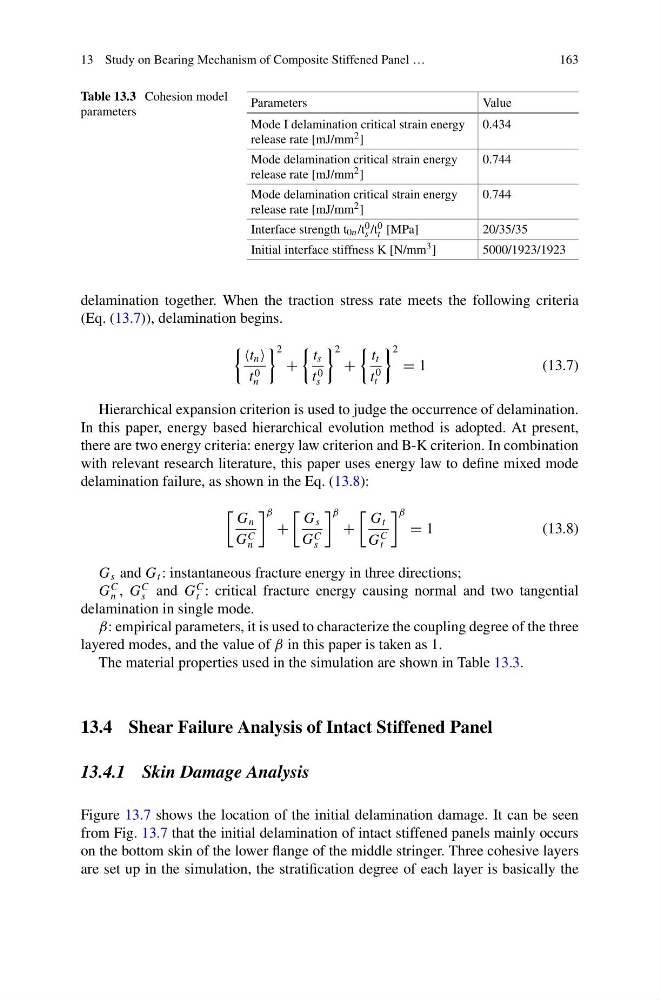
Table 13.3 Cohesion model
parameters
Parameters
Value
Mode I delamination critical strain energy
release rate [mJ/mm 2 ]
0.434
Mode delamination critical strain energy
release rate [mJ/mm 2 ]
0.744
Mode delamination critical strain energy
release rate [mJ/mm 2 ]
0.744
Interface strength t 0n /t 0
s /t 0
t [MPa]
20/35/35
Initial interface stiffness K [N/mm 3 ]
5000/1923/1923
delamination together. When the traction stress rate meets the following criteria
(Eq. (13.7)), delamination begins.
t n
t 0
n
2
+
t s
t 0
s
2
+
t t
t
0
t
2
= 1
(13.7)
Hierarchical expansion criterion is used to judge the occurrence of delamination.
In this paper, energy based hierarchical evolution method is adopted. At present,
there are two energy criteria: energy law criterion and B-K criterion. In combination
with relevant research literature, this paper uses energy law to define mixed mode
delamination failure, as shown in the Eq. (13.8):
G n
G C
n
β
+
G s
G C
s
β
+
G t
G
C
t
β
= 1
(13.8)
G s and G t : instantaneous fracture energy in three directions;
G
C
n , G
C
s and G
C
t : critical fracture energy causing normal and two tangential
delamination in single mode.
β: empirical parameters, it is used to characterize the coupling degree of the three
layered modes, and the value of β in this paper is taken as 1.
The material properties used in the simulation are shown in Table 13.3.
13.4 Shear Failure Analysis of Intact Stiffened Panel
13.4.1 Skin Damage Analysis
Figure 13.7 shows the location of the initial delamination damage. It can be seen
from Fig. 13.7 that the initial delamination of intact stiffened panels mainly occurs
on the bottom skin of the lower flange of the middle stringer. Three cohesive layers
are set up in the simulation, the stratification degree of each layer is basically the
163
Table 13.3 Cohesion model
parameters
Parameters
Value
Mode I delamination critical strain energy
release rate [mJ/mm 2 ]
0.434
Mode delamination critical strain energy
release rate [mJ/mm 2 ]
0.744
Mode delamination critical strain energy
release rate [mJ/mm 2 ]
0.744
Interface strength t 0n /t 0
s /t 0
t [MPa]
20/35/35
Initial interface stiffness K [N/mm 3 ]
5000/1923/1923
delamination together. When the traction stress rate meets the following criteria
(Eq. (13.7)), delamination begins.
t n
t 0
n
2
+
t s
t 0
s
2
+
t t
t
0
t
2
= 1
(13.7)
Hierarchical expansion criterion is used to judge the occurrence of delamination.
In this paper, energy based hierarchical evolution method is adopted. At present,
there are two energy criteria: energy law criterion and B-K criterion. In combination
with relevant research literature, this paper uses energy law to define mixed mode
delamination failure, as shown in the Eq. (13.8):
G n
G C
n
β
+
G s
G C
s
β
+
G t
G
C
t
β
= 1
(13.8)
G s and G t : instantaneous fracture energy in three directions;
G
C
n , G
C
s and G
C
t : critical fracture energy causing normal and two tangential
delamination in single mode.
β: empirical parameters, it is used to characterize the coupling degree of the three
layered modes, and the value of β in this paper is taken as 1.
The material properties used in the simulation are shown in Table 13.3.
13.4 Shear Failure Analysis of Intact Stiffened Panel
13.4.1 Skin Damage Analysis
Figure 13.7 shows the location of the initial delamination damage. It can be seen
from Fig. 13.7 that the initial delamination of intact stiffened panels mainly occurs
on the bottom skin of the lower flange of the middle stringer. Three cohesive layers
are set up in the simulation, the stratification degree of each layer is basically the