

13 Study on Bearing Mechanism of Composite Stiffened Panel …
161
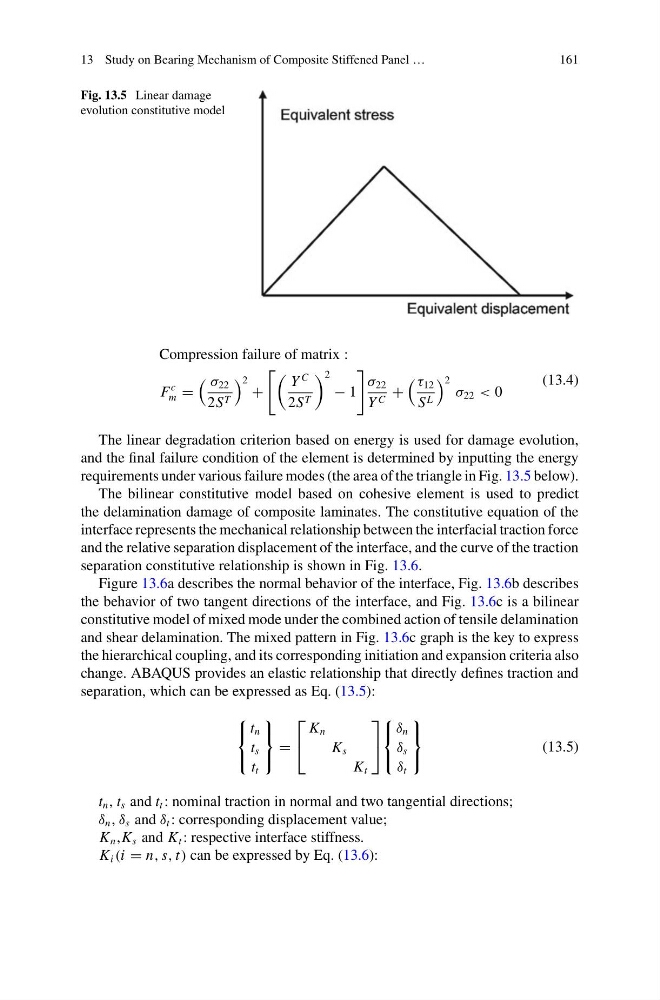
Fig. 13.5 Linear damage
evolution constitutive model
Compression failure of matrix :
F
c
m =
σ 22
2S T
2 +
Y
C
2S T
2
− 1
σ 22
Y C +
τ 12
S L
2 σ 22 < 0
(13.4)
The linear degradation criterion based on energy is used for damage evolution,
and the final failure condition of the element is determined by inputting the energy
requirements under various failure modes (the area of the triangle in Fig. 13.5 below).
The bilinear constitutive model based on cohesive element is used to predict
the delamination damage of composite laminates. The constitutive equation of the
interface represents the mechanical relationship between the interfacial traction force
and the relative separation displacement of the interface, and the curve of the traction
separation constitutive relationship is shown in Fig. 13.6.
Figure 13.6a describes the normal behavior of the interface, Fig. 13.6b describes
the behavior of two tangent directions of the interface, and Fig. 13.6c is a bilinear
constitutive model of mixed mode under the combined action of tensile delamination
and shear delamination. The mixed pattern in Fig. 13.6c graph is the key to express
the hierarchical coupling, and its corresponding initiation and expansion criteria also
change. ABAQUS provides an elastic relationship that directly defines traction and
separation, which can be expressed as Eq. (13.5):
⎧
⎨
⎩
t n
t s
t t
⎫
⎬
⎭
=
⎡
⎣
K n
K s
K t
⎤
⎦
⎧
⎨
⎩
δ n
δ s
δ t
⎫
⎬
⎭
(13.5)
t n , t s and t t : nominal traction in normal and two tangential directions;
δ n , δ s and δ t : corresponding displacement value;
K n ,K s and K t : respective interface stiffness.
K i (i = n, s, t) can be expressed by Eq. (13.6):
161
Fig. 13.5 Linear damage
evolution constitutive model
Compression failure of matrix :
F
c
m =
σ 22
2S T
2 +
Y
C
2S T
2
− 1
σ 22
Y C +
τ 12
S L
2 σ 22 < 0
(13.4)
The linear degradation criterion based on energy is used for damage evolution,
and the final failure condition of the element is determined by inputting the energy
requirements under various failure modes (the area of the triangle in Fig. 13.5 below).
The bilinear constitutive model based on cohesive element is used to predict
the delamination damage of composite laminates. The constitutive equation of the
interface represents the mechanical relationship between the interfacial traction force
and the relative separation displacement of the interface, and the curve of the traction
separation constitutive relationship is shown in Fig. 13.6.
Figure 13.6a describes the normal behavior of the interface, Fig. 13.6b describes
the behavior of two tangent directions of the interface, and Fig. 13.6c is a bilinear
constitutive model of mixed mode under the combined action of tensile delamination
and shear delamination. The mixed pattern in Fig. 13.6c graph is the key to express
the hierarchical coupling, and its corresponding initiation and expansion criteria also
change. ABAQUS provides an elastic relationship that directly defines traction and
separation, which can be expressed as Eq. (13.5):
⎧
⎨
⎩
t n
t s
t t
⎫
⎬
⎭
=
⎡
⎣
K n
K s
K t
⎤
⎦
⎧
⎨
⎩
δ n
δ s
δ t
⎫
⎬
⎭
(13.5)
t n , t s and t t : nominal traction in normal and two tangential directions;
δ n , δ s and δ t : corresponding displacement value;
K n ,K s and K t : respective interface stiffness.
K i (i = n, s, t) can be expressed by Eq. (13.6):