

150
Z. Liu et al.
12.4 Strength Assessment Based on Limit-Load Analysis
Method
When the maximum stress reaches the yields limit, the actual structure usually does
not lose its load-carrying capability immediately. With the increase of the load, the
stress in the high stress zone first reaches the yield limit, and the material enters
the yield state. Then the stress will be redistributed and the range of plastic zone
will be expanded. The ultimate load refers to the load corresponding to the plastic
state when the component changes from elastic state to plastic state under the action
of external load. When the ultimate load is reached, the component will enter the
instability state. The results of the Limit-load Analysis Method are closer to the real
failure conditions.
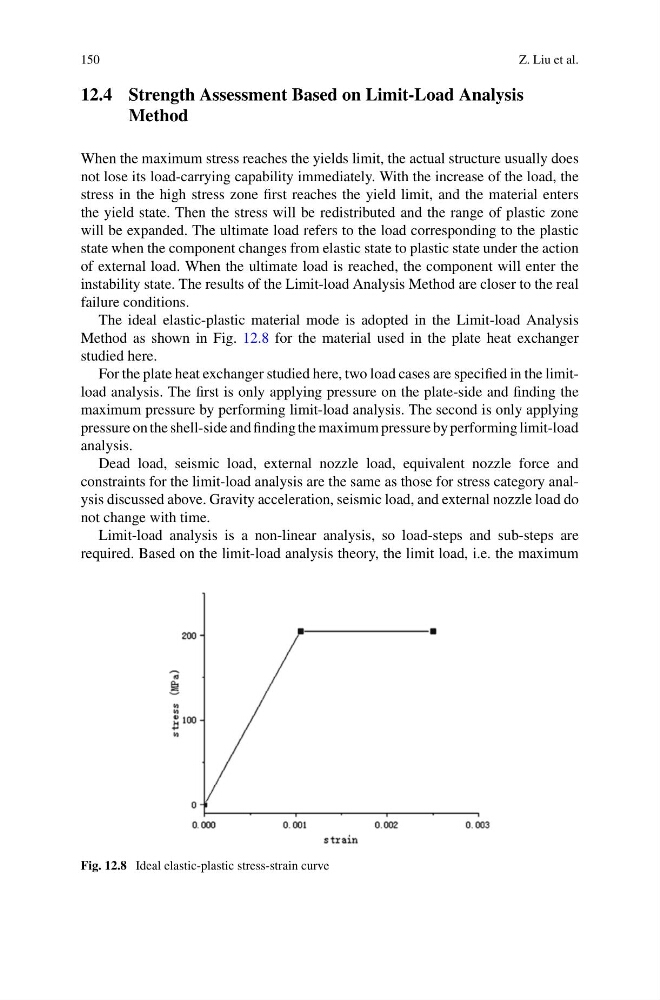
The ideal elastic-plastic material mode is adopted in the Limit-load Analysis
Method as shown in Fig. 12.8 for the material used in the plate heat exchanger
studied here.
For the plate heat exchanger studied here, two load cases are specified in the limitload analysis. The first is only applying pressure on the plate-side and finding the
maximum pressure by performing limit-load analysis. The second is only applying
pressure on the shell-side and finding the maximum pressure by performing limit-load
analysis.
Dead load, seismic load, external nozzle load, equivalent nozzle force and
constraints for the limit-load analysis are the same as those for stress category analysis discussed above. Gravity acceleration, seismic load, and external nozzle load do
not change with time.
Limit-load analysis is a non-linear analysis, so load-steps and sub-steps are
required. Based on the limit-load analysis theory, the limit load, i.e. the maximum
Fig. 12.8 Ideal elastic-plastic stress-strain curve
Z. Liu et al.
12.4 Strength Assessment Based on Limit-Load Analysis
Method
When the maximum stress reaches the yields limit, the actual structure usually does
not lose its load-carrying capability immediately. With the increase of the load, the
stress in the high stress zone first reaches the yield limit, and the material enters
the yield state. Then the stress will be redistributed and the range of plastic zone
will be expanded. The ultimate load refers to the load corresponding to the plastic
state when the component changes from elastic state to plastic state under the action
of external load. When the ultimate load is reached, the component will enter the
instability state. The results of the Limit-load Analysis Method are closer to the real
failure conditions.
The ideal elastic-plastic material mode is adopted in the Limit-load Analysis
Method as shown in Fig. 12.8 for the material used in the plate heat exchanger
studied here.
For the plate heat exchanger studied here, two load cases are specified in the limitload analysis. The first is only applying pressure on the plate-side and finding the
maximum pressure by performing limit-load analysis. The second is only applying
pressure on the shell-side and finding the maximum pressure by performing limit-load
analysis.
Dead load, seismic load, external nozzle load, equivalent nozzle force and
constraints for the limit-load analysis are the same as those for stress category analysis discussed above. Gravity acceleration, seismic load, and external nozzle load do
not change with time.
Limit-load analysis is a non-linear analysis, so load-steps and sub-steps are
required. Based on the limit-load analysis theory, the limit load, i.e. the maximum
Fig. 12.8 Ideal elastic-plastic stress-strain curve