

9 Numerical Simulation on the Slab Heat Transfer Behavior …
111
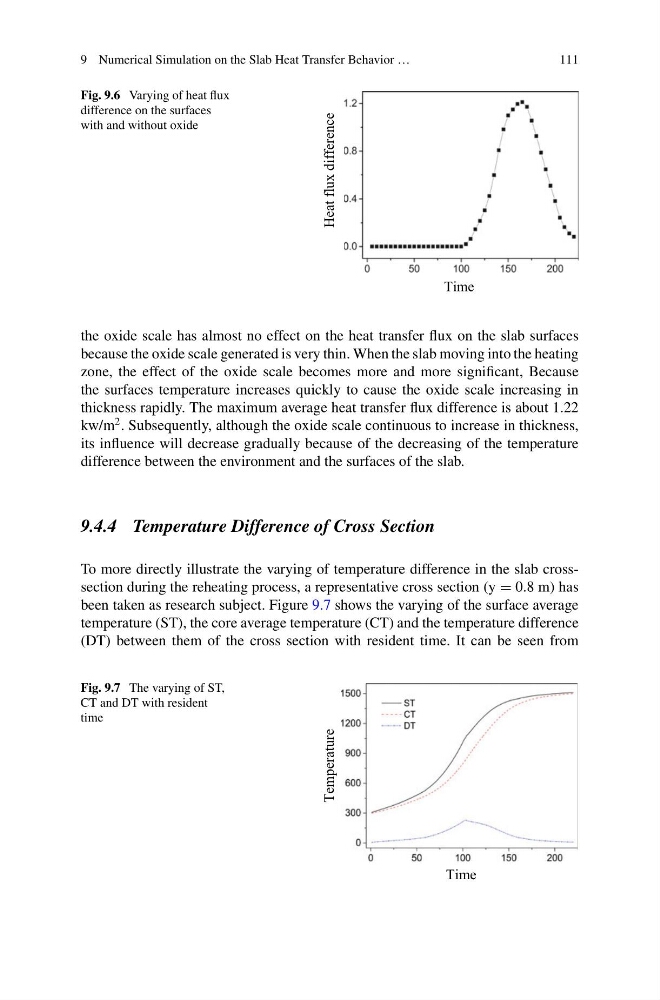
Fig. 9.6 Varying of heat flux
difference on the surfaces
with and without oxide
Time
Heat flux difference
the oxide scale has almost no effect on the heat transfer flux on the slab surfaces
because the oxide scale generated is very thin. When the slab moving into the heating
zone, the effect of the oxide scale becomes more and more significant, Because
the surfaces temperature increases quickly to cause the oxide scale increasing in
thickness rapidly. The maximum average heat transfer flux difference is about 1.22
kw/m
2 . Subsequently, although the oxide scale continuous to increase in thickness,
its influence will decrease gradually because of the decreasing of the temperature
difference between the environment and the surfaces of the slab.
9.4.4 Temperature Difference of Cross Section
To more directly illustrate the varying of temperature difference in the slab crosssection during the reheating process, a representative cross section (y = 0.8 m) has
been taken as research subject. Figure 9.7 shows the varying of the surface average
temperature (ST), the core average temperature (CT) and the temperature difference
(DT) between them of the cross section with resident time. It can be seen from
Fig. 9.7 The varying of ST,
CT and DT with resident
time
Temperature
Time
111
Fig. 9.6 Varying of heat flux
difference on the surfaces
with and without oxide
Time
Heat flux difference
the oxide scale has almost no effect on the heat transfer flux on the slab surfaces
because the oxide scale generated is very thin. When the slab moving into the heating
zone, the effect of the oxide scale becomes more and more significant, Because
the surfaces temperature increases quickly to cause the oxide scale increasing in
thickness rapidly. The maximum average heat transfer flux difference is about 1.22
kw/m
2 . Subsequently, although the oxide scale continuous to increase in thickness,
its influence will decrease gradually because of the decreasing of the temperature
difference between the environment and the surfaces of the slab.
9.4.4 Temperature Difference of Cross Section
To more directly illustrate the varying of temperature difference in the slab crosssection during the reheating process, a representative cross section (y = 0.8 m) has
been taken as research subject. Figure 9.7 shows the varying of the surface average
temperature (ST), the core average temperature (CT) and the temperature difference
(DT) between them of the cross section with resident time. It can be seen from
Fig. 9.7 The varying of ST,
CT and DT with resident
time
Temperature
Time