

58
6 Nonlocal Gravity
L =
1
G
|g|
R + ψ
∞
n=1
c n
M 2n+2
n
ψ −
ψ(( − 1) −
c 0
M 2 ψ
2
.
(6.6)
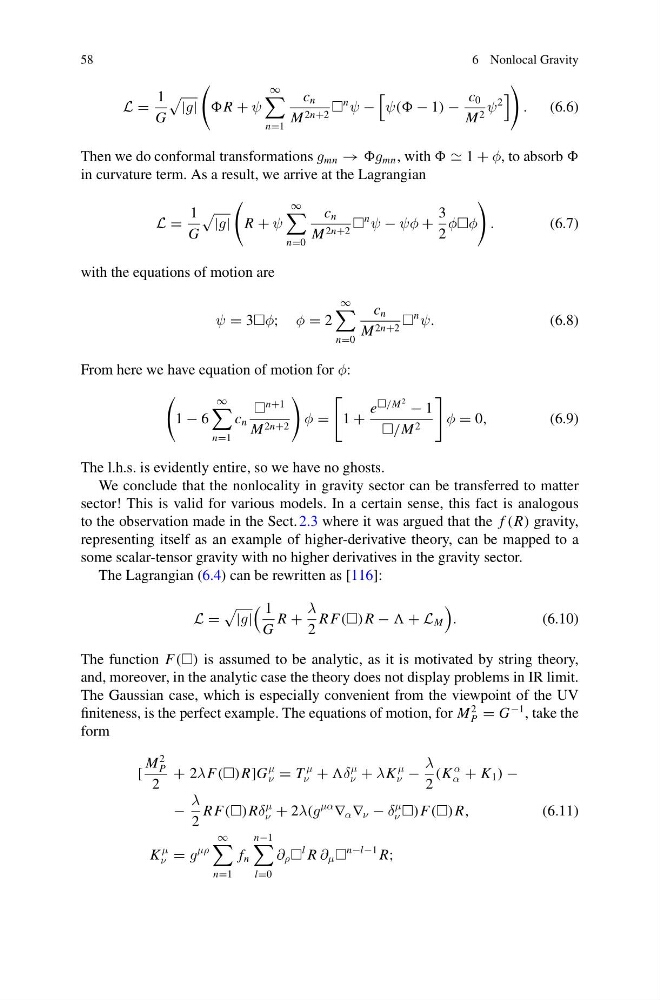
Then we do conformal transformations g mn → g mn , with 1 + φ, to absorb
in curvature term. As a result, we arrive at the Lagrangian
L =
1
G
|g|
R + ψ
∞
n=0
c n
M 2n+2
n
ψ − ψφ +
3
2
φφ
.
(6.7)
with the equations of motion are
ψ = 3φ; φ = 2
∞
n=0
c n
M 2n+2
n
ψ.
(6.8)
From here we have equation of motion for φ:
1 − 6
∞
n=1
c n
n+1
M 2n+2
φ =
1 +
e
/M
2 − 1
/M 2
φ = 0,
(6.9)
The l.h.s. is evidently entire, so we have no ghosts.
We conclude that the nonlocality in gravity sector can be transferred to matter
sector! This is valid for various models. In a certain sense, this fact is analogous
to the observation made in the Sect. 2.3 where it was argued that the f (R) gravity,
representing itself as an example of higher-derivative theory, can be mapped to a
some scalar-tensor gravity with no higher derivatives in the gravity sector.
The Lagrangian (6.4) can be rewritten as [116]:
L =
|g|
1
G
R +
λ
2
R F()R − + L M
.
(6.10)
The function F() is assumed to be analytic, as it is motivated by string theory,
and, moreover, in the analytic case the theory does not display problems in IR limit.
The Gaussian case, which is especially convenient from the viewpoint of the UV
finiteness, is the perfect example. The equations of motion, for M
2
P = G
−1 , take the
form
[
M
2
P
2
+ 2λF()R]G
μ
ν = T
μ
ν + δ
μ
ν + λK
μ
ν −
λ
2
(K
α
α + K 1 ) −
−
λ
2
R F()Rδ
μ
ν + 2λ(g
μα
∇ α ∇ ν − δ
μ
ν )F()R,
(6.11)
K
μ
ν = g
μρ
∞
n=1
f n
n−1
l=0
∂ ρ
l R ∂ μ
n−l−1 R;
6 Nonlocal Gravity
L =
1
G
|g|
R + ψ
∞
n=1
c n
M 2n+2
n
ψ −
ψ(( − 1) −
c 0
M 2 ψ
2
.
(6.6)
Then we do conformal transformations g mn → g mn , with 1 + φ, to absorb
in curvature term. As a result, we arrive at the Lagrangian
L =
1
G
|g|
R + ψ
∞
n=0
c n
M 2n+2
n
ψ − ψφ +
3
2
φφ
.
(6.7)
with the equations of motion are
ψ = 3φ; φ = 2
∞
n=0
c n
M 2n+2
n
ψ.
(6.8)
From here we have equation of motion for φ:
1 − 6
∞
n=1
c n
n+1
M 2n+2
φ =
1 +
e
/M
2 − 1
/M 2
φ = 0,
(6.9)
The l.h.s. is evidently entire, so we have no ghosts.
We conclude that the nonlocality in gravity sector can be transferred to matter
sector! This is valid for various models. In a certain sense, this fact is analogous
to the observation made in the Sect. 2.3 where it was argued that the f (R) gravity,
representing itself as an example of higher-derivative theory, can be mapped to a
some scalar-tensor gravity with no higher derivatives in the gravity sector.
The Lagrangian (6.4) can be rewritten as [116]:
L =
|g|
1
G
R +
λ
2
R F()R − + L M
.
(6.10)
The function F() is assumed to be analytic, as it is motivated by string theory,
and, moreover, in the analytic case the theory does not display problems in IR limit.
The Gaussian case, which is especially convenient from the viewpoint of the UV
finiteness, is the perfect example. The equations of motion, for M
2
P = G
−1 , take the
form
[
M
2
P
2
+ 2λF()R]G
μ
ν = T
μ
ν + δ
μ
ν + λK
μ
ν −
λ
2
(K
α
α + K 1 ) −
−
λ
2
R F()Rδ
μ
ν + 2λ(g
μα
∇ α ∇ ν − δ
μ
ν )F()R,
(6.11)
K
μ
ν = g
μρ
∞
n=1
f n
n−1
l=0
∂ ρ
l R ∂ μ
n−l−1 R;