

6.2 Some Results in Non-gravitational Nonlocal Theories
57
consider the limit of an infinite nonlocality scale → ∞, the theory returns to the
local limit and becomes to be divergent, i.e. the nonlocality acts as a kind of the higherderivative regularization, so, the quantum contributions are singular in this limit
growing as
2 if the local counterpart of the theory involves quadratic divergences,
or as ln
2 , if it involves the logarithmic ones. From a formal viewpoint, the existence
of this singularity can be exemplified by the fact that the typical integral in nonlocal
(Euclidean) theory grows quadratically with scale since
d
4 k
(2π) 4
1
k 2 e
−k
2 //
2 ∝
2 .
Effectively, the problem of the singularity of the result at → ∞ is nothing more
that the problem of large quantum corrections arising also in higher-derivative and
noncommutative field theories.
At the same time, the problems of unitarity and causality in nonlocal theories
require special attention since the nonlocality is commonly associated with an instant
propagation of a signal. These problems were discussed in details in various papers.
So, it has been claimed in [113] that the problems of unitarity and causality can be
solved at least for certain forms of nonlocal functions. Further this result was corroborated and discussed in more details in [114]. However, the complete discussion
of unitarity and causality in nonlocal field theories is still to be done. Otherwise, the
nonlocal theories must be treated only as effective ones.
So, to begin with studies of gravity, we can formulate some preliminary conclusions: (i) there is a mechanism allowing to avoid UV divergences: (ii) this mechanism
is Lorentz covariant and ghost free: (iii) the unitarity and causality still are to be studied.
6.3 Classical Solutions in Nonlocal Gravity Models
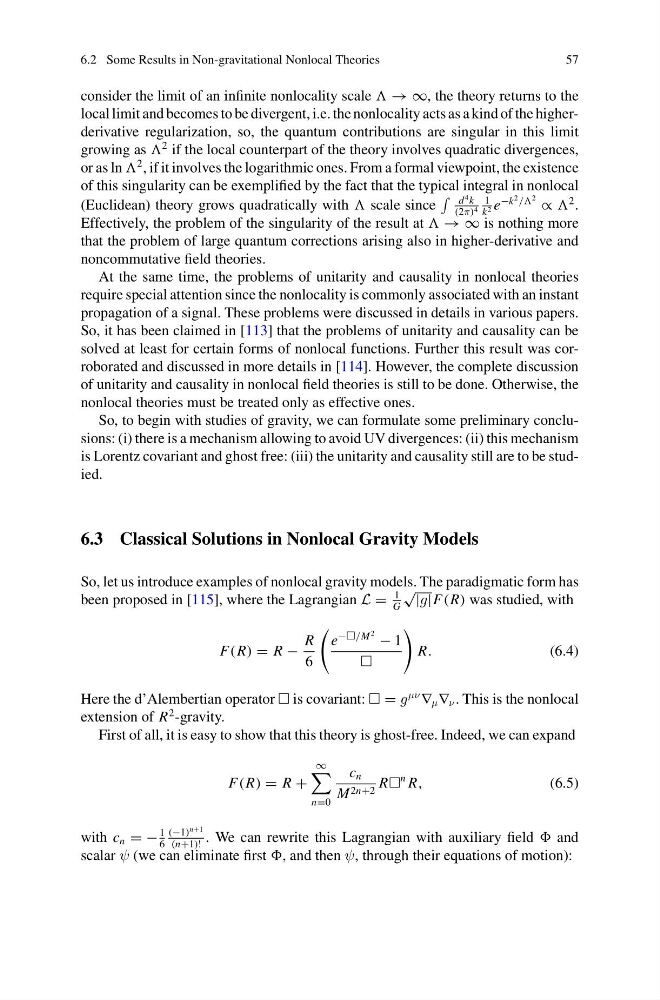
So, let us introduce examples of nonlocal gravity models. The paradigmatic form has
been proposed in [115], where the Lagrangian L =
1
G
√
|g|F(R) was studied, with
F(R) = R −
R
6
e
−/M
2 − 1
R.
(6.4)
Here the d’Alembertian operator is covariant: = g
μν
∇ μ ∇ ν . This is the nonlocal
extension of R
2 -gravity.
First of all, it is easy to show that this theory is ghost-free. Indeed, we can expand
F(R) = R +
∞
n=0
c n
M 2n+2 R
n R,
(6.5)
with c n = −
1
6
(−1)
n+1
(n+1)!
. We can rewrite this Lagrangian with auxiliary field and
scalar ψ (we can eliminate first , and then ψ, through their equations of motion):
57
consider the limit of an infinite nonlocality scale → ∞, the theory returns to the
local limit and becomes to be divergent, i.e. the nonlocality acts as a kind of the higherderivative regularization, so, the quantum contributions are singular in this limit
growing as
2 if the local counterpart of the theory involves quadratic divergences,
or as ln
2 , if it involves the logarithmic ones. From a formal viewpoint, the existence
of this singularity can be exemplified by the fact that the typical integral in nonlocal
(Euclidean) theory grows quadratically with scale since
d
4 k
(2π) 4
1
k 2 e
−k
2 //
2 ∝
2 .
Effectively, the problem of the singularity of the result at → ∞ is nothing more
that the problem of large quantum corrections arising also in higher-derivative and
noncommutative field theories.
At the same time, the problems of unitarity and causality in nonlocal theories
require special attention since the nonlocality is commonly associated with an instant
propagation of a signal. These problems were discussed in details in various papers.
So, it has been claimed in [113] that the problems of unitarity and causality can be
solved at least for certain forms of nonlocal functions. Further this result was corroborated and discussed in more details in [114]. However, the complete discussion
of unitarity and causality in nonlocal field theories is still to be done. Otherwise, the
nonlocal theories must be treated only as effective ones.
So, to begin with studies of gravity, we can formulate some preliminary conclusions: (i) there is a mechanism allowing to avoid UV divergences: (ii) this mechanism
is Lorentz covariant and ghost free: (iii) the unitarity and causality still are to be studied.
6.3 Classical Solutions in Nonlocal Gravity Models
So, let us introduce examples of nonlocal gravity models. The paradigmatic form has
been proposed in [115], where the Lagrangian L =
1
G
√
|g|F(R) was studied, with
F(R) = R −
R
6
e
−/M
2 − 1
R.
(6.4)
Here the d’Alembertian operator is covariant: = g
μν
∇ μ ∇ ν . This is the nonlocal
extension of R
2 -gravity.
First of all, it is easy to show that this theory is ghost-free. Indeed, we can expand
F(R) = R +
∞
n=0
c n
M 2n+2 R
n R,
(6.5)
with c n = −
1
6
(−1)
n+1
(n+1)!
. We can rewrite this Lagrangian with auxiliary field and
scalar ψ (we can eliminate first , and then ψ, through their equations of motion):