

32
3 Scalar-Tensor Gravities
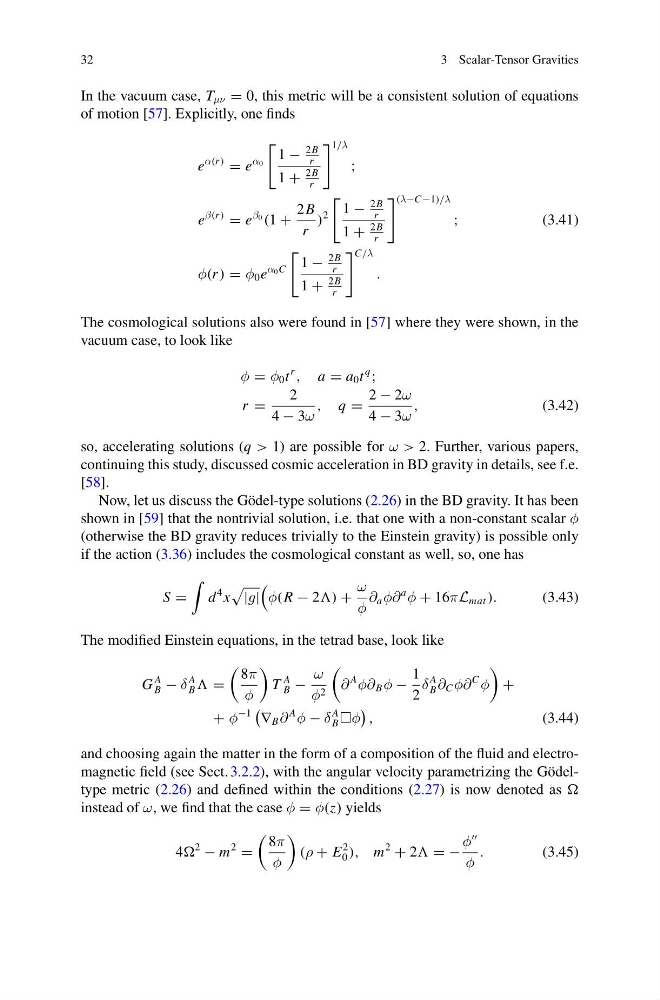
In the vacuum case, T μν = 0, this metric will be a consistent solution of equations
of motion [57]. Explicitly, one finds
e
α(r )
= e
α 0
1 −
2B
r
1 +
2B
r
1/λ
;
e
β(r )
= e
β 0 (1 +
2B
r
)
2
1 −
2B
r
1 +
2B
r
(λ−C−1)/λ
;
(3.41)
φ(r ) = φ 0 e
α 0 C
1 −
2B
r
1 +
2B
r
C/λ
.
The cosmological solutions also were found in [57] where they were shown, in the
vacuum case, to look like
φ = φ 0 t
r
, a = a 0 t
q
;
r =
2
4 − 3ω
, q =
2 − 2ω
4 − 3ω
,
(3.42)
so, accelerating solutions (q > 1) are possible for ω > 2. Further, various papers,
continuing this study, discussed cosmic acceleration in BD gravity in details, see f.e.
[58].
Now, let us discuss the Gödel-type solutions (2.26) in the BD gravity. It has been
shown in [59] that the nontrivial solution, i.e. that one with a non-constant scalar φ
(otherwise the BD gravity reduces trivially to the Einstein gravity) is possible only
if the action (3.36) includes the cosmological constant as well, so, one has
S =
d
4 x
|g|
φ(R − 2) +
ω
φ
∂ a φ∂
a
φ + 16πL mat ).
(3.43)
The modified Einstein equations, in the tetrad base, look like
G
A
B − δ
A
B =
8π
φ
T
A
B −
ω
φ 2
∂
A
φ∂ B φ −
1
2
δ
A
B ∂ C φ∂
C
φ
+
+ φ
−1
∇ B ∂
A
φ − δ
A
B φ
,
(3.44)
and choosing again the matter in the form of a composition of the fluid and electromagnetic field (see Sect. 3.2.2), with the angular velocity parametrizing the Gödeltype metric (2.26) and defined within the conditions (2.27) is now denoted as
instead of ω, we find that the case φ = φ(z) yields
4
2
− m
2
=
8π
φ
(ρ + E
2
0 ), m
2
+ 2 = −
φ
φ
.
(3.45)
3 Scalar-Tensor Gravities
In the vacuum case, T μν = 0, this metric will be a consistent solution of equations
of motion [57]. Explicitly, one finds
e
α(r )
= e
α 0
1 −
2B
r
1 +
2B
r
1/λ
;
e
β(r )
= e
β 0 (1 +
2B
r
)
2
1 −
2B
r
1 +
2B
r
(λ−C−1)/λ
;
(3.41)
φ(r ) = φ 0 e
α 0 C
1 −
2B
r
1 +
2B
r
C/λ
.
The cosmological solutions also were found in [57] where they were shown, in the
vacuum case, to look like
φ = φ 0 t
r
, a = a 0 t
q
;
r =
2
4 − 3ω
, q =
2 − 2ω
4 − 3ω
,
(3.42)
so, accelerating solutions (q > 1) are possible for ω > 2. Further, various papers,
continuing this study, discussed cosmic acceleration in BD gravity in details, see f.e.
[58].
Now, let us discuss the Gödel-type solutions (2.26) in the BD gravity. It has been
shown in [59] that the nontrivial solution, i.e. that one with a non-constant scalar φ
(otherwise the BD gravity reduces trivially to the Einstein gravity) is possible only
if the action (3.36) includes the cosmological constant as well, so, one has
S =
d
4 x
|g|
φ(R − 2) +
ω
φ
∂ a φ∂
a
φ + 16πL mat ).
(3.43)
The modified Einstein equations, in the tetrad base, look like
G
A
B − δ
A
B =
8π
φ
T
A
B −
ω
φ 2
∂
A
φ∂ B φ −
1
2
δ
A
B ∂ C φ∂
C
φ
+
+ φ
−1
∇ B ∂
A
φ − δ
A
B φ
,
(3.44)
and choosing again the matter in the form of a composition of the fluid and electromagnetic field (see Sect. 3.2.2), with the angular velocity parametrizing the Gödeltype metric (2.26) and defined within the conditions (2.27) is now denoted as
instead of ω, we find that the case φ = φ(z) yields
4
2
− m
2
=
8π
φ
(ρ + E
2
0 ), m
2
+ 2 = −
φ
φ
.
(3.45)