

3.3 Brans–Dicke Gravity
31
3.3 Brans–Dicke Gravity
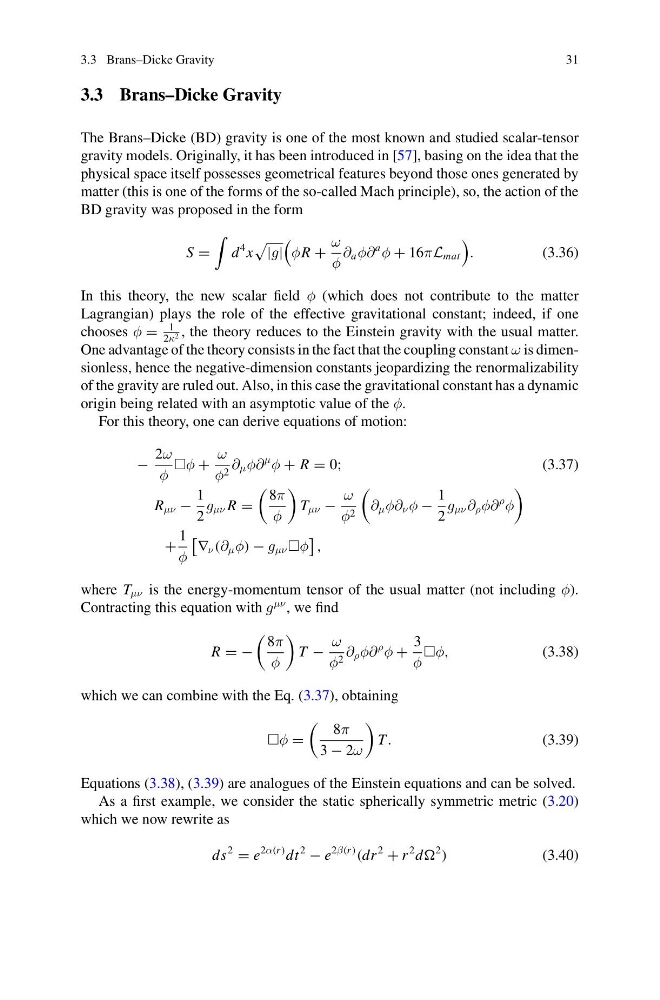
The Brans–Dicke (BD) gravity is one of the most known and studied scalar-tensor
gravity models. Originally, it has been introduced in [57], basing on the idea that the
physical space itself possesses geometrical features beyond those ones generated by
matter (this is one of the forms of the so-called Mach principle), so, the action of the
BD gravity was proposed in the form
S =
d
4 x
|g|
φR +
ω
φ
∂ a φ∂
a
φ + 16πL mat
.
(3.36)
In this theory, the new scalar field φ (which does not contribute to the matter
Lagrangian) plays the role of the effective gravitational constant; indeed, if one
chooses φ =
1
2κ 2 , the theory reduces to the Einstein gravity with the usual matter.
One advantage of the theory consists in the fact that the coupling constant ω is dimensionless, hence the negative-dimension constants jeopardizing the renormalizability
of the gravity are ruled out. Also, in this case the gravitational constant has a dynamic
origin being related with an asymptotic value of the φ.
For this theory, one can derive equations of motion:
−
2ω
φ
φ +
ω
φ 2 ∂ μ φ∂
μ
φ + R = 0;
(3.37)
R μν −
1
2
g μν R =
8π
φ
T μν −
ω
φ 2
∂ μ φ∂ ν φ −
1
2
g μν ∂ ρ φ∂
ρ
φ
+
1
φ
∇ ν (∂ μ φ) − g μν φ
,
where T μν is the energy-momentum tensor of the usual matter (not including φ).
Contracting this equation with g
μν , we find
R = −
8π
φ
T −
ω
φ 2 ∂ ρ φ∂
ρ
φ +
3
φ
φ,
(3.38)
which we can combine with the Eq. (3.37), obtaining
φ =
8π
3 − 2ω
T.
(3.39)
Equations (3.38), (3.39) are analogues of the Einstein equations and can be solved.
As a first example, we consider the static spherically symmetric metric (3.20)
which we now rewrite as
ds
2
= e
2α(r ) dt
2
− e
2β(r )
(dr
2
+ r
2 d
2
)
(3.40)
31
3.3 Brans–Dicke Gravity
The Brans–Dicke (BD) gravity is one of the most known and studied scalar-tensor
gravity models. Originally, it has been introduced in [57], basing on the idea that the
physical space itself possesses geometrical features beyond those ones generated by
matter (this is one of the forms of the so-called Mach principle), so, the action of the
BD gravity was proposed in the form
S =
d
4 x
|g|
φR +
ω
φ
∂ a φ∂
a
φ + 16πL mat
.
(3.36)
In this theory, the new scalar field φ (which does not contribute to the matter
Lagrangian) plays the role of the effective gravitational constant; indeed, if one
chooses φ =
1
2κ 2 , the theory reduces to the Einstein gravity with the usual matter.
One advantage of the theory consists in the fact that the coupling constant ω is dimensionless, hence the negative-dimension constants jeopardizing the renormalizability
of the gravity are ruled out. Also, in this case the gravitational constant has a dynamic
origin being related with an asymptotic value of the φ.
For this theory, one can derive equations of motion:
−
2ω
φ
φ +
ω
φ 2 ∂ μ φ∂
μ
φ + R = 0;
(3.37)
R μν −
1
2
g μν R =
8π
φ
T μν −
ω
φ 2
∂ μ φ∂ ν φ −
1
2
g μν ∂ ρ φ∂
ρ
φ
+
1
φ
∇ ν (∂ μ φ) − g μν φ
,
where T μν is the energy-momentum tensor of the usual matter (not including φ).
Contracting this equation with g
μν , we find
R = −
8π
φ
T −
ω
φ 2 ∂ ρ φ∂
ρ
φ +
3
φ
φ,
(3.38)
which we can combine with the Eq. (3.37), obtaining
φ =
8π
3 − 2ω
T.
(3.39)
Equations (3.38), (3.39) are analogues of the Einstein equations and can be solved.
As a first example, we consider the static spherically symmetric metric (3.20)
which we now rewrite as
ds
2
= e
2α(r ) dt
2
− e
2β(r )
(dr
2
+ r
2 d
2
)
(3.40)