

14
2 Modifications of the Pure Gravitational Sector
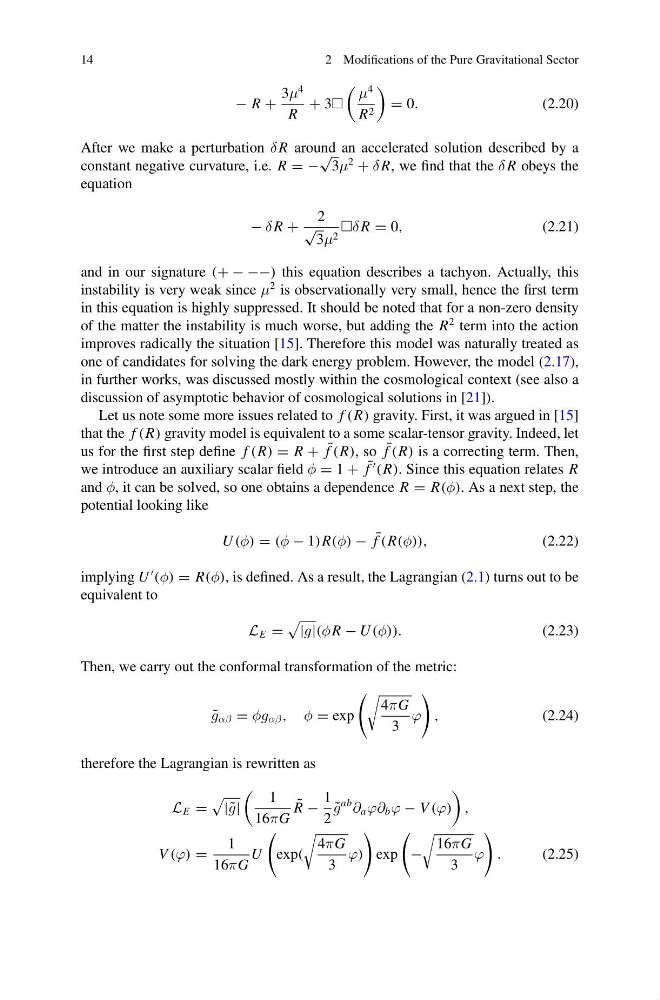
− R +
3μ
4
R
+ 3
μ
4
R 2
= 0.
(2.20)
After we make a perturbation δ R around an accelerated solution described by a
constant negative curvature, i.e. R = −
√
3μ
2
+ δ R, we find that the δ R obeys the
equation
− δ R +
2
√
3μ 2
δ R = 0,
(2.21)
and in our signature (+ − −−) this equation describes a tachyon. Actually, this
instability is very weak since μ
2 is observationally very small, hence the first term
in this equation is highly suppressed. It should be noted that for a non-zero density
of the matter the instability is much worse, but adding the R
2 term into the action
improves radically the situation [15]. Therefore this model was naturally treated as
one of candidates for solving the dark energy problem. However, the model (2.17),
in further works, was discussed mostly within the cosmological context (see also a
discussion of asymptotic behavior of cosmological solutions in [21]).
Let us note some more issues related to f (R) gravity. First, it was argued in [15]
that the f (R) gravity model is equivalent to a some scalar-tensor gravity. Indeed, let
us for the first step define f (R) = R + ¯
f (R), so ¯
f (R) is a correcting term. Then,
we introduce an auxiliary scalar field φ = 1 + ¯
f
(R). Since this equation relates R
and φ, it can be solved, so one obtains a dependence R = R(φ). As a next step, the
potential looking like
U (φ) = (φ − 1)R(φ) − ¯
f (R(φ)),
(2.22)
implying U
(φ) = R(φ), is defined. As a result, the Lagrangian (2.1) turns out to be
equivalent to
L E =
|g|(φR − U (φ)).
(2.23)
Then, we carry out the conformal transformation of the metric:
˜
g αβ = φg αβ , φ = exp
4πG
3
ϕ
,
(2.24)
therefore the Lagrangian is rewritten as
L E =
| ˜
g|
1
16πG
˜
R −
1
2
˜
g
ab
∂ a ϕ∂ b ϕ − V (ϕ)
,
V (ϕ) =
1
16πG
U
exp(
4πG
3
ϕ)
exp
−
16πG
3
ϕ
.
(2.25)
2 Modifications of the Pure Gravitational Sector
− R +
3μ
4
R
+ 3
μ
4
R 2
= 0.
(2.20)
After we make a perturbation δ R around an accelerated solution described by a
constant negative curvature, i.e. R = −
√
3μ
2
+ δ R, we find that the δ R obeys the
equation
− δ R +
2
√
3μ 2
δ R = 0,
(2.21)
and in our signature (+ − −−) this equation describes a tachyon. Actually, this
instability is very weak since μ
2 is observationally very small, hence the first term
in this equation is highly suppressed. It should be noted that for a non-zero density
of the matter the instability is much worse, but adding the R
2 term into the action
improves radically the situation [15]. Therefore this model was naturally treated as
one of candidates for solving the dark energy problem. However, the model (2.17),
in further works, was discussed mostly within the cosmological context (see also a
discussion of asymptotic behavior of cosmological solutions in [21]).
Let us note some more issues related to f (R) gravity. First, it was argued in [15]
that the f (R) gravity model is equivalent to a some scalar-tensor gravity. Indeed, let
us for the first step define f (R) = R + ¯
f (R), so ¯
f (R) is a correcting term. Then,
we introduce an auxiliary scalar field φ = 1 + ¯
f
(R). Since this equation relates R
and φ, it can be solved, so one obtains a dependence R = R(φ). As a next step, the
potential looking like
U (φ) = (φ − 1)R(φ) − ¯
f (R(φ)),
(2.22)
implying U
(φ) = R(φ), is defined. As a result, the Lagrangian (2.1) turns out to be
equivalent to
L E =
|g|(φR − U (φ)).
(2.23)
Then, we carry out the conformal transformation of the metric:
˜
g αβ = φg αβ , φ = exp
4πG
3
ϕ
,
(2.24)
therefore the Lagrangian is rewritten as
L E =
| ˜
g|
1
16πG
˜
R −
1
2
˜
g
ab
∂ a ϕ∂ b ϕ − V (ϕ)
,
V (ϕ) =
1
16πG
U
exp(
4πG
3
ϕ)
exp
−
16πG
3
ϕ
.
(2.25)