

2.2 R 2 -Gravity
9
H μν ≡ (α − 2β)∇ μ ∇ ν R − αR μν −
α
2
− 2β
g μν R +
+ 2αR
ρλ R μρνλ − 2β R R μν −
1
2
g μν (αR
ρλ R ρλ − β R
2
) +
+
1
G
R μν −
1
2
Rg μν
= T μν .
(2.4)
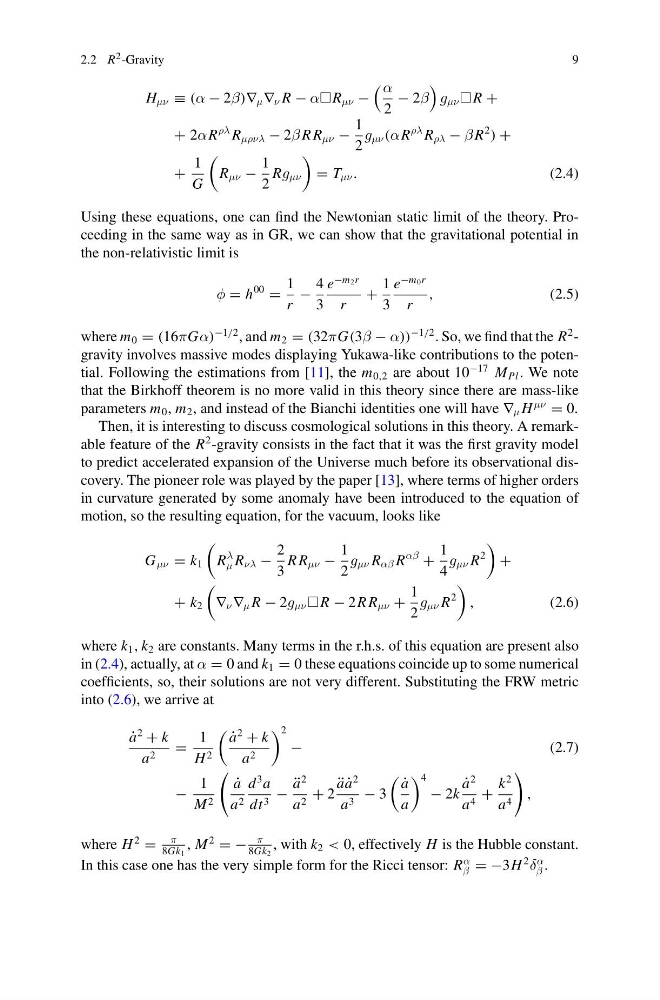
Using these equations, one can find the Newtonian static limit of the theory. Proceeding in the same way as in GR, we can show that the gravitational potential in
the non-relativistic limit is
φ = h
00
=
1
r
−
4
3
e
−m 2 r
r
+
1
3
e
−m 0 r
r
,
(2.5)
where m 0 = (16πGα)
−1/2 , and m 2 = (32πG(3β − α))
−1/2 . So, we find that the R
2 -
gravity involves massive modes displaying Yukawa-like contributions to the potential. Following the estimations from [11], the m 0,2 are about 10
−17 M Pl . We note
that the Birkhoff theorem is no more valid in this theory since there are mass-like
parameters m 0 , m 2 , and instead of the Bianchi identities one will have ∇ μ H
μν
= 0.
Then, it is interesting to discuss cosmological solutions in this theory. A remarkable feature of the R
2 -gravity consists in the fact that it was the first gravity model
to predict accelerated expansion of the Universe much before its observational discovery. The pioneer role was played by the paper [13], where terms of higher orders
in curvature generated by some anomaly have been introduced to the equation of
motion, so the resulting equation, for the vacuum, looks like
G μν = k 1
R
λ
μ R νλ −
2
3
R R μν −
1
2
g μν R αβ R
αβ
+
1
4
g μν R
2
+
+ k 2
∇ ν ∇ μ R − 2g μν R − 2R R μν +
1
2
g μν R
2
,
(2.6)
where k 1 , k 2 are constants. Many terms in the r.h.s. of this equation are present also
in (2.4), actually, at α = 0 and k 1 = 0 these equations coincide up to some numerical
coefficients, so, their solutions are not very different. Substituting the FRW metric
into (2.6), we arrive at
˙
a
2
+ k
a 2 =
1
H 2
˙
a
2
+ k
a 2
2
−
(2.7)
−
1
M 2
˙
a
a 2
d
3 a
dt 3 −
¨
a
2
a 2 + 2
¨
a ˙
a
2
a 3 − 3
˙
a
a
4
− 2k
˙
a
2
a 4 +
k
2
a 4
,
where H
2
=
π
8Gk 1
, M
2
= −
π
8Gk 2
, with k 2 < 0, effectively H is the Hubble constant.
In this case one has the very simple form for the Ricci tensor: R
α
β = −3H
2
δ
α
β .
9
H μν ≡ (α − 2β)∇ μ ∇ ν R − αR μν −
α
2
− 2β
g μν R +
+ 2αR
ρλ R μρνλ − 2β R R μν −
1
2
g μν (αR
ρλ R ρλ − β R
2
) +
+
1
G
R μν −
1
2
Rg μν
= T μν .
(2.4)
Using these equations, one can find the Newtonian static limit of the theory. Proceeding in the same way as in GR, we can show that the gravitational potential in
the non-relativistic limit is
φ = h
00
=
1
r
−
4
3
e
−m 2 r
r
+
1
3
e
−m 0 r
r
,
(2.5)
where m 0 = (16πGα)
−1/2 , and m 2 = (32πG(3β − α))
−1/2 . So, we find that the R
2 -
gravity involves massive modes displaying Yukawa-like contributions to the potential. Following the estimations from [11], the m 0,2 are about 10
−17 M Pl . We note
that the Birkhoff theorem is no more valid in this theory since there are mass-like
parameters m 0 , m 2 , and instead of the Bianchi identities one will have ∇ μ H
μν
= 0.
Then, it is interesting to discuss cosmological solutions in this theory. A remarkable feature of the R
2 -gravity consists in the fact that it was the first gravity model
to predict accelerated expansion of the Universe much before its observational discovery. The pioneer role was played by the paper [13], where terms of higher orders
in curvature generated by some anomaly have been introduced to the equation of
motion, so the resulting equation, for the vacuum, looks like
G μν = k 1
R
λ
μ R νλ −
2
3
R R μν −
1
2
g μν R αβ R
αβ
+
1
4
g μν R
2
+
+ k 2
∇ ν ∇ μ R − 2g μν R − 2R R μν +
1
2
g μν R
2
,
(2.6)
where k 1 , k 2 are constants. Many terms in the r.h.s. of this equation are present also
in (2.4), actually, at α = 0 and k 1 = 0 these equations coincide up to some numerical
coefficients, so, their solutions are not very different. Substituting the FRW metric
into (2.6), we arrive at
˙
a
2
+ k
a 2 =
1
H 2
˙
a
2
+ k
a 2
2
−
(2.7)
−
1
M 2
˙
a
a 2
d
3 a
dt 3 −
¨
a
2
a 2 + 2
¨
a ˙
a
2
a 3 − 3
˙
a
a
4
− 2k
˙
a
2
a 4 +
k
2
a 4
,
where H
2
=
π
8Gk 1
, M
2
= −
π
8Gk 2
, with k 2 < 0, effectively H is the Hubble constant.
In this case one has the very simple form for the Ricci tensor: R
α
β = −3H
2
δ
α
β .