

8
2 Modifications of the Pure Gravitational Sector
2.2 R 2 -Gravity
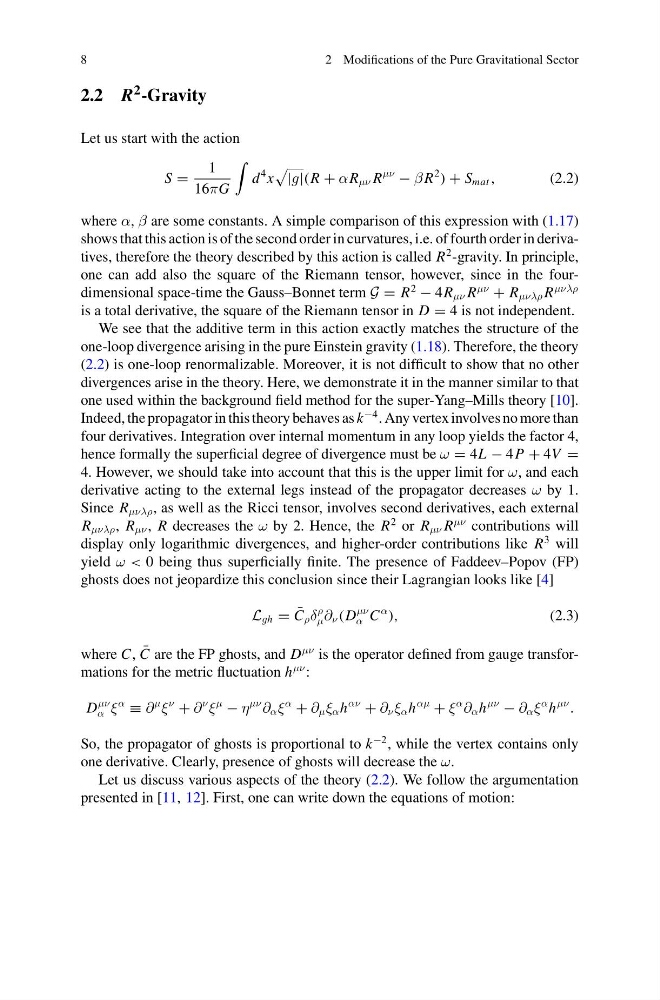
Let us start with the action
S =
1
16πG
d
4 x
|g|(R + αR μν R
μν
− β R
2
) + S mat ,
(2.2)
where α, β are some constants. A simple comparison of this expression with (1.17)
shows that this action is of the second order in curvatures, i.e. of fourth order in derivatives, therefore the theory described by this action is called R
2 -gravity. In principle,
one can add also the square of the Riemann tensor, however, since in the fourdimensional space-time the Gauss–Bonnet term G = R
2
− 4R μν R
μν
+ R μνλρ R
μνλρ
is a total derivative, the square of the Riemann tensor in D = 4 is not independent.
We see that the additive term in this action exactly matches the structure of the
one-loop divergence arising in the pure Einstein gravity (1.18). Therefore, the theory
(2.2) is one-loop renormalizable. Moreover, it is not difficult to show that no other
divergences arise in the theory. Here, we demonstrate it in the manner similar to that
one used within the background field method for the super-Yang–Mills theory [10].
Indeed, the propagator in this theory behaves as k
−4 . Any vertex involves no more than
four derivatives. Integration over internal momentum in any loop yields the factor 4,
hence formally the superficial degree of divergence must be ω = 4L − 4P + 4V =
4. However, we should take into account that this is the upper limit for ω, and each
derivative acting to the external legs instead of the propagator decreases ω by 1.
Since R μνλρ , as well as the Ricci tensor, involves second derivatives, each external
R μνλρ , R μν , R decreases the ω by 2. Hence, the R
2 or R μν R
μν contributions will
display only logarithmic divergences, and higher-order contributions like R
3 will
yield ω < 0 being thus superficially finite. The presence of Faddeev–Popov (FP)
ghosts does not jeopardize this conclusion since their Lagrangian looks like [4]
L gh = ¯
C ρ δ
ρ
μ ∂ ν (D
μν
α C
α
),
(2.3)
where C, ¯
C are the FP ghosts, and D
μν is the operator defined from gauge transformations for the metric fluctuation h
μν :
D
μν
α ξ
α
≡ ∂
μ
ξ
ν
+ ∂
ν
ξ
μ
− η
μν
∂ α ξ
α
+ ∂ μ ξ α h
αν
+ ∂ ν ξ α h
αμ
+ ξ
α
∂ α h
μν
− ∂ α ξ
α h
μν
.
So, the propagator of ghosts is proportional to k
−2 , while the vertex contains only
one derivative. Clearly, presence of ghosts will decrease the ω.
Let us discuss various aspects of the theory (2.2). We follow the argumentation
presented in [11, 12]. First, one can write down the equations of motion:
2 Modifications of the Pure Gravitational Sector
2.2 R 2 -Gravity
Let us start with the action
S =
1
16πG
d
4 x
|g|(R + αR μν R
μν
− β R
2
) + S mat ,
(2.2)
where α, β are some constants. A simple comparison of this expression with (1.17)
shows that this action is of the second order in curvatures, i.e. of fourth order in derivatives, therefore the theory described by this action is called R
2 -gravity. In principle,
one can add also the square of the Riemann tensor, however, since in the fourdimensional space-time the Gauss–Bonnet term G = R
2
− 4R μν R
μν
+ R μνλρ R
μνλρ
is a total derivative, the square of the Riemann tensor in D = 4 is not independent.
We see that the additive term in this action exactly matches the structure of the
one-loop divergence arising in the pure Einstein gravity (1.18). Therefore, the theory
(2.2) is one-loop renormalizable. Moreover, it is not difficult to show that no other
divergences arise in the theory. Here, we demonstrate it in the manner similar to that
one used within the background field method for the super-Yang–Mills theory [10].
Indeed, the propagator in this theory behaves as k
−4 . Any vertex involves no more than
four derivatives. Integration over internal momentum in any loop yields the factor 4,
hence formally the superficial degree of divergence must be ω = 4L − 4P + 4V =
4. However, we should take into account that this is the upper limit for ω, and each
derivative acting to the external legs instead of the propagator decreases ω by 1.
Since R μνλρ , as well as the Ricci tensor, involves second derivatives, each external
R μνλρ , R μν , R decreases the ω by 2. Hence, the R
2 or R μν R
μν contributions will
display only logarithmic divergences, and higher-order contributions like R
3 will
yield ω < 0 being thus superficially finite. The presence of Faddeev–Popov (FP)
ghosts does not jeopardize this conclusion since their Lagrangian looks like [4]
L gh = ¯
C ρ δ
ρ
μ ∂ ν (D
μν
α C
α
),
(2.3)
where C, ¯
C are the FP ghosts, and D
μν is the operator defined from gauge transformations for the metric fluctuation h
μν :
D
μν
α ξ
α
≡ ∂
μ
ξ
ν
+ ∂
ν
ξ
μ
− η
μν
∂ α ξ
α
+ ∂ μ ξ α h
αν
+ ∂ ν ξ α h
αμ
+ ξ
α
∂ α h
μν
− ∂ α ξ
α h
μν
.
So, the propagator of ghosts is proportional to k
−2 , while the vertex contains only
one derivative. Clearly, presence of ghosts will decrease the ω.
Let us discuss various aspects of the theory (2.2). We follow the argumentation
presented in [11, 12]. First, one can write down the equations of motion: