

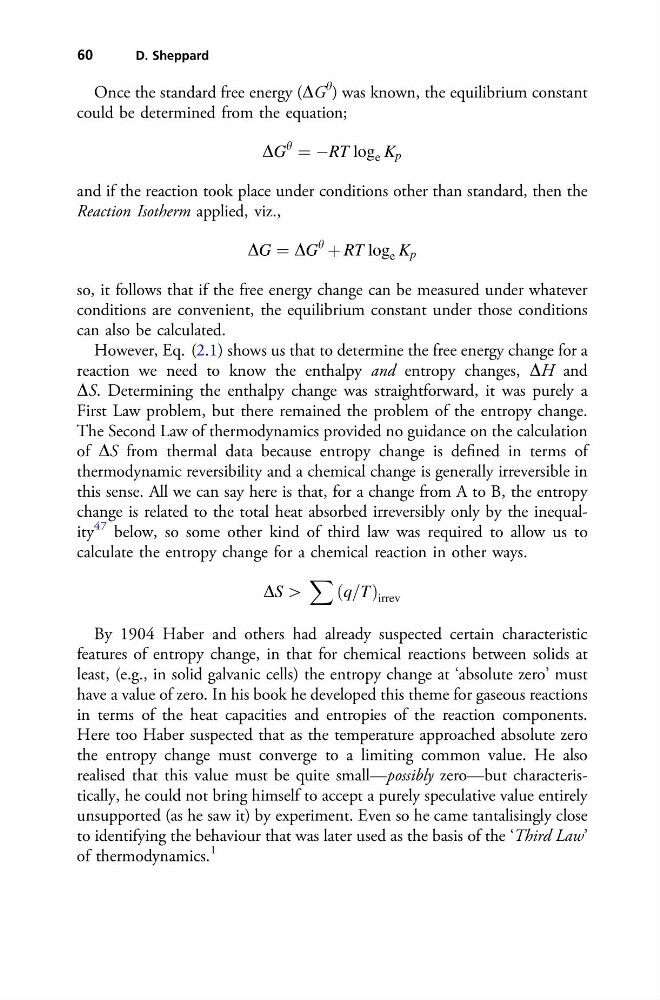
Once the standard free energy (DG
h ) was known, the equilibrium constant
could be determined from the equation;
DG
h
¼ ÀRT log e K p
and if the reaction took place under conditions other than standard, then the
Reaction Isotherm applied, viz.,
DG ¼ DG
h
þ RT log e K p
so, it follows that if the free energy change can be measured under whatever
conditions are convenient, the equilibrium constant under those conditions
can also be calculated.
However, Eq. (2.1) shows us that to determine the free energy change for a
reaction we need to know the enthalpy and entropy changes, DH and
DS. Determining the enthalpy change was straightforward, it was purely a
First Law problem, but there remained the problem of the entropy change.
The Second Law of thermodynamics provided no guidance on the calculation
of DS from thermal data because entropy change is defined in terms of
thermodynamic reversibility and a chemical change is generally irreversible in
this sense. All we can say here is that, for a change from A to B, the entropy
change is related to the total heat absorbed irreversibly only by the inequality
47 below, so some other kind of third law was required to allow us to
calculate the entropy change for a chemical reaction in other ways.
DS [
X ðq=TÞ irrev
By 1904 Haber and others had already suspected certain characteristic
features of entropy change, in that for chemical reactions between solids at
least, (e.g., in solid galvanic cells) the entropy change at ‘absolute zero’ must
have a value of zero. In his book he developed this theme for gaseous reactions
in terms of the heat capacities and entropies of the reaction components.
Here too Haber suspected that as the temperature approached absolute zero
the entropy change must converge to a limiting common value. He also
realised that this value must be quite small—possibly zero—but characteristically, he could not bring himself to accept a purely speculative value entirely
unsupported (as he saw it) by experiment. Even so he came tantalisingly close
to identifying the behaviour that was later used as the basis of the ‘Third Law’
of thermodynamics.
1
60
D. Sheppard
h ) was known, the equilibrium constant
could be determined from the equation;
DG
h
¼ ÀRT log e K p
and if the reaction took place under conditions other than standard, then the
Reaction Isotherm applied, viz.,
DG ¼ DG
h
þ RT log e K p
so, it follows that if the free energy change can be measured under whatever
conditions are convenient, the equilibrium constant under those conditions
can also be calculated.
However, Eq. (2.1) shows us that to determine the free energy change for a
reaction we need to know the enthalpy and entropy changes, DH and
DS. Determining the enthalpy change was straightforward, it was purely a
First Law problem, but there remained the problem of the entropy change.
The Second Law of thermodynamics provided no guidance on the calculation
of DS from thermal data because entropy change is defined in terms of
thermodynamic reversibility and a chemical change is generally irreversible in
this sense. All we can say here is that, for a change from A to B, the entropy
change is related to the total heat absorbed irreversibly only by the inequality
47 below, so some other kind of third law was required to allow us to
calculate the entropy change for a chemical reaction in other ways.
DS [
X ðq=TÞ irrev
By 1904 Haber and others had already suspected certain characteristic
features of entropy change, in that for chemical reactions between solids at
least, (e.g., in solid galvanic cells) the entropy change at ‘absolute zero’ must
have a value of zero. In his book he developed this theme for gaseous reactions
in terms of the heat capacities and entropies of the reaction components.
Here too Haber suspected that as the temperature approached absolute zero
the entropy change must converge to a limiting common value. He also
realised that this value must be quite small—possibly zero—but characteristically, he could not bring himself to accept a purely speculative value entirely
unsupported (as he saw it) by experiment. Even so he came tantalisingly close
to identifying the behaviour that was later used as the basis of the ‘Third Law’
of thermodynamics.
1
60
D. Sheppard