

Action’.
44 But it was in its treatment of gaseous equilibria that its impact was
most felt.
1
Until the publication of Haber’s book, gaseous equilibria had been discussed quantitatively in terms of the ‘Law of Mass Action’ and qualitatively
through ‘Le Châtelier’s Principle’,
45 but as early as 1888 Henri Le Chatelier
had pointed to the importance of heat capacity in calculating equilibrium
positions over a wide temperature range. Chemists generally had failed to
recognise the importance of heat capacity, but writing primarily as a chemist
—and referring to well known industrially important examples—Haber
brought this aspect of chemical equilibria to the forefront of international
teaching and research.
1
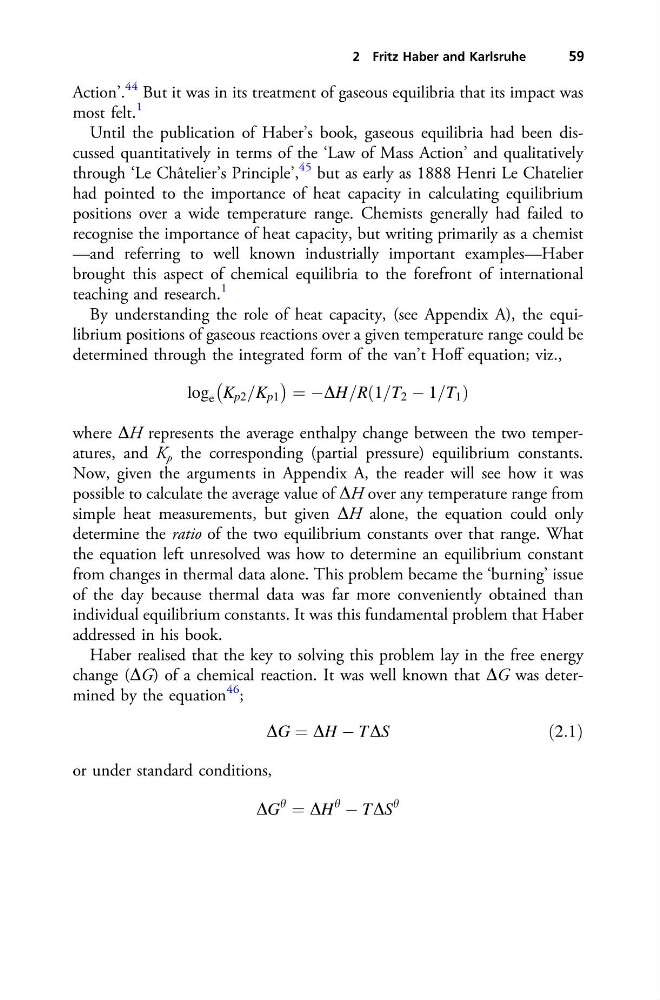
By understanding the role of heat capacity, (see Appendix A), the equilibrium positions of gaseous reactions over a given temperature range could be
determined through the integrated form of the van’t Hoff equation; viz.,
log e K p2 =K p1
À
Á ¼ ÀDH=R 1=T 2 À 1=T 1
ð
Þ
where DH represents the average enthalpy change between the two temperatures, and K p the corresponding (partial pressure) equilibrium constants.
Now, given the arguments in Appendix A, the reader will see how it was
possible to calculate the average value of DH over any temperature range from
simple heat measurements, but given DH alone, the equation could only
determine the ratio of the two equilibrium constants over that range. What
the equation left unresolved was how to determine an equilibrium constant
from changes in thermal data alone. This problem became the ‘burning’ issue
of the day because thermal data was far more conveniently obtained than
individual equilibrium constants. It was this fundamental problem that Haber
addressed in his book.
Haber realised that the key to solving this problem lay in the free energy
change (DG) of a chemical reaction. It was well known that DG was determined by the equation
46
;
DG ¼ DH À TDS
ð2:1Þ
or under standard conditions,
DG
h
¼ DH
h
À TDS
h
2 Fritz Haber and Karlsruhe
59
44 But it was in its treatment of gaseous equilibria that its impact was
most felt.
1
Until the publication of Haber’s book, gaseous equilibria had been discussed quantitatively in terms of the ‘Law of Mass Action’ and qualitatively
through ‘Le Châtelier’s Principle’,
45 but as early as 1888 Henri Le Chatelier
had pointed to the importance of heat capacity in calculating equilibrium
positions over a wide temperature range. Chemists generally had failed to
recognise the importance of heat capacity, but writing primarily as a chemist
—and referring to well known industrially important examples—Haber
brought this aspect of chemical equilibria to the forefront of international
teaching and research.
1
By understanding the role of heat capacity, (see Appendix A), the equilibrium positions of gaseous reactions over a given temperature range could be
determined through the integrated form of the van’t Hoff equation; viz.,
log e K p2 =K p1
À
Á ¼ ÀDH=R 1=T 2 À 1=T 1
ð
Þ
where DH represents the average enthalpy change between the two temperatures, and K p the corresponding (partial pressure) equilibrium constants.
Now, given the arguments in Appendix A, the reader will see how it was
possible to calculate the average value of DH over any temperature range from
simple heat measurements, but given DH alone, the equation could only
determine the ratio of the two equilibrium constants over that range. What
the equation left unresolved was how to determine an equilibrium constant
from changes in thermal data alone. This problem became the ‘burning’ issue
of the day because thermal data was far more conveniently obtained than
individual equilibrium constants. It was this fundamental problem that Haber
addressed in his book.
Haber realised that the key to solving this problem lay in the free energy
change (DG) of a chemical reaction. It was well known that DG was determined by the equation
46
;
DG ¼ DH À TDS
ð2:1Þ
or under standard conditions,
DG
h
¼ DH
h
À TDS
h
2 Fritz Haber and Karlsruhe
59