

On passing out of the reactor tube, the ammonia was once again absorbed
and in each case the ammonia remaining/formed was determined by volumetric analysis using titration with methyl orange as indicator. Haber and van
Oordt found that the amount of ammonia formed in the second reactor was
virtually equal to the amount of undecomposed gas leaving the first reactor.
For the first time then, the equilibrium position was confirmed and from
both sides of the equation. The yield of ammonia however was predictably
low varying between 0.005 and 0.0125%. Haber originally favoured the
higher value as more representative but later work showed the lower value to
be nearer the true equilibrium position, the higher yield eventually being
traced to a special effect of the iron catalyst when fresh, viz., the presence of
nitride in the iron.
38
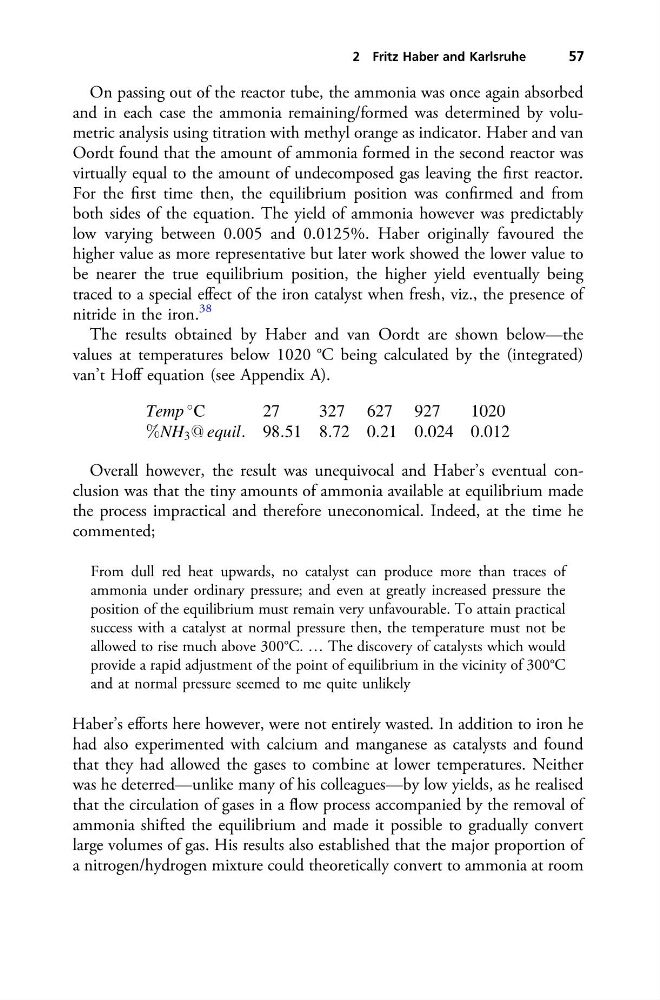
The results obtained by Haber and van Oordt are shown below—the
values at temperatures below 1020 °C being calculated by the (integrated)
van’t Hoff equation (see Appendix A).
Temp
C
27
327 627 927
1020
%NH 3 @ equil: 98:51 8:72 0:21 0:024 0:012
Overall however, the result was unequivocal and Haber’s eventual conclusion was that the tiny amounts of ammonia available at equilibrium made
the process impractical and therefore uneconomical. Indeed, at the time he
commented;
From dull red heat upwards, no catalyst can produce more than traces of
ammonia under ordinary pressure; and even at greatly increased pressure the
position of the equilibrium must remain very unfavourable. To attain practical
success with a catalyst at normal pressure then, the temperature must not be
allowed to rise much above 300°C. … The discovery of catalysts which would
provide a rapid adjustment of the point of equilibrium in the vicinity of 300°C
and at normal pressure seemed to me quite unlikely
Haber’s efforts here however, were not entirely wasted. In addition to iron he
had also experimented with calcium and manganese as catalysts and found
that they had allowed the gases to combine at lower temperatures. Neither
was he deterred—unlike many of his colleagues—by low yields, as he realised
that the circulation of gases in a flow process accompanied by the removal of
ammonia shifted the equilibrium and made it possible to gradually convert
large volumes of gas. His results also established that the major proportion of
a nitrogen/hydrogen mixture could theoretically convert to ammonia at room
2 Fritz Haber and Karlsruhe
57
and in each case the ammonia remaining/formed was determined by volumetric analysis using titration with methyl orange as indicator. Haber and van
Oordt found that the amount of ammonia formed in the second reactor was
virtually equal to the amount of undecomposed gas leaving the first reactor.
For the first time then, the equilibrium position was confirmed and from
both sides of the equation. The yield of ammonia however was predictably
low varying between 0.005 and 0.0125%. Haber originally favoured the
higher value as more representative but later work showed the lower value to
be nearer the true equilibrium position, the higher yield eventually being
traced to a special effect of the iron catalyst when fresh, viz., the presence of
nitride in the iron.
38
The results obtained by Haber and van Oordt are shown below—the
values at temperatures below 1020 °C being calculated by the (integrated)
van’t Hoff equation (see Appendix A).
Temp
C
27
327 627 927
1020
%NH 3 @ equil: 98:51 8:72 0:21 0:024 0:012
Overall however, the result was unequivocal and Haber’s eventual conclusion was that the tiny amounts of ammonia available at equilibrium made
the process impractical and therefore uneconomical. Indeed, at the time he
commented;
From dull red heat upwards, no catalyst can produce more than traces of
ammonia under ordinary pressure; and even at greatly increased pressure the
position of the equilibrium must remain very unfavourable. To attain practical
success with a catalyst at normal pressure then, the temperature must not be
allowed to rise much above 300°C. … The discovery of catalysts which would
provide a rapid adjustment of the point of equilibrium in the vicinity of 300°C
and at normal pressure seemed to me quite unlikely
Haber’s efforts here however, were not entirely wasted. In addition to iron he
had also experimented with calcium and manganese as catalysts and found
that they had allowed the gases to combine at lower temperatures. Neither
was he deterred—unlike many of his colleagues—by low yields, as he realised
that the circulation of gases in a flow process accompanied by the removal of
ammonia shifted the equilibrium and made it possible to gradually convert
large volumes of gas. His results also established that the major proportion of
a nitrogen/hydrogen mixture could theoretically convert to ammonia at room
2 Fritz Haber and Karlsruhe
57