

N 2ðgÞ þ 3H 2ðgÞ 2NH 3ðgÞ
In this approach he built upon the work of William Ramsay and Sidney
Young who in 1884 had examined the decomposition of ammonia at
atmospheric pressure and 800 °C using iron as a catalyst.
36 They found that
the decomposition of ammonia was never quite complete, but when they
reversed the reaction, by trying to form ammonia from nitrogen and
hydrogen under the same conditions, no detectable ammonia was formed.
The persistence of ammonia in the decomposition process clearly suggested an
equilibrium between nitrogen, hydrogen and ammonia but it also meant that
the equilibrium position for this (formation) reaction lay far to the left, but
Haber detected a degree of uncertainty here and felt the process worthy of
re-examination if only to determine once and for all the feasibility of the
elemental synthesis of ammonia.
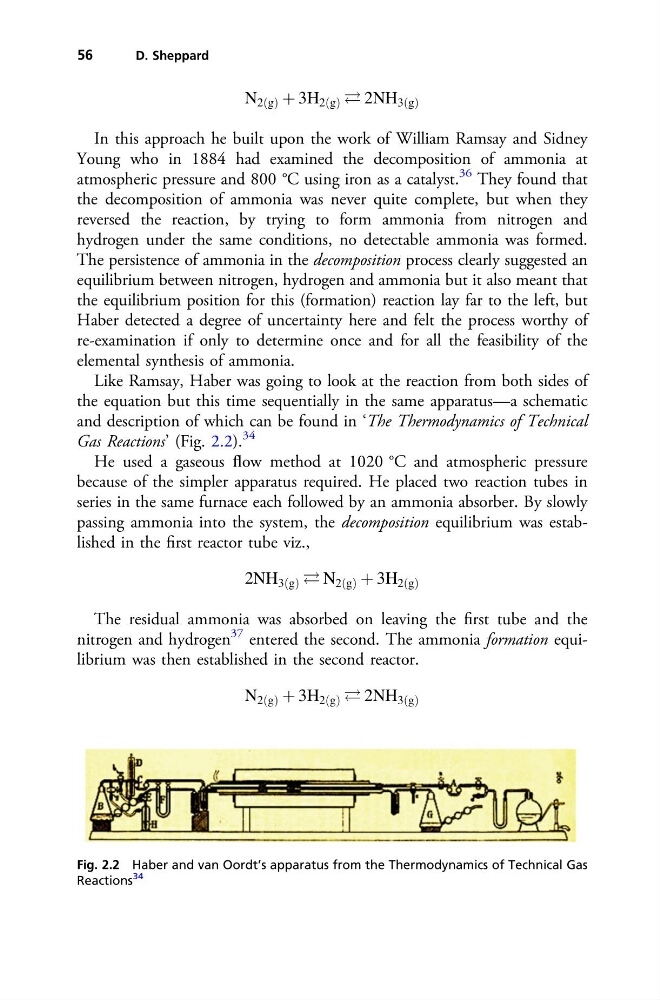
Like Ramsay, Haber was going to look at the reaction from both sides of
the equation but this time sequentially in the same apparatus—a schematic
and description of which can be found in ‘The Thermodynamics of Technical
Gas Reactions’ (Fig. 2.2).
34
He used a gaseous flow method at 1020 °C and atmospheric pressure
because of the simpler apparatus required. He placed two reaction tubes in
series in the same furnace each followed by an ammonia absorber. By slowly
passing ammonia into the system, the decomposition equilibrium was established in the first reactor tube viz.,
2NH 3ðgÞ N 2ðgÞ þ 3H 2ðgÞ
The residual ammonia was absorbed on leaving the first tube and the
nitrogen and hydrogen
37 entered the second. The ammonia formation equilibrium was then established in the second reactor.
N 2ðgÞ þ 3H 2ðgÞ 2NH 3ðgÞ
Fig. 2.2 Haber and van Oordt’s apparatus from the Thermodynamics of Technical Gas
Reactions
34
56
D. Sheppard
In this approach he built upon the work of William Ramsay and Sidney
Young who in 1884 had examined the decomposition of ammonia at
atmospheric pressure and 800 °C using iron as a catalyst.
36 They found that
the decomposition of ammonia was never quite complete, but when they
reversed the reaction, by trying to form ammonia from nitrogen and
hydrogen under the same conditions, no detectable ammonia was formed.
The persistence of ammonia in the decomposition process clearly suggested an
equilibrium between nitrogen, hydrogen and ammonia but it also meant that
the equilibrium position for this (formation) reaction lay far to the left, but
Haber detected a degree of uncertainty here and felt the process worthy of
re-examination if only to determine once and for all the feasibility of the
elemental synthesis of ammonia.
Like Ramsay, Haber was going to look at the reaction from both sides of
the equation but this time sequentially in the same apparatus—a schematic
and description of which can be found in ‘The Thermodynamics of Technical
Gas Reactions’ (Fig. 2.2).
34
He used a gaseous flow method at 1020 °C and atmospheric pressure
because of the simpler apparatus required. He placed two reaction tubes in
series in the same furnace each followed by an ammonia absorber. By slowly
passing ammonia into the system, the decomposition equilibrium was established in the first reactor tube viz.,
2NH 3ðgÞ N 2ðgÞ þ 3H 2ðgÞ
The residual ammonia was absorbed on leaving the first tube and the
nitrogen and hydrogen
37 entered the second. The ammonia formation equilibrium was then established in the second reactor.
N 2ðgÞ þ 3H 2ðgÞ 2NH 3ðgÞ
Fig. 2.2 Haber and van Oordt’s apparatus from the Thermodynamics of Technical Gas
Reactions
34
56
D. Sheppard