

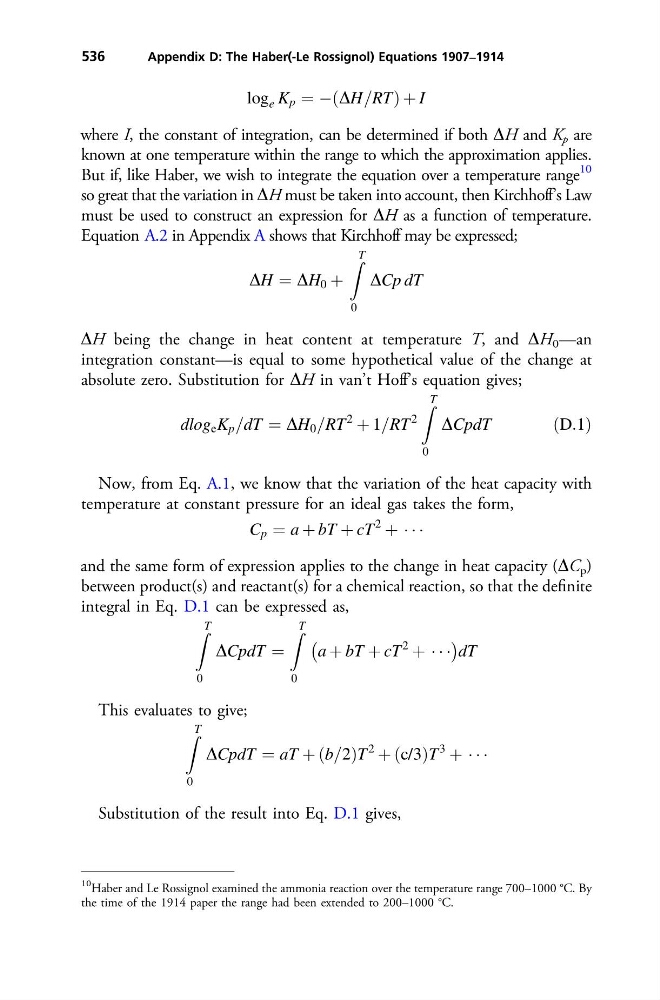
log e K p ¼ ÀðDH=RTÞ þ I
where I, the constant of integration, can be determined if both DH and K p are
known at one temperature within the range to which the approximation applies.
But if, like Haber, we wish to integrate the equation over a temperature range
10
so great that the variation in DH must be taken into account, then Kirchhoff’s Law
must be used to construct an expression for DH as a function of temperature.
Equation A.2 in Appendix A shows that Kirchhoff may be expressed;
DH ¼ DH 0 þ
Z T
0
DCp dT
DH being the change in heat content at temperature T, and DH 0 —an
integration constant—is equal to some hypothetical value of the change at
absolute zero. Substitution for DH in van’t Hoff’s equation gives;
dlog e K p =dT ¼ DH 0 =RT
2
þ 1=RT
2
Z T
0
DCpdT
ðD:1Þ
Now, from Eq. A.1, we know that the variation of the heat capacity with
temperature at constant pressure for an ideal gas takes the form,
C p ¼ a þ bT þ cT
2
þ Á Á Á
and the same form of expression applies to the change in heat capacity (DC p )
between product(s) and reactant(s) for a chemical reaction, so that the definite
integral in Eq. D.1 can be expressed as,
Z T
0
DCpdT ¼
Z T
0
a þ bT þ cT
2
þ Á Á Á
À
Á
dT
This evaluates to give;
Z T
0
DCpdT ¼ aT þ ðb=2ÞT
2
þ ðc/3ÞT
3
þ Á Á Á
Substitution of the result into Eq. D.1 gives,
10 Haber and Le Rossignol examined the ammonia reaction over the temperature range 700–1000 °C. By
the time of the 1914 paper the range had been extended to 200–1000 °C.
536
Appendix D: The Haber(-Le Rossignol) Equations 1907–1914
where I, the constant of integration, can be determined if both DH and K p are
known at one temperature within the range to which the approximation applies.
But if, like Haber, we wish to integrate the equation over a temperature range
10
so great that the variation in DH must be taken into account, then Kirchhoff’s Law
must be used to construct an expression for DH as a function of temperature.
Equation A.2 in Appendix A shows that Kirchhoff may be expressed;
DH ¼ DH 0 þ
Z T
0
DCp dT
DH being the change in heat content at temperature T, and DH 0 —an
integration constant—is equal to some hypothetical value of the change at
absolute zero. Substitution for DH in van’t Hoff’s equation gives;
dlog e K p =dT ¼ DH 0 =RT
2
þ 1=RT
2
Z T
0
DCpdT
ðD:1Þ
Now, from Eq. A.1, we know that the variation of the heat capacity with
temperature at constant pressure for an ideal gas takes the form,
C p ¼ a þ bT þ cT
2
þ Á Á Á
and the same form of expression applies to the change in heat capacity (DC p )
between product(s) and reactant(s) for a chemical reaction, so that the definite
integral in Eq. D.1 can be expressed as,
Z T
0
DCpdT ¼
Z T
0
a þ bT þ cT
2
þ Á Á Á
À
Á
dT
This evaluates to give;
Z T
0
DCpdT ¼ aT þ ðb=2ÞT
2
þ ðc/3ÞT
3
þ Á Á Á
Substitution of the result into Eq. D.1 gives,
10 Haber and Le Rossignol examined the ammonia reaction over the temperature range 700–1000 °C. By
the time of the 1914 paper the range had been extended to 200–1000 °C.
536
Appendix D: The Haber(-Le Rossignol) Equations 1907–1914