

capacity of solid n-butane has been measured is 10 K. The change in entropy
from zero to 10 K is therefore calculated with the Debye equation. At
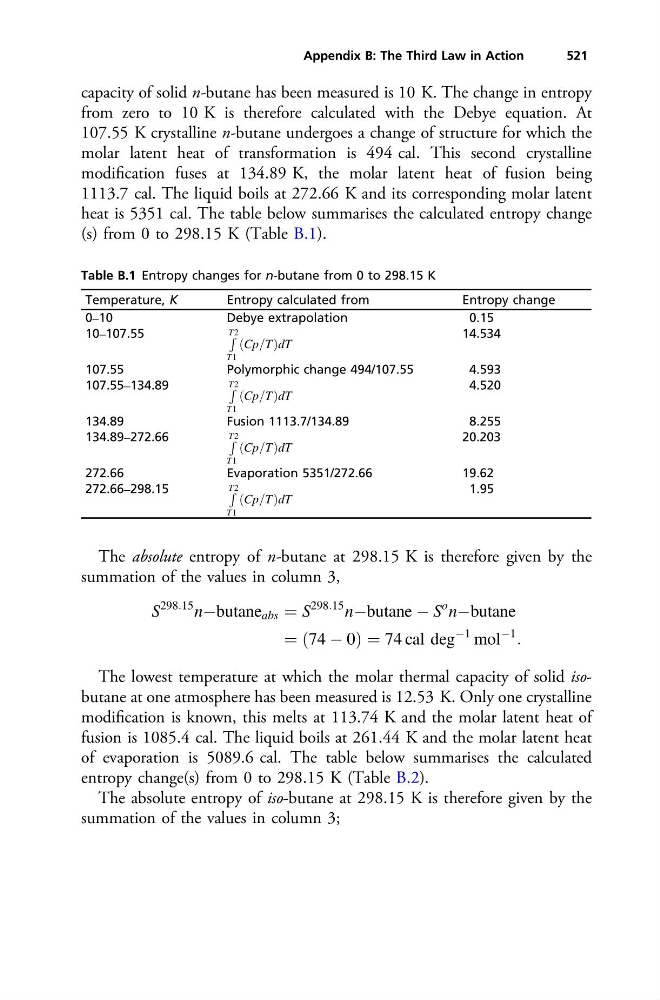
107.55 K crystalline n-butane undergoes a change of structure for which the
molar latent heat of transformation is 494 cal. This second crystalline
modification fuses at 134.89 K, the molar latent heat of fusion being
1113.7 cal. The liquid boils at 272.66 K and its corresponding molar latent
heat is 5351 cal. The table below summarises the calculated entropy change
(s) from 0 to 298.15 K (Table B.1).
The absolute entropy of n-butane at 298.15 K is therefore given by the
summation of the values in column 3,
S
298:15
nÀbutane abs ¼ S
298:15
nÀbutane À S
o
nÀbutane
¼ ð74 À 0Þ ¼ 74 cal deg
À1 mol
À1
:
The lowest temperature at which the molar thermal capacity of solid isobutane at one atmosphere has been measured is 12.53 K. Only one crystalline
modification is known, this melts at 113.74 K and the molar latent heat of
fusion is 1085.4 cal. The liquid boils at 261.44 K and the molar latent heat
of evaporation is 5089.6 cal. The table below summarises the calculated
entropy change(s) from 0 to 298.15 K (Table B.2).
The absolute entropy of iso-butane at 298.15 K is therefore given by the
summation of the values in column 3;
Table B.1 Entropy changes for n-butane from 0 to 298.15 K
Temperature, K
Entropy calculated from
Entropy change
0–10
Debye extrapolation
0.15
10–107.55
R
T2
T1
Cp=T
ð
ÞdT
14.534
107.55
Polymorphic change 494/107.55
4.593
107.55–134.89
R
T2
T1
ðCp=TÞdT
4.520
134.89
Fusion 1113.7/134.89
8.255
134.89–272.66
R
T2
T1
ðCp=TÞdT
20.203
272.66
Evaporation 5351/272.66
19.62
272.66–298.15
R
T2
T1
ðCp=TÞdT
1.95
Appendix B: The Third Law in Action
521
from zero to 10 K is therefore calculated with the Debye equation. At
107.55 K crystalline n-butane undergoes a change of structure for which the
molar latent heat of transformation is 494 cal. This second crystalline
modification fuses at 134.89 K, the molar latent heat of fusion being
1113.7 cal. The liquid boils at 272.66 K and its corresponding molar latent
heat is 5351 cal. The table below summarises the calculated entropy change
(s) from 0 to 298.15 K (Table B.1).
The absolute entropy of n-butane at 298.15 K is therefore given by the
summation of the values in column 3,
S
298:15
nÀbutane abs ¼ S
298:15
nÀbutane À S
o
nÀbutane
¼ ð74 À 0Þ ¼ 74 cal deg
À1 mol
À1
:
The lowest temperature at which the molar thermal capacity of solid isobutane at one atmosphere has been measured is 12.53 K. Only one crystalline
modification is known, this melts at 113.74 K and the molar latent heat of
fusion is 1085.4 cal. The liquid boils at 261.44 K and the molar latent heat
of evaporation is 5089.6 cal. The table below summarises the calculated
entropy change(s) from 0 to 298.15 K (Table B.2).
The absolute entropy of iso-butane at 298.15 K is therefore given by the
summation of the values in column 3;
Table B.1 Entropy changes for n-butane from 0 to 298.15 K
Temperature, K
Entropy calculated from
Entropy change
0–10
Debye extrapolation
0.15
10–107.55
R
T2
T1
Cp=T
ð
ÞdT
14.534
107.55
Polymorphic change 494/107.55
4.593
107.55–134.89
R
T2
T1
ðCp=TÞdT
4.520
134.89
Fusion 1113.7/134.89
8.255
134.89–272.66
R
T2
T1
ðCp=TÞdT
20.203
272.66
Evaporation 5351/272.66
19.62
272.66–298.15
R
T2
T1
ðCp=TÞdT
1.95
Appendix B: The Third Law in Action
521