

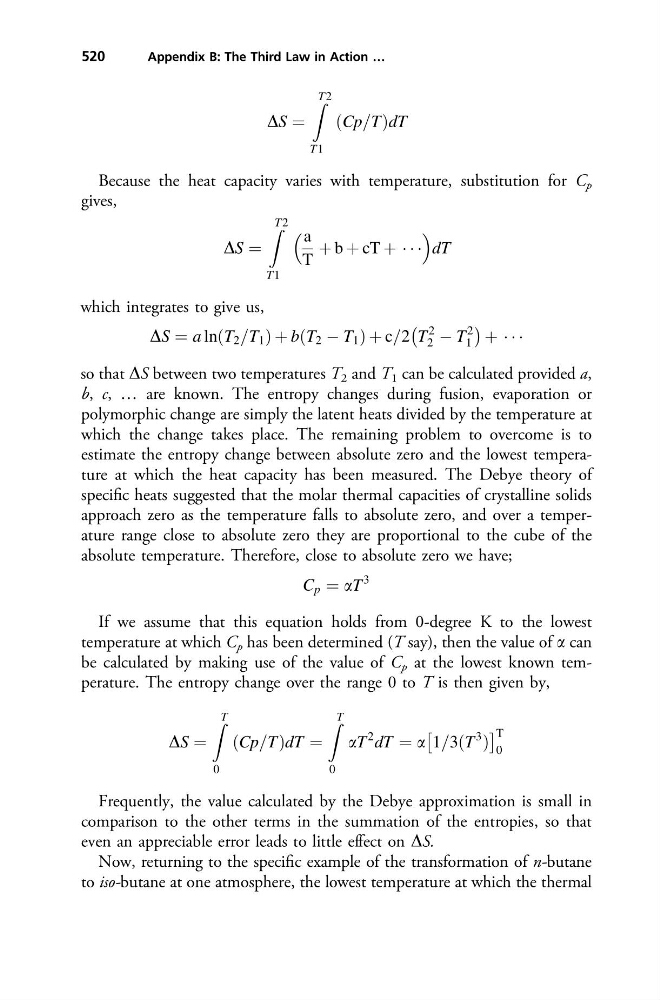
DS ¼
Z T2
T1
ðCp=TÞdT
Because the heat capacity varies with temperature, substitution for C p
gives,
DS ¼
Z T2
T1
a
T
þ b þ cT þ Á Á Á
dT
which integrates to give us,
DS ¼ a ln T 2 =T 1
ð
Þþb T 2 À T 1
ð
Þþc=2 T
2
2 À T
2
1
À
Á þ Á Á Á
so that DS between two temperatures T 2 and T 1 can be calculated provided a,
b, c, … are known. The entropy changes during fusion, evaporation or
polymorphic change are simply the latent heats divided by the temperature at
which the change takes place. The remaining problem to overcome is to
estimate the entropy change between absolute zero and the lowest temperature at which the heat capacity has been measured. The Debye theory of
specific heats suggested that the molar thermal capacities of crystalline solids
approach zero as the temperature falls to absolute zero, and over a temperature range close to absolute zero they are proportional to the cube of the
absolute temperature. Therefore, close to absolute zero we have;
C p ¼ aT
3
If we assume that this equation holds from 0-degree K to the lowest
temperature at which C p has been determined (T say), then the value of a can
be calculated by making use of the value of C p at the lowest known temperature. The entropy change over the range 0 to T is then given by,
DS ¼
Z T
0
ðCp=TÞdT ¼
Z T
0
aT
2
dT ¼ a 1=3ðT
3
Þ
Â
à T
0
Frequently, the value calculated by the Debye approximation is small in
comparison to the other terms in the summation of the entropies, so that
even an appreciable error leads to little effect on DS.
Now, returning to the specific example of the transformation of n-butane
to iso-butane at one atmosphere, the lowest temperature at which the thermal
520
Appendix B: The Third Law in Action …
Z T2
T1
ðCp=TÞdT
Because the heat capacity varies with temperature, substitution for C p
gives,
DS ¼
Z T2
T1
a
T
þ b þ cT þ Á Á Á
dT
which integrates to give us,
DS ¼ a ln T 2 =T 1
ð
Þþb T 2 À T 1
ð
Þþc=2 T
2
2 À T
2
1
À
Á þ Á Á Á
so that DS between two temperatures T 2 and T 1 can be calculated provided a,
b, c, … are known. The entropy changes during fusion, evaporation or
polymorphic change are simply the latent heats divided by the temperature at
which the change takes place. The remaining problem to overcome is to
estimate the entropy change between absolute zero and the lowest temperature at which the heat capacity has been measured. The Debye theory of
specific heats suggested that the molar thermal capacities of crystalline solids
approach zero as the temperature falls to absolute zero, and over a temperature range close to absolute zero they are proportional to the cube of the
absolute temperature. Therefore, close to absolute zero we have;
C p ¼ aT
3
If we assume that this equation holds from 0-degree K to the lowest
temperature at which C p has been determined (T say), then the value of a can
be calculated by making use of the value of C p at the lowest known temperature. The entropy change over the range 0 to T is then given by,
DS ¼
Z T
0
ðCp=TÞdT ¼
Z T
0
aT
2
dT ¼ a 1=3ðT
3
Þ
Â
à T
0
Frequently, the value calculated by the Debye approximation is small in
comparison to the other terms in the summation of the entropies, so that
even an appreciable error leads to little effect on DS.
Now, returning to the specific example of the transformation of n-butane
to iso-butane at one atmosphere, the lowest temperature at which the thermal
520
Appendix B: The Third Law in Action …