

question was quite obvious … ‘How much did Robert tell you of his work
with Haber in Germany?’.
It appears that the two men had discussed the German episode but not in
any great depth, and only on the odd occasion. Dr. Sims recalled that Robert
told him that he had worked alongside a ‘senior German’ at the time, but he
revealed little regarding his role in building the high-pressure machine.
Except, that finding a suitable catalyst proved a particularly difficult problem.
Indeed, following on from Robert’s discussions with Jaenicke in 1959,
10
where—contrary to his 1928 paper
11
—he declared that he really had ‘no
problems’ building the machine, it now seems clear that the catalyst—not the
engineering—was the major stumbling block for ‘fixation’, and understandably so because neither Haber nor Le Rossignol were experts in such matters
and both were fixated on pure substances as the only contenders for the role.
Robert’s opinion that the catalyst was the major problem becomes more
credible when we realise that he was recalling events for Dr. Sims from some
fifty years earlier, but it was this problem alone that he chose to share. But
here it seems we reach the end of the line regarding the detail of the creation
of the technology, for Dr. Sims could recall Robert telling him nothing more
on the matter.
I therefore moved to ask Dr. Sims about Robert and Emily. He said that he
‘got on very well with Robert’, but only knew him well in the last two years of
his life, adding, ‘a lovely man, I liked him a lot …’. He described Robert as
‘devoted’ to Emily who was confined to her wheelchair, physically ‘distorted’
because of her severe arthritis, ‘totally uncommunicative’, never involved in
anything, and a recluse.
12 Dr Sims said that he wasn’t on ‘first name’ familiar
terms with Emily, and never heard her speak and so he didn’t know if her
English was good, or bad, or whether she spoke it at all!
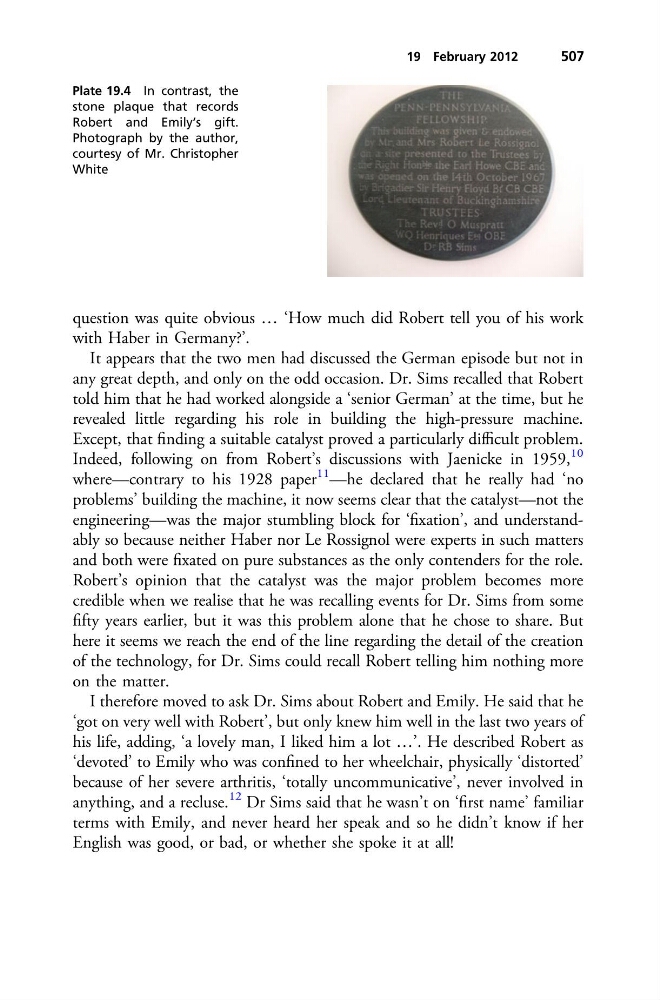
Plate 19.4 In contrast, the
stone plaque that records
Robert and Emily’s gift.
Photograph by the author,
courtesy of Mr. Christopher
White
19 February 2012
507
with Haber in Germany?’.
It appears that the two men had discussed the German episode but not in
any great depth, and only on the odd occasion. Dr. Sims recalled that Robert
told him that he had worked alongside a ‘senior German’ at the time, but he
revealed little regarding his role in building the high-pressure machine.
Except, that finding a suitable catalyst proved a particularly difficult problem.
Indeed, following on from Robert’s discussions with Jaenicke in 1959,
10
where—contrary to his 1928 paper
11
—he declared that he really had ‘no
problems’ building the machine, it now seems clear that the catalyst—not the
engineering—was the major stumbling block for ‘fixation’, and understandably so because neither Haber nor Le Rossignol were experts in such matters
and both were fixated on pure substances as the only contenders for the role.
Robert’s opinion that the catalyst was the major problem becomes more
credible when we realise that he was recalling events for Dr. Sims from some
fifty years earlier, but it was this problem alone that he chose to share. But
here it seems we reach the end of the line regarding the detail of the creation
of the technology, for Dr. Sims could recall Robert telling him nothing more
on the matter.
I therefore moved to ask Dr. Sims about Robert and Emily. He said that he
‘got on very well with Robert’, but only knew him well in the last two years of
his life, adding, ‘a lovely man, I liked him a lot …’. He described Robert as
‘devoted’ to Emily who was confined to her wheelchair, physically ‘distorted’
because of her severe arthritis, ‘totally uncommunicative’, never involved in
anything, and a recluse.
12 Dr Sims said that he wasn’t on ‘first name’ familiar
terms with Emily, and never heard her speak and so he didn’t know if her
English was good, or bad, or whether she spoke it at all!
Plate 19.4 In contrast, the
stone plaque that records
Robert and Emily’s gift.
Photograph by the author,
courtesy of Mr. Christopher
White
19 February 2012
507