

during the war viz., Aircraft Interception (AI) radar, Air-to-Surface-Vessel
(ASV) radar and the airborne ground scanning navigational radar system,
‘H2S’, this involvement being particularly in terms of electronic circuits,
microwave components, antennae, display units, together with flight testing.
Also, a scanner developed at Wembley was the first to be used in the ASV and
H2S systems.
15 Other aspects of the Laboratories’ work during the war was
unknown to all but those who worked on them and to senior members of
staff. These involved developing electronic-countermeasures,
16 equipment to
confound German bombing beams, ‘jamming’ enemy ground and airborne
radars, and developing search receivers to detect various enemy transmissions.
Unsurprisingly, little is known of these activities even today
15 but as a senior
member of staff one can only assume that, along with others, Robert’s advice
in these matters would have been sought and valued.
17.2 Airborne Radars; the Context of Robert’s
War
During August 1936 Watson-Watt, by then the Superintendent of the Air
Ministry Research Establishment at Bawdsey, formed an Airborne Group
under Dr Edward George ‘Taffy’ Bowen to develop AI and ASV radar systems. The ‘CH’ station at Bawdsey had a transmitter that weighed several
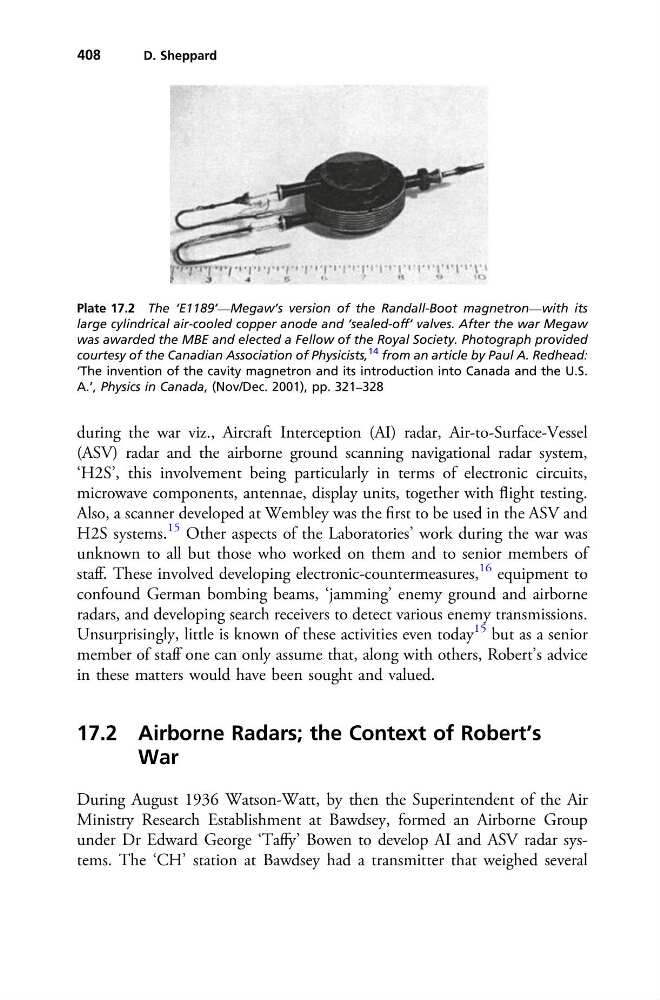
Plate 17.2 The ‘E1189’—Megaw’s version of the Randall-Boot magnetron—with its
large cylindrical air-cooled copper anode and ‘sealed-off’ valves. After the war Megaw
was awarded the MBE and elected a Fellow of the Royal Society. Photograph provided
courtesy of the Canadian Association of Physicists,
14 from an article by Paul A. Redhead:
‘The invention of the cavity magnetron and its introduction into Canada and the U.S.
A.’, Physics in Canada, (Nov/Dec. 2001), pp. 321–328
408
D. Sheppard
(ASV) radar and the airborne ground scanning navigational radar system,
‘H2S’, this involvement being particularly in terms of electronic circuits,
microwave components, antennae, display units, together with flight testing.
Also, a scanner developed at Wembley was the first to be used in the ASV and
H2S systems.
15 Other aspects of the Laboratories’ work during the war was
unknown to all but those who worked on them and to senior members of
staff. These involved developing electronic-countermeasures,
16 equipment to
confound German bombing beams, ‘jamming’ enemy ground and airborne
radars, and developing search receivers to detect various enemy transmissions.
Unsurprisingly, little is known of these activities even today
15 but as a senior
member of staff one can only assume that, along with others, Robert’s advice
in these matters would have been sought and valued.
17.2 Airborne Radars; the Context of Robert’s
War
During August 1936 Watson-Watt, by then the Superintendent of the Air
Ministry Research Establishment at Bawdsey, formed an Airborne Group
under Dr Edward George ‘Taffy’ Bowen to develop AI and ASV radar systems. The ‘CH’ station at Bawdsey had a transmitter that weighed several
Plate 17.2 The ‘E1189’—Megaw’s version of the Randall-Boot magnetron—with its
large cylindrical air-cooled copper anode and ‘sealed-off’ valves. After the war Megaw
was awarded the MBE and elected a Fellow of the Royal Society. Photograph provided
courtesy of the Canadian Association of Physicists,
14 from an article by Paul A. Redhead:
‘The invention of the cavity magnetron and its introduction into Canada and the U.S.
A.’, Physics in Canada, (Nov/Dec. 2001), pp. 321–328
408
D. Sheppard