

surrounding an axial thermionic cathode placed between the poles of an
electromagnet. Their device was water cooled and its vacuum tube was
continuously pumped, but by 21 February 1940 they had used it to generate
400 kW power on a short ‘centimetric’ wavelength of about 10 cm. Quite
simply, this performance was revolutionary.
Work on magnetrons had long been conducted at Wembley—ever since
1932 in fact—but this new small device generated astonishing levels of
microwave energy ideally suited as the source of power in mobile, high
resolution radar. Randall and Boot’s cavity magnetron however only became a
working reality through the resources and experience of the GEC, and in
April 1940, in great secrecy, the pair established contact with E. C. S. Megaw
at Wembley to help develop the device into a practical concern. By July 1940,
Megaw had produced a powerful pulsed signal (10 kW, again on a centimetric wavelength of 10 cm) from a ‘sealed-off’ version of their magnetron,
with a permanent magnet, an air cooled copper anode, a new type of oxide
coated cathode recently discovered by Henry Gutton in France, and gold
(‘Housekeeper’) discs which allowed compact end plates to be attached to the
magnetron to make the final seal.
12 With Megaw’s improvements, the
Randall-Boot cavity magnetron was transformed into a unit suitable for aircraft, capable of being manufactured in quantity for operational use. This
development more than any other allowed an unrestricted growth in mobile
microwave radar to take place over the war years.
13 The GEC device was
eventually introduced into ground, airborne and naval radars as the ‘E1189’
(NT98) and its essential features are retained in radars today—even in your
microwave oven (Plate 17.2)!
Because of these developments, it was inevitable that the Laboratories
would become intimately involved with the main airborne radar systems used
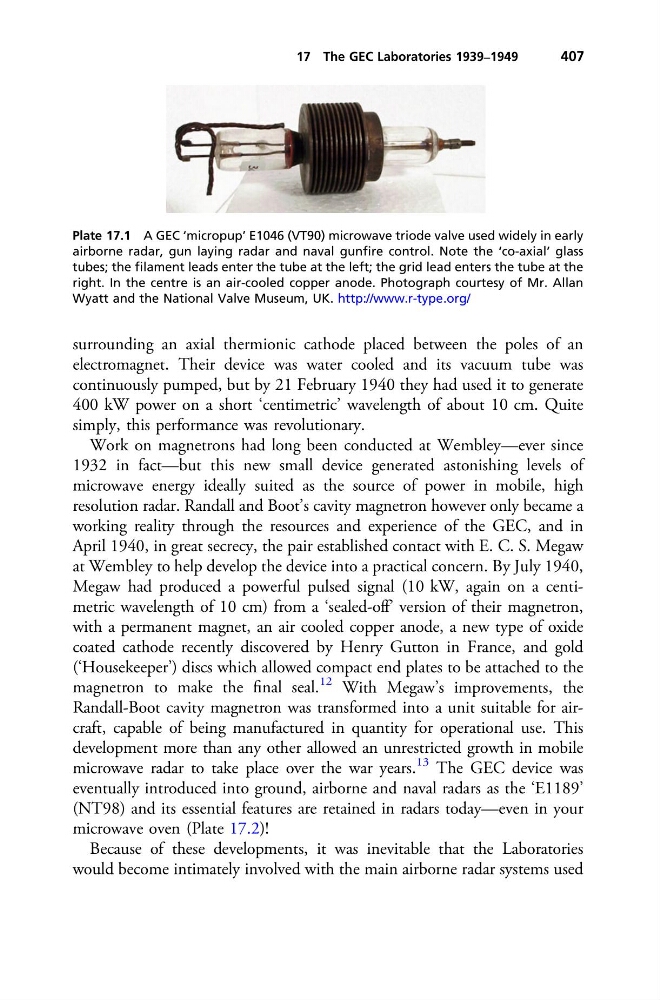
Plate 17.1 A GEC ‘micropup’ E1046 (VT90) microwave triode valve used widely in early
airborne radar, gun laying radar and naval gunfire control. Note the ‘co-axial’ glass
tubes; the filament leads enter the tube at the left; the grid lead enters the tube at the
right. In the centre is an air-cooled copper anode. Photograph courtesy of Mr. Allan
Wyatt and the National Valve Museum, UK. http://www.r-type.org/
17 The GEC Laboratories 1939–1949
407
electromagnet. Their device was water cooled and its vacuum tube was
continuously pumped, but by 21 February 1940 they had used it to generate
400 kW power on a short ‘centimetric’ wavelength of about 10 cm. Quite
simply, this performance was revolutionary.
Work on magnetrons had long been conducted at Wembley—ever since
1932 in fact—but this new small device generated astonishing levels of
microwave energy ideally suited as the source of power in mobile, high
resolution radar. Randall and Boot’s cavity magnetron however only became a
working reality through the resources and experience of the GEC, and in
April 1940, in great secrecy, the pair established contact with E. C. S. Megaw
at Wembley to help develop the device into a practical concern. By July 1940,
Megaw had produced a powerful pulsed signal (10 kW, again on a centimetric wavelength of 10 cm) from a ‘sealed-off’ version of their magnetron,
with a permanent magnet, an air cooled copper anode, a new type of oxide
coated cathode recently discovered by Henry Gutton in France, and gold
(‘Housekeeper’) discs which allowed compact end plates to be attached to the
magnetron to make the final seal.
12 With Megaw’s improvements, the
Randall-Boot cavity magnetron was transformed into a unit suitable for aircraft, capable of being manufactured in quantity for operational use. This
development more than any other allowed an unrestricted growth in mobile
microwave radar to take place over the war years.
13 The GEC device was
eventually introduced into ground, airborne and naval radars as the ‘E1189’
(NT98) and its essential features are retained in radars today—even in your
microwave oven (Plate 17.2)!
Because of these developments, it was inevitable that the Laboratories
would become intimately involved with the main airborne radar systems used
Plate 17.1 A GEC ‘micropup’ E1046 (VT90) microwave triode valve used widely in early
airborne radar, gun laying radar and naval gunfire control. Note the ‘co-axial’ glass
tubes; the filament leads enter the tube at the left; the grid lead enters the tube at the
right. In the centre is an air-cooled copper anode. Photograph courtesy of Mr. Allan
Wyatt and the National Valve Museum, UK. http://www.r-type.org/
17 The GEC Laboratories 1939–1949
407