

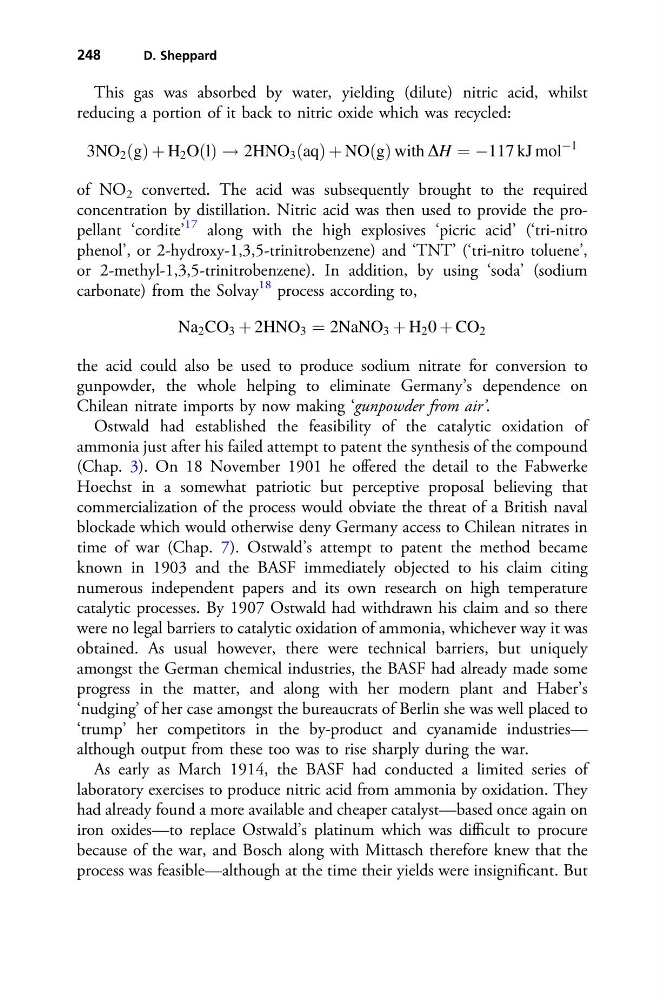
This gas was absorbed by water, yielding (dilute) nitric acid, whilst
reducing a portion of it back to nitric oxide which was recycled:
3NO 2 ðgÞ þ H 2 OðlÞ ! 2HNO 3 ðaqÞ þ NOðgÞ with DH ¼ À117 kJ mol
À1
of NO 2 converted. The acid was subsequently brought to the required
concentration by distillation. Nitric acid was then used to provide the propellant ‘cordite’
17 along with the high explosives ‘picric acid’ (‘tri-nitro
phenol’, or 2-hydroxy-1,3,5-trinitrobenzene) and ‘TNT’ (‘tri-nitro toluene’,
or 2-methyl-1,3,5-trinitrobenzene). In addition, by using ‘soda’ (sodium
carbonate) from the Solvay
18 process according to,
Na 2 CO 3 þ 2HNO 3 ¼ 2NaNO 3 þ H 2 0 þ CO 2
the acid could also be used to produce sodium nitrate for conversion to
gunpowder, the whole helping to eliminate Germany’s dependence on
Chilean nitrate imports by now making ‘gunpowder from air’.
Ostwald had established the feasibility of the catalytic oxidation of
ammonia just after his failed attempt to patent the synthesis of the compound
(Chap. 3). On 18 November 1901 he offered the detail to the Fabwerke
Hoechst in a somewhat patriotic but perceptive proposal believing that
commercialization of the process would obviate the threat of a British naval
blockade which would otherwise deny Germany access to Chilean nitrates in
time of war (Chap. 7). Ostwald’s attempt to patent the method became
known in 1903 and the BASF immediately objected to his claim citing
numerous independent papers and its own research on high temperature
catalytic processes. By 1907 Ostwald had withdrawn his claim and so there
were no legal barriers to catalytic oxidation of ammonia, whichever way it was
obtained. As usual however, there were technical barriers, but uniquely
amongst the German chemical industries, the BASF had already made some
progress in the matter, and along with her modern plant and Haber’s
‘nudging’ of her case amongst the bureaucrats of Berlin she was well placed to
‘trump’ her competitors in the by-product and cyanamide industries—
although output from these too was to rise sharply during the war.
As early as March 1914, the BASF had conducted a limited series of
laboratory exercises to produce nitric acid from ammonia by oxidation. They
had already found a more available and cheaper catalyst—based once again on
iron oxides—to replace Ostwald’s platinum which was difficult to procure
because of the war, and Bosch along with Mittasch therefore knew that the
process was feasible—although at the time their yields were insignificant. But
248
D. Sheppard
reducing a portion of it back to nitric oxide which was recycled:
3NO 2 ðgÞ þ H 2 OðlÞ ! 2HNO 3 ðaqÞ þ NOðgÞ with DH ¼ À117 kJ mol
À1
of NO 2 converted. The acid was subsequently brought to the required
concentration by distillation. Nitric acid was then used to provide the propellant ‘cordite’
17 along with the high explosives ‘picric acid’ (‘tri-nitro
phenol’, or 2-hydroxy-1,3,5-trinitrobenzene) and ‘TNT’ (‘tri-nitro toluene’,
or 2-methyl-1,3,5-trinitrobenzene). In addition, by using ‘soda’ (sodium
carbonate) from the Solvay
18 process according to,
Na 2 CO 3 þ 2HNO 3 ¼ 2NaNO 3 þ H 2 0 þ CO 2
the acid could also be used to produce sodium nitrate for conversion to
gunpowder, the whole helping to eliminate Germany’s dependence on
Chilean nitrate imports by now making ‘gunpowder from air’.
Ostwald had established the feasibility of the catalytic oxidation of
ammonia just after his failed attempt to patent the synthesis of the compound
(Chap. 3). On 18 November 1901 he offered the detail to the Fabwerke
Hoechst in a somewhat patriotic but perceptive proposal believing that
commercialization of the process would obviate the threat of a British naval
blockade which would otherwise deny Germany access to Chilean nitrates in
time of war (Chap. 7). Ostwald’s attempt to patent the method became
known in 1903 and the BASF immediately objected to his claim citing
numerous independent papers and its own research on high temperature
catalytic processes. By 1907 Ostwald had withdrawn his claim and so there
were no legal barriers to catalytic oxidation of ammonia, whichever way it was
obtained. As usual however, there were technical barriers, but uniquely
amongst the German chemical industries, the BASF had already made some
progress in the matter, and along with her modern plant and Haber’s
‘nudging’ of her case amongst the bureaucrats of Berlin she was well placed to
‘trump’ her competitors in the by-product and cyanamide industries—
although output from these too was to rise sharply during the war.
As early as March 1914, the BASF had conducted a limited series of
laboratory exercises to produce nitric acid from ammonia by oxidation. They
had already found a more available and cheaper catalyst—based once again on
iron oxides—to replace Ostwald’s platinum which was difficult to procure
because of the war, and Bosch along with Mittasch therefore knew that the
process was feasible—although at the time their yields were insignificant. But
248
D. Sheppard