

Finally, using the data and equations from Chap. 5 of his book, Haber
presented the following expression for K p which took into account the change
in the heat capacities of ammonia and the ‘permanent gases’ (nitrogen and
hydrogen), which they had by now measured themselves;
log 10 K p ¼ 2215=T À 3:626 log 10 T þ 3:07 Â 10
À4
T þ 2:9
 10
À7
T
2
þ 4:82
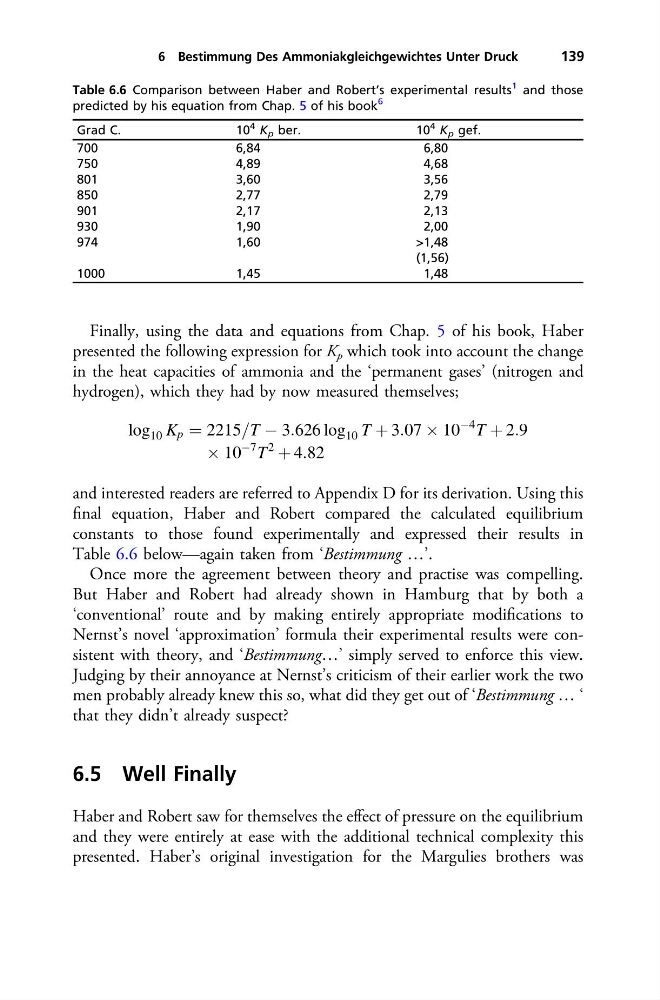
and interested readers are referred to Appendix D for its derivation. Using this
final equation, Haber and Robert compared the calculated equilibrium
constants to those found experimentally and expressed their results in
Table 6.6 below—again taken from ‘Bestimmung …’.
Once more the agreement between theory and practise was compelling.
But Haber and Robert had already shown in Hamburg that by both a
‘conventional’ route and by making entirely appropriate modifications to
Nernst’s novel ‘approximation’ formula their experimental results were consistent with theory, and ‘Bestimmung…’ simply served to enforce this view.
Judging by their annoyance at Nernst’s criticism of their earlier work the two
men probably already knew this so, what did they get out of ‘Bestimmung … ‘
that they didn’t already suspect?
6.5 Well Finally
Haber and Robert saw for themselves the effect of pressure on the equilibrium
and they were entirely at ease with the additional technical complexity this
presented. Haber’s original investigation for the Margulies brothers was
Table 6.6 Comparison between Haber and Robert’s experimental results
1 and those
predicted by his equation from Chap. 5 of his book
6
Grad C.
10
4 K p ber.
10
4 K p gef.
700
6,84
6,80
750
4,89
4,68
801
3,60
3,56
850
2,77
2,79
901
2,17
2,13
930
1,90
2,00
974
1,60
>1,48
(1,56)
1000
1,45
1,48
6 Bestimmung Des Ammoniakgleichgewichtes Unter Druck
139
presented the following expression for K p which took into account the change
in the heat capacities of ammonia and the ‘permanent gases’ (nitrogen and
hydrogen), which they had by now measured themselves;
log 10 K p ¼ 2215=T À 3:626 log 10 T þ 3:07 Â 10
À4
T þ 2:9
 10
À7
T
2
þ 4:82
and interested readers are referred to Appendix D for its derivation. Using this
final equation, Haber and Robert compared the calculated equilibrium
constants to those found experimentally and expressed their results in
Table 6.6 below—again taken from ‘Bestimmung …’.
Once more the agreement between theory and practise was compelling.
But Haber and Robert had already shown in Hamburg that by both a
‘conventional’ route and by making entirely appropriate modifications to
Nernst’s novel ‘approximation’ formula their experimental results were consistent with theory, and ‘Bestimmung…’ simply served to enforce this view.
Judging by their annoyance at Nernst’s criticism of their earlier work the two
men probably already knew this so, what did they get out of ‘Bestimmung … ‘
that they didn’t already suspect?
6.5 Well Finally
Haber and Robert saw for themselves the effect of pressure on the equilibrium
and they were entirely at ease with the additional technical complexity this
presented. Haber’s original investigation for the Margulies brothers was
Table 6.6 Comparison between Haber and Robert’s experimental results
1 and those
predicted by his equation from Chap. 5 of his book
6
Grad C.
10
4 K p ber.
10
4 K p gef.
700
6,84
6,80
750
4,89
4,68
801
3,60
3,56
850
2,77
2,79
901
2,17
2,13
930
1,90
2,00
974
1,60
>1,48
(1,56)
1000
1,45
1,48
6 Bestimmung Des Ammoniakgleichgewichtes Unter Druck
139