

5.4 The Discussion
In all honesty, the detail of their investigation did not come out in the
meeting,
28 and one has to accept that the simplicity of Nernst’s approach was
probably more convincing. Nernst too was a rather abrasive character. Having
already ruffled Theodore Richard’s feathers with regard to the Third Law he
was not on particularly good terms with Svante Arrhenius the Swedish
physical chemist, and he was about to become bad friends with Haber
because Robert’s results of course, were consistently higher than his own. J. E.
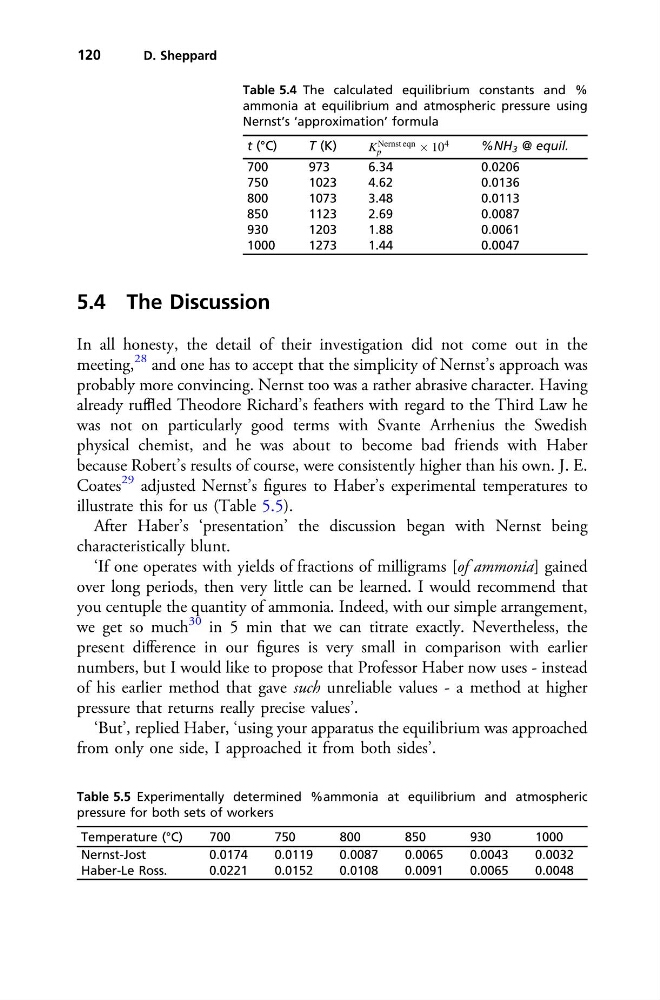
Coates
29 adjusted Nernst’s figures to Haber’s experimental temperatures to
illustrate this for us (Table 5.5).
After Haber’s ‘presentation’ the discussion began with Nernst being
characteristically blunt.
‘If one operates with yields of fractions of milligrams [of ammonia] gained
over long periods, then very little can be learned. I would recommend that
you centuple the quantity of ammonia. Indeed, with our simple arrangement,
we get so much
30 in 5 min that we can titrate exactly. Nevertheless, the
present difference in our figures is very small in comparison with earlier
numbers, but I would like to propose that Professor Haber now uses - instead
of his earlier method that gave such unreliable values - a method at higher
pressure that returns really precise values’.
‘But’, replied Haber, ‘using your apparatus the equilibrium was approached
from only one side, I approached it from both sides’.
Table 5.4 The calculated equilibrium constants and %
ammonia at equilibrium and atmospheric pressure using
Nernst’s ‘approximation’ formula
t (°C)
T (K)
K
Nernst eqn
p
 10
4
%NH 3 @ equil.
700
973
6.34
0.0206
750
1023
4.62
0.0136
800
1073
3.48
0.0113
850
1123
2.69
0.0087
930
1203
1.88
0.0061
1000
1273
1.44
0.0047
Table 5.5 Experimentally determined %ammonia at equilibrium and atmospheric
pressure for both sets of workers
Temperature (°C)
700
750
800
850
930
1000
Nernst-Jost
0.0174
0.0119
0.0087
0.0065
0.0043
0.0032
Haber-Le Ross.
0.0221
0.0152
0.0108
0.0091
0.0065
0.0048
120
D. Sheppard
In all honesty, the detail of their investigation did not come out in the
meeting,
28 and one has to accept that the simplicity of Nernst’s approach was
probably more convincing. Nernst too was a rather abrasive character. Having
already ruffled Theodore Richard’s feathers with regard to the Third Law he
was not on particularly good terms with Svante Arrhenius the Swedish
physical chemist, and he was about to become bad friends with Haber
because Robert’s results of course, were consistently higher than his own. J. E.
Coates
29 adjusted Nernst’s figures to Haber’s experimental temperatures to
illustrate this for us (Table 5.5).
After Haber’s ‘presentation’ the discussion began with Nernst being
characteristically blunt.
‘If one operates with yields of fractions of milligrams [of ammonia] gained
over long periods, then very little can be learned. I would recommend that
you centuple the quantity of ammonia. Indeed, with our simple arrangement,
we get so much
30 in 5 min that we can titrate exactly. Nevertheless, the
present difference in our figures is very small in comparison with earlier
numbers, but I would like to propose that Professor Haber now uses - instead
of his earlier method that gave such unreliable values - a method at higher
pressure that returns really precise values’.
‘But’, replied Haber, ‘using your apparatus the equilibrium was approached
from only one side, I approached it from both sides’.
Table 5.4 The calculated equilibrium constants and %
ammonia at equilibrium and atmospheric pressure using
Nernst’s ‘approximation’ formula
t (°C)
T (K)
K
Nernst eqn
p
 10
4
%NH 3 @ equil.
700
973
6.34
0.0206
750
1023
4.62
0.0136
800
1073
3.48
0.0113
850
1123
2.69
0.0087
930
1203
1.88
0.0061
1000
1273
1.44
0.0047
Table 5.5 Experimentally determined %ammonia at equilibrium and atmospheric
pressure for both sets of workers
Temperature (°C)
700
750
800
850
930
1000
Nernst-Jost
0.0174
0.0119
0.0087
0.0065
0.0043
0.0032
Haber-Le Ross.
0.0221
0.0152
0.0108
0.0091
0.0065
0.0048
120
D. Sheppard