

3.3 Early Commercial Progress in Nitrogen
Fixation
The oxidation of atmospheric nitrogen was probably the most technically
advanced commercial attempt to bind elemental nitrogen. The process had a
long history. It was well known to occur during thunderstorms and in the
laboratory by ‘sparking’ mixtures of nitrogen and oxygen. But by 1890
researchers realised that using an electric arc discharge concentrated huge
amounts of energy in a small space resulting in much higher yields. However,
even at 2000 °C very little conversion occurred, and temperatures above
3000 °C were necessary to produce commercially useful amounts of the oxide
(but still only 1.5–2% by volume). The highly endothermic nature of the
formation required large amounts of energy and the electric arc process could
only be commercially viable in countries where sustained supplies of inexpensive electricity were readily available. The arrangement of the arc(s) too
was important and several novel solutions arose to maximise conversion.
A further technical difficulty concerned the conversion of the oxide to useable
product. Nitric oxide was stable at high temperatures but cooling favoured
the reverse reaction causing the equilibrium to shift to the left, decomposing
the oxide back into nitrogen and oxygen. To avoid decomposition of the
expensively obtained oxide, rapid cooling, or ‘quenching’ was necessary to
bring the it to a manageable temperature (around 800–1000 °C) without
losing too much yield. Subsequent condensation of the gases produced nitric
acid which was reacted with ‘lime’ to produce calcium nitrate Ca(NO 3 ) 2 , a
compound containing 17% nitrogen used directly as a fertiliser.
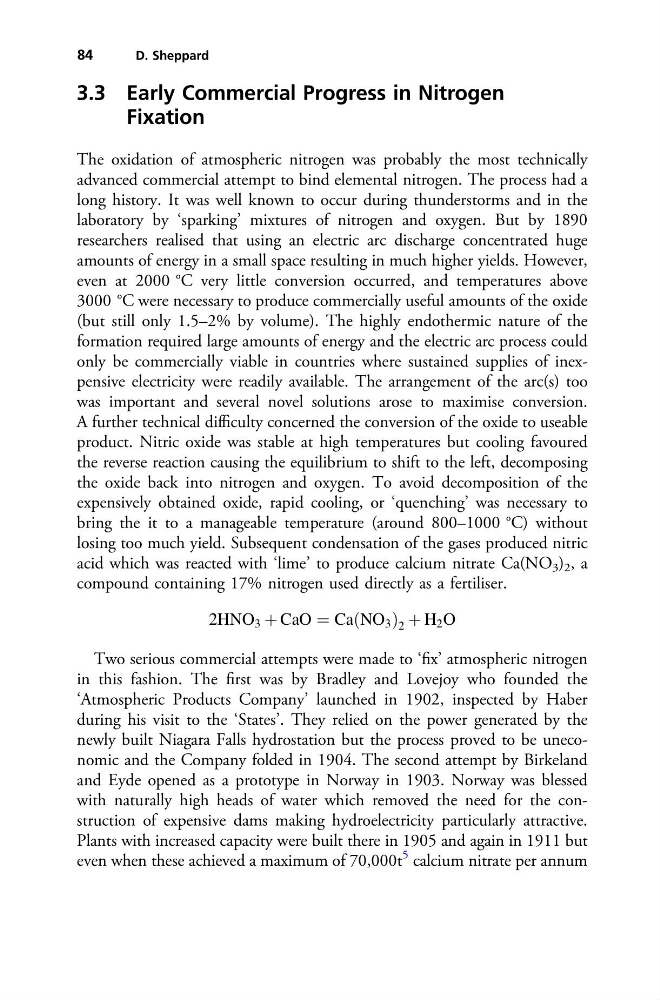
2HNO 3 þ CaO ¼ Ca NO 3
ð
Þ 2 þ H 2 O
Two serious commercial attempts were made to ‘fix’ atmospheric nitrogen
in this fashion. The first was by Bradley and Lovejoy who founded the
‘Atmospheric Products Company’ launched in 1902, inspected by Haber
during his visit to the ‘States’. They relied on the power generated by the
newly built Niagara Falls hydrostation but the process proved to be uneconomic and the Company folded in 1904. The second attempt by Birkeland
and Eyde opened as a prototype in Norway in 1903. Norway was blessed
with naturally high heads of water which removed the need for the construction of expensive dams making hydroelectricity particularly attractive.
Plants with increased capacity were built there in 1905 and again in 1911 but
even when these achieved a maximum of 70,000t
5 calcium nitrate per annum
84
D. Sheppard
Fixation
The oxidation of atmospheric nitrogen was probably the most technically
advanced commercial attempt to bind elemental nitrogen. The process had a
long history. It was well known to occur during thunderstorms and in the
laboratory by ‘sparking’ mixtures of nitrogen and oxygen. But by 1890
researchers realised that using an electric arc discharge concentrated huge
amounts of energy in a small space resulting in much higher yields. However,
even at 2000 °C very little conversion occurred, and temperatures above
3000 °C were necessary to produce commercially useful amounts of the oxide
(but still only 1.5–2% by volume). The highly endothermic nature of the
formation required large amounts of energy and the electric arc process could
only be commercially viable in countries where sustained supplies of inexpensive electricity were readily available. The arrangement of the arc(s) too
was important and several novel solutions arose to maximise conversion.
A further technical difficulty concerned the conversion of the oxide to useable
product. Nitric oxide was stable at high temperatures but cooling favoured
the reverse reaction causing the equilibrium to shift to the left, decomposing
the oxide back into nitrogen and oxygen. To avoid decomposition of the
expensively obtained oxide, rapid cooling, or ‘quenching’ was necessary to
bring the it to a manageable temperature (around 800–1000 °C) without
losing too much yield. Subsequent condensation of the gases produced nitric
acid which was reacted with ‘lime’ to produce calcium nitrate Ca(NO 3 ) 2 , a
compound containing 17% nitrogen used directly as a fertiliser.
2HNO 3 þ CaO ¼ Ca NO 3
ð
Þ 2 þ H 2 O
Two serious commercial attempts were made to ‘fix’ atmospheric nitrogen
in this fashion. The first was by Bradley and Lovejoy who founded the
‘Atmospheric Products Company’ launched in 1902, inspected by Haber
during his visit to the ‘States’. They relied on the power generated by the
newly built Niagara Falls hydrostation but the process proved to be uneconomic and the Company folded in 1904. The second attempt by Birkeland
and Eyde opened as a prototype in Norway in 1903. Norway was blessed
with naturally high heads of water which removed the need for the construction of expensive dams making hydroelectricity particularly attractive.
Plants with increased capacity were built there in 1905 and again in 1911 but
even when these achieved a maximum of 70,000t
5 calcium nitrate per annum
84
D. Sheppard