

Professor Extraordinarius Haber was probably present when Engler delivered
his speech, a speech which permeated the Institute and which reflected all of
Crookes fears. But Haber at least was not to be exhorted in this matter.
Nitrogen was stubborn and its fixation was not a candidate for the attention of
a journeyman academic. Other goals were far more attainable and much less
subject to failure. Even by 1904 when he was tempted to approach the fixation
problem by the Margulies brothers he did so reluctantly, and by 1905—with
regard to ammonia at least—he had made his position perfectly clear.
‘The peculiar inertness characteristic of nitrogen which appears so prominently ….
will always place a serious handicap on the cheap technical preparation of ammonia
particularly so long as the tremendous amount of combined organic nitrogen with
which nature has provided us lasts. Nature brings about the transformation of
elemental nitrogen into ammonia and nitric acid in her slow way with the greatest
facility and on a most colossal scale. While she has accumulated nitrates at but one
place on the earth’s surface in sufficient quantities to mine—and its exhaustion is
imminent—she has provided for us a much richer and more varied supply of
combined nitrogen easily converted into ammonia’.
10
Haber it appeared, was relaxed about the continued availability of naturally
fixed nitrogen—whether organic or inorganic. At the time, the mines of Chile
provided the most convenient form of nitrate and although these were considered all but ‘exhausted’ he maintained other sources would always be
available because the enormity of the natural nitrogen cycle would guarantee a
continued supply of this most critical of chemicals.
11 Maybe in this sense
Haber was ahead of his time, realising that recoverable resource estimates were
always far too conservative. Haber then was not going to voluntarily embark
on the epic quest of finding a ’cheap technical fix’ for the nitrogen problem.
Nitrogen was stubborn and nature knew best how to resolve its fixation.
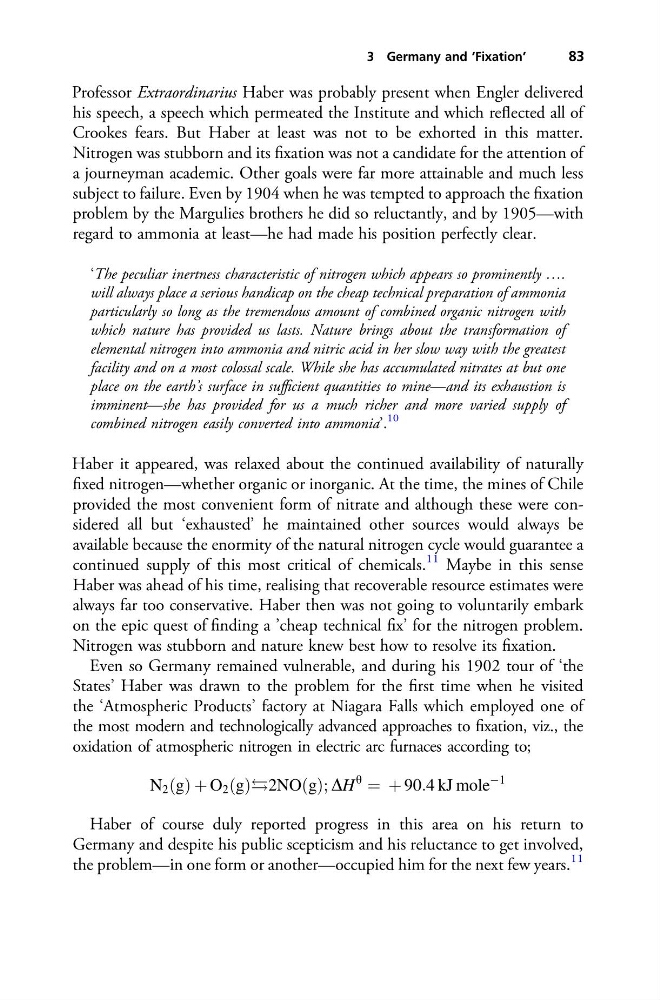
Even so Germany remained vulnerable, and during his 1902 tour of ‘the
States’ Haber was drawn to the problem for the first time when he visited
the ‘Atmospheric Products’ factory at Niagara Falls which employed one of
the most modern and technologically advanced approaches to fixation, viz., the
oxidation of atmospheric nitrogen in electric arc furnaces according to;
N 2 ðgÞ þ O 2 ðgÞ2NOðgÞ; DH
h
¼ þ 90:4 kJ mole
À1
Haber of course duly reported progress in this area on his return to
Germany and despite his public scepticism and his reluctance to get involved,
the problem—in one form or another—occupied him for the next few years.
11
3 Germany and ‘Fixation’
83
his speech, a speech which permeated the Institute and which reflected all of
Crookes fears. But Haber at least was not to be exhorted in this matter.
Nitrogen was stubborn and its fixation was not a candidate for the attention of
a journeyman academic. Other goals were far more attainable and much less
subject to failure. Even by 1904 when he was tempted to approach the fixation
problem by the Margulies brothers he did so reluctantly, and by 1905—with
regard to ammonia at least—he had made his position perfectly clear.
‘The peculiar inertness characteristic of nitrogen which appears so prominently ….
will always place a serious handicap on the cheap technical preparation of ammonia
particularly so long as the tremendous amount of combined organic nitrogen with
which nature has provided us lasts. Nature brings about the transformation of
elemental nitrogen into ammonia and nitric acid in her slow way with the greatest
facility and on a most colossal scale. While she has accumulated nitrates at but one
place on the earth’s surface in sufficient quantities to mine—and its exhaustion is
imminent—she has provided for us a much richer and more varied supply of
combined nitrogen easily converted into ammonia’.
10
Haber it appeared, was relaxed about the continued availability of naturally
fixed nitrogen—whether organic or inorganic. At the time, the mines of Chile
provided the most convenient form of nitrate and although these were considered all but ‘exhausted’ he maintained other sources would always be
available because the enormity of the natural nitrogen cycle would guarantee a
continued supply of this most critical of chemicals.
11 Maybe in this sense
Haber was ahead of his time, realising that recoverable resource estimates were
always far too conservative. Haber then was not going to voluntarily embark
on the epic quest of finding a ’cheap technical fix’ for the nitrogen problem.
Nitrogen was stubborn and nature knew best how to resolve its fixation.
Even so Germany remained vulnerable, and during his 1902 tour of ‘the
States’ Haber was drawn to the problem for the first time when he visited
the ‘Atmospheric Products’ factory at Niagara Falls which employed one of
the most modern and technologically advanced approaches to fixation, viz., the
oxidation of atmospheric nitrogen in electric arc furnaces according to;
N 2 ðgÞ þ O 2 ðgÞ2NOðgÞ; DH
h
¼ þ 90:4 kJ mole
À1
Haber of course duly reported progress in this area on his return to
Germany and despite his public scepticism and his reluctance to get involved,
the problem—in one form or another—occupied him for the next few years.
11
3 Germany and ‘Fixation’
83