

80
2 Description of the Wolfram SystemModeler
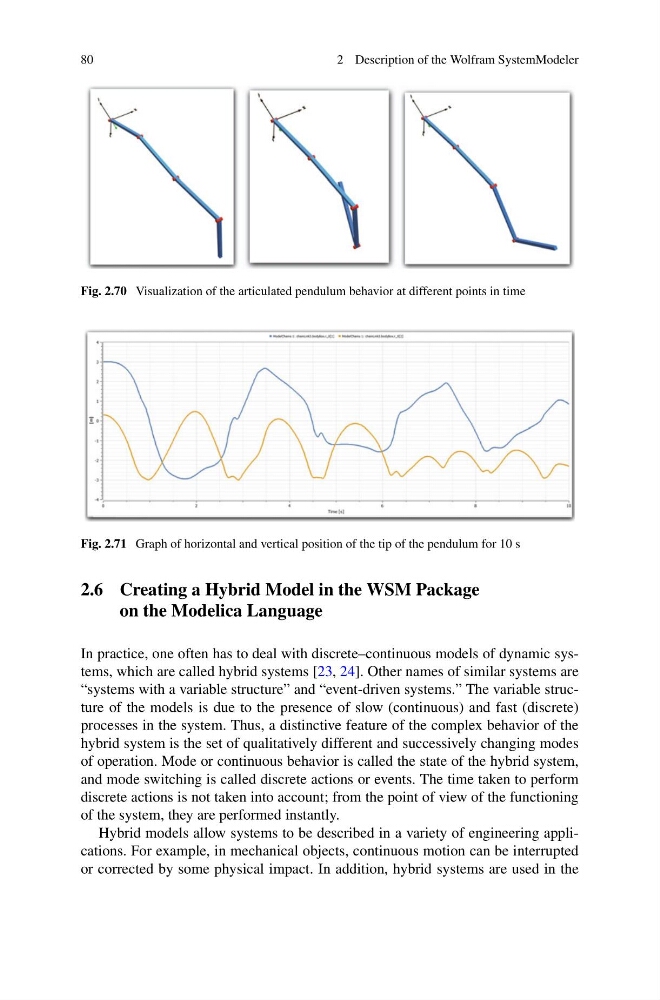
Fig. 2.70 Visualization of the articulated pendulum behavior at different points in time
Fig. 2.71 Graph of horizontal and vertical position of the tip of the pendulum for 10 s
2.6 Creating a Hybrid Model in the WSM Package
on the Modelica Language
In practice, one often has to deal with discrete–continuous models of dynamic systems, which are called hybrid systems [23, 24]. Other names of similar systems are
“systems with a variable structure” and “event-driven systems.” The variable structure of the models is due to the presence of slow (continuous) and fast (discrete)
processes in the system. Thus, a distinctive feature of the complex behavior of the
hybrid system is the set of qualitatively different and successively changing modes
of operation. Mode or continuous behavior is called the state of the hybrid system,
and mode switching is called discrete actions or events. The time taken to perform
discrete actions is not taken into account; from the point of view of the functioning
of the system, they are performed instantly.
Hybrid models allow systems to be described in a variety of engineering applications. For example, in mechanical objects, continuous motion can be interrupted
or corrected by some physical impact. In addition, hybrid systems are used in the
2 Description of the Wolfram SystemModeler
Fig. 2.70 Visualization of the articulated pendulum behavior at different points in time
Fig. 2.71 Graph of horizontal and vertical position of the tip of the pendulum for 10 s
2.6 Creating a Hybrid Model in the WSM Package
on the Modelica Language
In practice, one often has to deal with discrete–continuous models of dynamic systems, which are called hybrid systems [23, 24]. Other names of similar systems are
“systems with a variable structure” and “event-driven systems.” The variable structure of the models is due to the presence of slow (continuous) and fast (discrete)
processes in the system. Thus, a distinctive feature of the complex behavior of the
hybrid system is the set of qualitatively different and successively changing modes
of operation. Mode or continuous behavior is called the state of the hybrid system,
and mode switching is called discrete actions or events. The time taken to perform
discrete actions is not taken into account; from the point of view of the functioning
of the system, they are performed instantly.
Hybrid models allow systems to be described in a variety of engineering applications. For example, in mechanical objects, continuous motion can be interrupted
or corrected by some physical impact. In addition, hybrid systems are used in the