

1.10 Component-Oriented Approach in Modeling
17
sources, resistors, capacitors, etc.) that can be used in many models. Each component
is characterized by its relatively small set of equations, and the aggregate system is
compiled automatically.
With this approach, the process of creating a model is reduced to its decomposition, that is, splitting into relatively simple components, which, if necessary, can be
refined depending on the task, thus when component modeling models are obtained
hierarchical.
As already noted, the components are connected by bonds, which can be of two
types: oriented (directed) and non-oriented (non-directional).
This tutorial covers only the basics of the component-oriented approach. More
information can be found in [2–4].
Oriented Link Components
Oriented links are used when the direction of information transfer between
components of a model is obvious to a model maker.
The most significant example of the use of oriented relations is the automatic
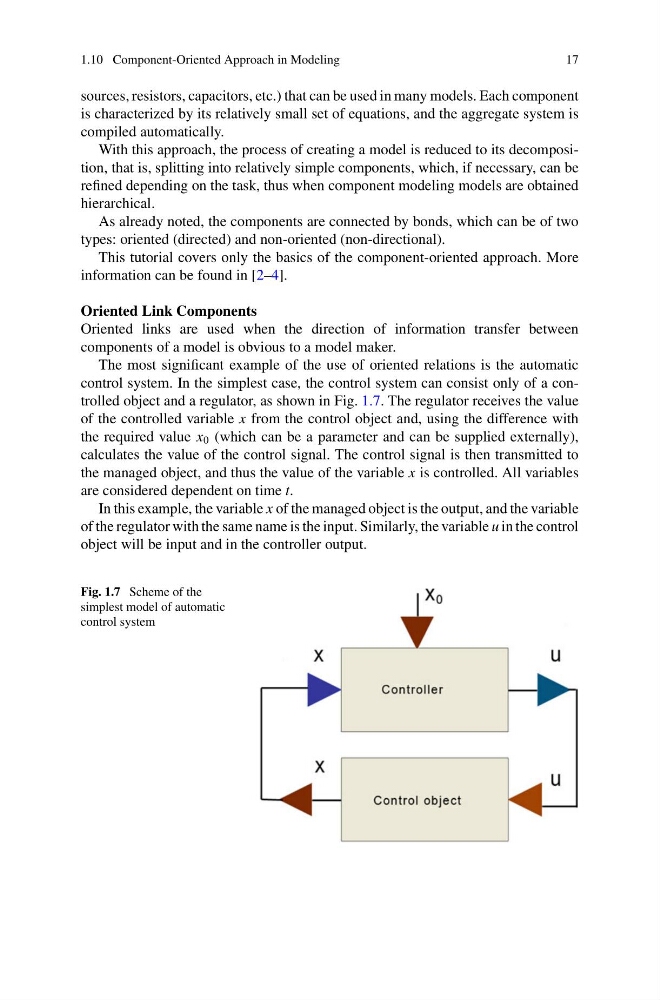
control system. In the simplest case, the control system can consist only of a controlled object and a regulator, as shown in Fig. 1.7. The regulator receives the value
of the controlled variable x from the control object and, using the difference with
the required value x 0 (which can be a parameter and can be supplied externally),
calculates the value of the control signal. The control signal is then transmitted to
the managed object, and thus the value of the variable x is controlled. All variables
are considered dependent on time t.
In this example, the variable x of the managed object is the output, and the variable
of the regulator with the same name is the input. Similarly, the variable u in the control
object will be input and in the controller output.
Fig. 1.7 Scheme of the
simplest model of automatic
control system
17
sources, resistors, capacitors, etc.) that can be used in many models. Each component
is characterized by its relatively small set of equations, and the aggregate system is
compiled automatically.
With this approach, the process of creating a model is reduced to its decomposition, that is, splitting into relatively simple components, which, if necessary, can be
refined depending on the task, thus when component modeling models are obtained
hierarchical.
As already noted, the components are connected by bonds, which can be of two
types: oriented (directed) and non-oriented (non-directional).
This tutorial covers only the basics of the component-oriented approach. More
information can be found in [2–4].
Oriented Link Components
Oriented links are used when the direction of information transfer between
components of a model is obvious to a model maker.
The most significant example of the use of oriented relations is the automatic
control system. In the simplest case, the control system can consist only of a controlled object and a regulator, as shown in Fig. 1.7. The regulator receives the value
of the controlled variable x from the control object and, using the difference with
the required value x 0 (which can be a parameter and can be supplied externally),
calculates the value of the control signal. The control signal is then transmitted to
the managed object, and thus the value of the variable x is controlled. All variables
are considered dependent on time t.
In this example, the variable x of the managed object is the output, and the variable
of the regulator with the same name is the input. Similarly, the variable u in the control
object will be input and in the controller output.
Fig. 1.7 Scheme of the
simplest model of automatic
control system