

260
6 Hierarchical Component Models
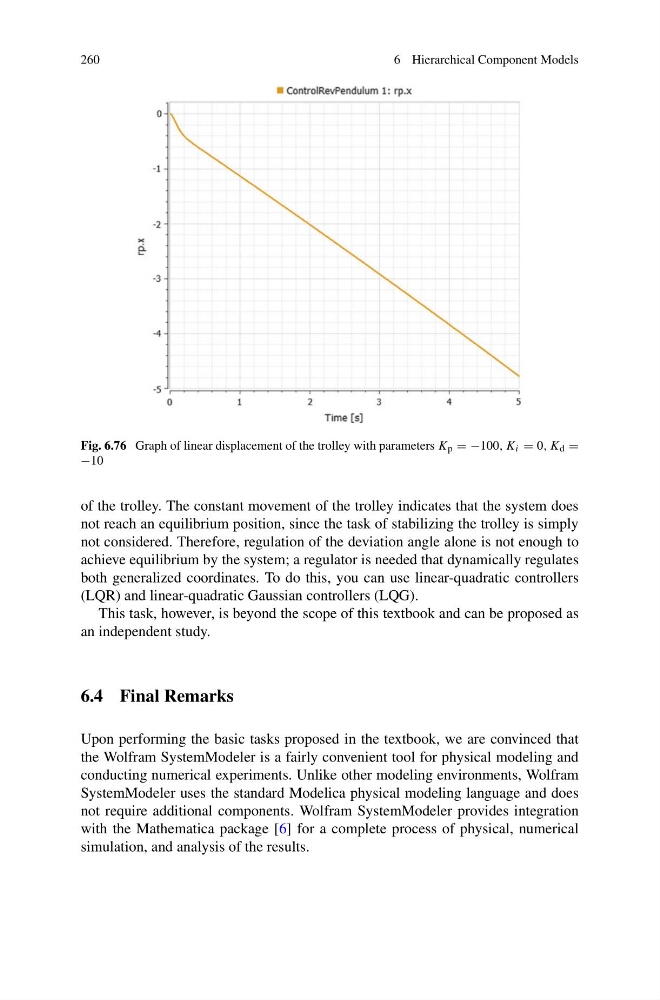
Fig. 6.76 Graph of linear displacement of the trolley with parameters K p = −100, K i = 0, K d =
−10
of the trolley. The constant movement of the trolley indicates that the system does
not reach an equilibrium position, since the task of stabilizing the trolley is simply
not considered. Therefore, regulation of the deviation angle alone is not enough to
achieve equilibrium by the system; a regulator is needed that dynamically regulates
both generalized coordinates. To do this, you can use linear-quadratic controllers
(LQR) and linear-quadratic Gaussian controllers (LQG).
This task, however, is beyond the scope of this textbook and can be proposed as
an independent study.
6.4 Final Remarks
Upon performing the basic tasks proposed in the textbook, we are convinced that
the Wolfram SystemModeler is a fairly convenient tool for physical modeling and
conducting numerical experiments. Unlike other modeling environments, Wolfram
SystemModeler uses the standard Modelica physical modeling language and does
not require additional components. Wolfram SystemModeler provides integration
with the Mathematica package [6] for a complete process of physical, numerical
simulation, and analysis of the results.
6 Hierarchical Component Models
Fig. 6.76 Graph of linear displacement of the trolley with parameters K p = −100, K i = 0, K d =
−10
of the trolley. The constant movement of the trolley indicates that the system does
not reach an equilibrium position, since the task of stabilizing the trolley is simply
not considered. Therefore, regulation of the deviation angle alone is not enough to
achieve equilibrium by the system; a regulator is needed that dynamically regulates
both generalized coordinates. To do this, you can use linear-quadratic controllers
(LQR) and linear-quadratic Gaussian controllers (LQG).
This task, however, is beyond the scope of this textbook and can be proposed as
an independent study.
6.4 Final Remarks
Upon performing the basic tasks proposed in the textbook, we are convinced that
the Wolfram SystemModeler is a fairly convenient tool for physical modeling and
conducting numerical experiments. Unlike other modeling environments, Wolfram
SystemModeler uses the standard Modelica physical modeling language and does
not require additional components. Wolfram SystemModeler provides integration
with the Mathematica package [6] for a complete process of physical, numerical
simulation, and analysis of the results.