

12
1 Modeling Systems
Also, component modeling involves the creation of some libraries of elementary components, on the basis of which more complex models can be built. When
designing complex objects using libraries of ready-made components, you can move
from top to bottom, stopping the detailing process, when the necessary component
is found in the library, and from the bottom up, building a model from ready-made
components. The lack of a finished component leads to the need to design a new
component, which further replenishes the library.
Each component in a multi-component model can in turn be elementary or
composite.
1.8 Continuous, Discrete, and Hybrid Models
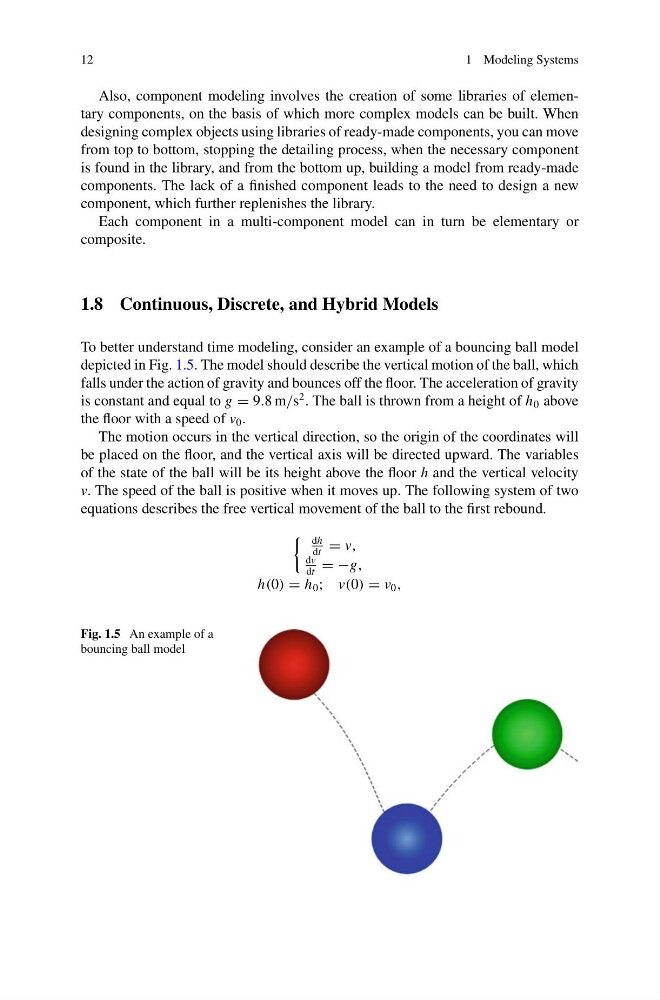
To better understand time modeling, consider an example of a bouncing ball model
depicted in Fig. 1.5. The model should describe the vertical motion of the ball, which
falls under the action of gravity and bounces off the floor. The acceleration of gravity
is constant and equal to g = 9.8 m/s
2 . The ball is thrown from a height of h 0 above
the floor with a speed of v 0 .
The motion occurs in the vertical direction, so the origin of the coordinates will
be placed on the floor, and the vertical axis will be directed upward. The variables
of the state of the ball will be its height above the floor h and the vertical velocity
v. The speed of the ball is positive when it moves up. The following system of two
equations describes the free vertical movement of the ball to the first rebound.
dh
dt
= v,
dv
dt
= −g,
h(0) = h 0 ; v(0) = v 0 ,
Fig. 1.5 An example of a
bouncing ball model
1 Modeling Systems
Also, component modeling involves the creation of some libraries of elementary components, on the basis of which more complex models can be built. When
designing complex objects using libraries of ready-made components, you can move
from top to bottom, stopping the detailing process, when the necessary component
is found in the library, and from the bottom up, building a model from ready-made
components. The lack of a finished component leads to the need to design a new
component, which further replenishes the library.
Each component in a multi-component model can in turn be elementary or
composite.
1.8 Continuous, Discrete, and Hybrid Models
To better understand time modeling, consider an example of a bouncing ball model
depicted in Fig. 1.5. The model should describe the vertical motion of the ball, which
falls under the action of gravity and bounces off the floor. The acceleration of gravity
is constant and equal to g = 9.8 m/s
2 . The ball is thrown from a height of h 0 above
the floor with a speed of v 0 .
The motion occurs in the vertical direction, so the origin of the coordinates will
be placed on the floor, and the vertical axis will be directed upward. The variables
of the state of the ball will be its height above the floor h and the vertical velocity
v. The speed of the ball is positive when it moves up. The following system of two
equations describes the free vertical movement of the ball to the first rebound.
dh
dt
= v,
dv
dt
= −g,
h(0) = h 0 ; v(0) = v 0 ,
Fig. 1.5 An example of a
bouncing ball model