

1.7 Single component and Multicomponent Models
11
1.7 Single component and Multicomponent Models
Earlier, we called the object model that does not consider its internal structure as
one component (or neutral). In this case, the object can interact with the external
environment, which will be considered in the model. If an object selected from the
environment is rather complicated and its structure is essential for modeling, then, by
creating its model, one can try to reflect its internal structure in the model. In this case,
the model is built as a set of objects functioning in parallel and interacting with each
other (e.g., a double pendulum). This approach to modeling is called component.
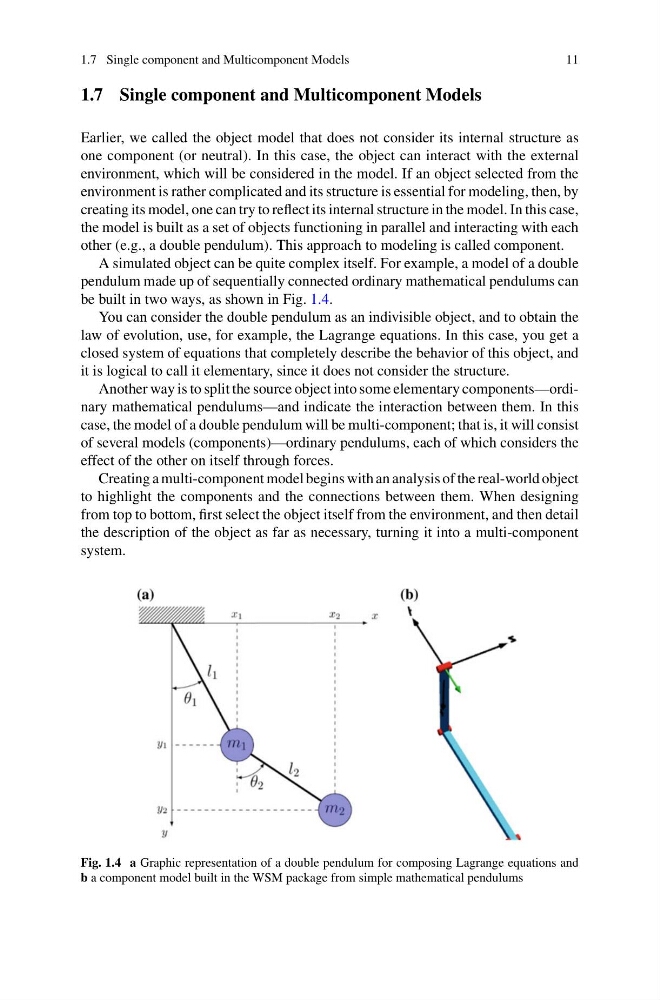
A simulated object can be quite complex itself. For example, a model of a double
pendulum made up of sequentially connected ordinary mathematical pendulums can
be built in two ways, as shown in Fig. 1.4.
You can consider the double pendulum as an indivisible object, and to obtain the
law of evolution, use, for example, the Lagrange equations. In this case, you get a
closed system of equations that completely describe the behavior of this object, and
it is logical to call it elementary, since it does not consider the structure.
Another way is to split the source object into some elementary components—ordinary mathematical pendulums—and indicate the interaction between them. In this
case, the model of a double pendulum will be multi-component; that is, it will consist
of several models (components)—ordinary pendulums, each of which considers the
effect of the other on itself through forces.
Creating a multi-component model begins with an analysis of the real-world object
to highlight the components and the connections between them. When designing
from top to bottom, first select the object itself from the environment, and then detail
the description of the object as far as necessary, turning it into a multi-component
system.
Fig. 1.4 a Graphic representation of a double pendulum for composing Lagrange equations and
b a component model built in the WSM package from simple mathematical pendulums
11
1.7 Single component and Multicomponent Models
Earlier, we called the object model that does not consider its internal structure as
one component (or neutral). In this case, the object can interact with the external
environment, which will be considered in the model. If an object selected from the
environment is rather complicated and its structure is essential for modeling, then, by
creating its model, one can try to reflect its internal structure in the model. In this case,
the model is built as a set of objects functioning in parallel and interacting with each
other (e.g., a double pendulum). This approach to modeling is called component.
A simulated object can be quite complex itself. For example, a model of a double
pendulum made up of sequentially connected ordinary mathematical pendulums can
be built in two ways, as shown in Fig. 1.4.
You can consider the double pendulum as an indivisible object, and to obtain the
law of evolution, use, for example, the Lagrange equations. In this case, you get a
closed system of equations that completely describe the behavior of this object, and
it is logical to call it elementary, since it does not consider the structure.
Another way is to split the source object into some elementary components—ordinary mathematical pendulums—and indicate the interaction between them. In this
case, the model of a double pendulum will be multi-component; that is, it will consist
of several models (components)—ordinary pendulums, each of which considers the
effect of the other on itself through forces.
Creating a multi-component model begins with an analysis of the real-world object
to highlight the components and the connections between them. When designing
from top to bottom, first select the object itself from the environment, and then detail
the description of the object as far as necessary, turning it into a multi-component
system.
Fig. 1.4 a Graphic representation of a double pendulum for composing Lagrange equations and
b a component model built in the WSM package from simple mathematical pendulums