

6.3 Inverted Pendulum Problem
247
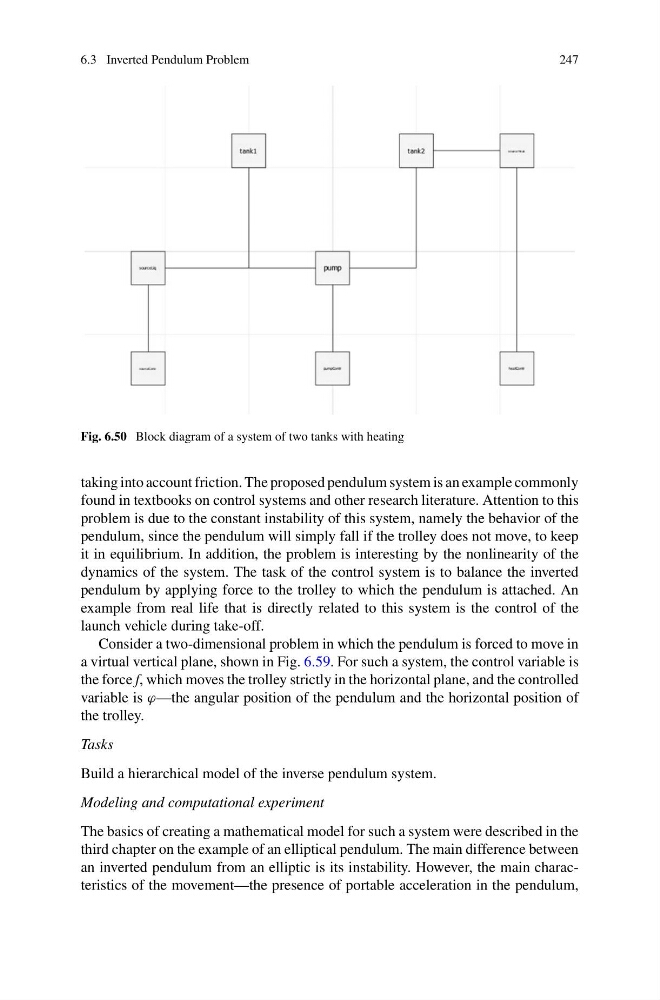
Fig. 6.50 Block diagram of a system of two tanks with heating
taking into account friction. The proposed pendulum system is an example commonly
found in textbooks on control systems and other research literature. Attention to this
problem is due to the constant instability of this system, namely the behavior of the
pendulum, since the pendulum will simply fall if the trolley does not move, to keep
it in equilibrium. In addition, the problem is interesting by the nonlinearity of the
dynamics of the system. The task of the control system is to balance the inverted
pendulum by applying force to the trolley to which the pendulum is attached. An
example from real life that is directly related to this system is the control of the
launch vehicle during take-off.
Consider a two-dimensional problem in which the pendulum is forced to move in
a virtual vertical plane, shown in Fig. 6.59. For such a system, the control variable is
the force f, which moves the trolley strictly in the horizontal plane, and the controlled
variable is ϕ—the angular position of the pendulum and the horizontal position of
the trolley.
Tasks
Build a hierarchical model of the inverse pendulum system.
Modeling and computational experiment
The basics of creating a mathematical model for such a system were described in the
third chapter on the example of an elliptical pendulum. The main difference between
an inverted pendulum from an elliptic is its instability. However, the main characteristics of the movement—the presence of portable acceleration in the pendulum,
247
Fig. 6.50 Block diagram of a system of two tanks with heating
taking into account friction. The proposed pendulum system is an example commonly
found in textbooks on control systems and other research literature. Attention to this
problem is due to the constant instability of this system, namely the behavior of the
pendulum, since the pendulum will simply fall if the trolley does not move, to keep
it in equilibrium. In addition, the problem is interesting by the nonlinearity of the
dynamics of the system. The task of the control system is to balance the inverted
pendulum by applying force to the trolley to which the pendulum is attached. An
example from real life that is directly related to this system is the control of the
launch vehicle during take-off.
Consider a two-dimensional problem in which the pendulum is forced to move in
a virtual vertical plane, shown in Fig. 6.59. For such a system, the control variable is
the force f, which moves the trolley strictly in the horizontal plane, and the controlled
variable is ϕ—the angular position of the pendulum and the horizontal position of
the trolley.
Tasks
Build a hierarchical model of the inverse pendulum system.
Modeling and computational experiment
The basics of creating a mathematical model for such a system were described in the
third chapter on the example of an elliptical pendulum. The main difference between
an inverted pendulum from an elliptic is its instability. However, the main characteristics of the movement—the presence of portable acceleration in the pendulum,