

192
5 Modeling of Mechanical Oscillatory Systems …
Modeling and computational experiment
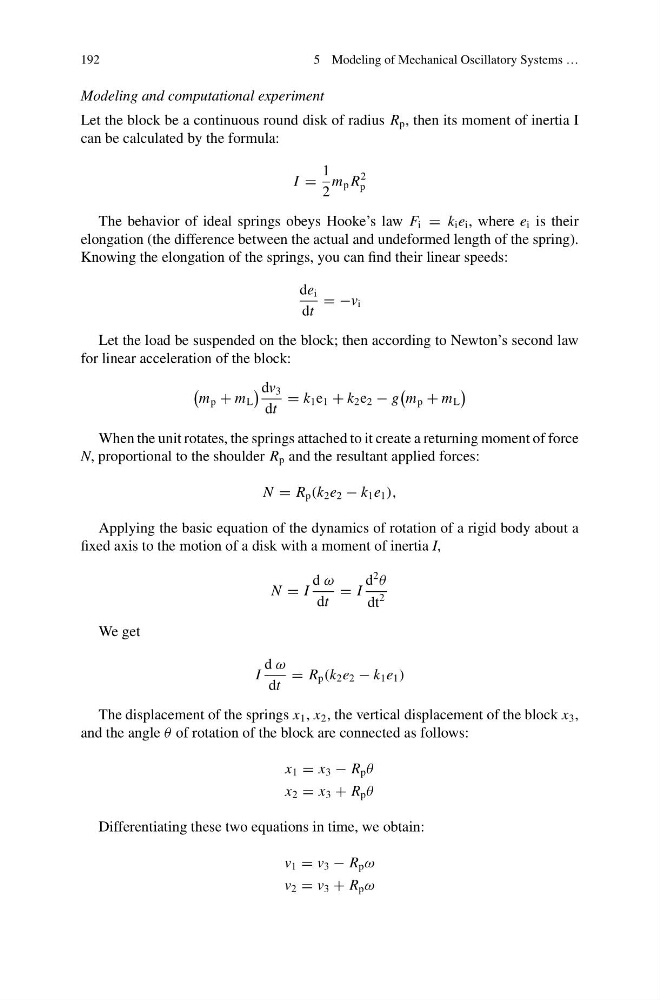
Let the block be a continuous round disk of radius R p , then its moment of inertia I
can be calculated by the formula:
I =
1
2
m p R
2
p
The behavior of ideal springs obeys Hooke’s law F i = k i e i , where e i is their
elongation (the difference between the actual and undeformed length of the spring).
Knowing the elongation of the springs, you can find their linear speeds:
de i
dt
= −v i
Let the load be suspended on the block; then according to Newton’s second law
for linear acceleration of the block:
m p + m L
dv 3
dt
= k 1 e 1 + k 2 e 2 − g
m p + m L
When the unit rotates, the springs attached to it create a returning moment of force
N, proportional to the shoulder R p and the resultant applied forces:
N = R p (k 2 e 2 − k 1 e 1 ),
Applying the basic equation of the dynamics of rotation of a rigid body about a
fixed axis to the motion of a disk with a moment of inertia I,
N = I
d ω
dt
= I
d
2
θ
dt
2
We get
I
d ω
dt
= R p (k 2 e 2 − k 1 e 1 )
The displacement of the springs x 1 , x 2 , the vertical displacement of the block x 3 ,
and the angle θ of rotation of the block are connected as follows:
x 1 = x 3 − R p θ
x 2 = x 3 + R p θ
Differentiating these two equations in time, we obtain:
v 1 = v 3 − R p ω
v 2 = v 3 + R p ω
5 Modeling of Mechanical Oscillatory Systems …
Modeling and computational experiment
Let the block be a continuous round disk of radius R p , then its moment of inertia I
can be calculated by the formula:
I =
1
2
m p R
2
p
The behavior of ideal springs obeys Hooke’s law F i = k i e i , where e i is their
elongation (the difference between the actual and undeformed length of the spring).
Knowing the elongation of the springs, you can find their linear speeds:
de i
dt
= −v i
Let the load be suspended on the block; then according to Newton’s second law
for linear acceleration of the block:
m p + m L
dv 3
dt
= k 1 e 1 + k 2 e 2 − g
m p + m L
When the unit rotates, the springs attached to it create a returning moment of force
N, proportional to the shoulder R p and the resultant applied forces:
N = R p (k 2 e 2 − k 1 e 1 ),
Applying the basic equation of the dynamics of rotation of a rigid body about a
fixed axis to the motion of a disk with a moment of inertia I,
N = I
d ω
dt
= I
d
2
θ
dt
2
We get
I
d ω
dt
= R p (k 2 e 2 − k 1 e 1 )
The displacement of the springs x 1 , x 2 , the vertical displacement of the block x 3 ,
and the angle θ of rotation of the block are connected as follows:
x 1 = x 3 − R p θ
x 2 = x 3 + R p θ
Differentiating these two equations in time, we obtain:
v 1 = v 3 − R p ω
v 2 = v 3 + R p ω