

5.5 Double Pendulum
177
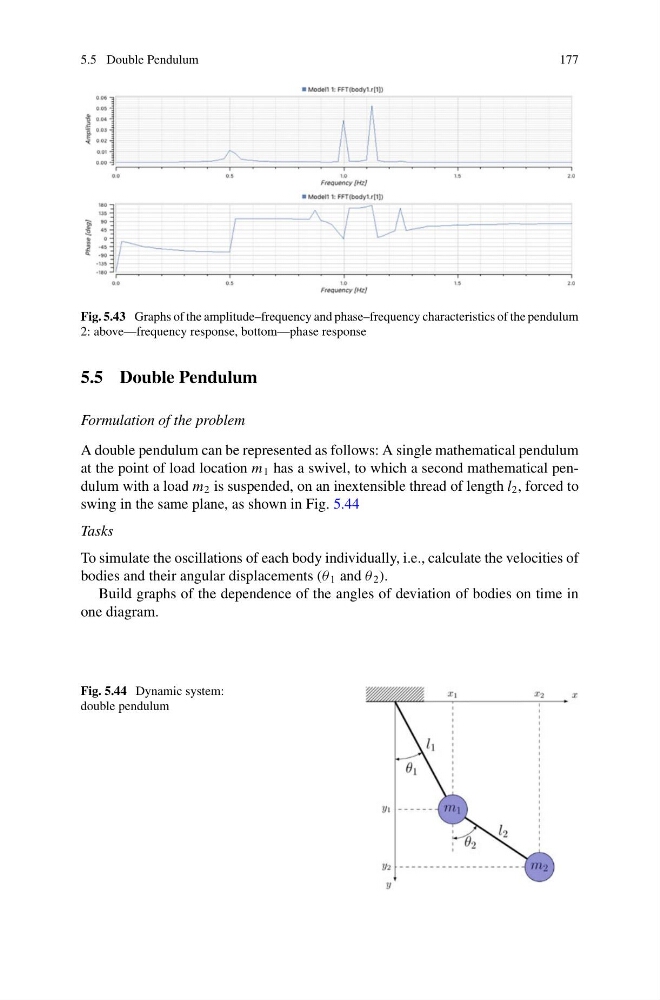
Fig. 5.43 Graphs of the amplitude–frequency and phase–frequency characteristics of the pendulum
2: above—frequency response, bottom—phase response
5.5 Double Pendulum
Formulation of the problem
A double pendulum can be represented as follows: A single mathematical pendulum
at the point of load location m 1 has a swivel, to which a second mathematical pendulum with a load m 2 is suspended, on an inextensible thread of length l 2 , forced to
swing in the same plane, as shown in Fig. 5.44
Tasks
To simulate the oscillations of each body individually, i.e., calculate the velocities of
bodies and their angular displacements (θ 1 and θ 2 ).
Build graphs of the dependence of the angles of deviation of bodies on time in
one diagram.
Fig. 5.44 Dynamic system:
double pendulum
177
Fig. 5.43 Graphs of the amplitude–frequency and phase–frequency characteristics of the pendulum
2: above—frequency response, bottom—phase response
5.5 Double Pendulum
Formulation of the problem
A double pendulum can be represented as follows: A single mathematical pendulum
at the point of load location m 1 has a swivel, to which a second mathematical pendulum with a load m 2 is suspended, on an inextensible thread of length l 2 , forced to
swing in the same plane, as shown in Fig. 5.44
Tasks
To simulate the oscillations of each body individually, i.e., calculate the velocities of
bodies and their angular displacements (θ 1 and θ 2 ).
Build graphs of the dependence of the angles of deviation of bodies on time in
one diagram.
Fig. 5.44 Dynamic system:
double pendulum