

5.4 Connected Pendulums
169
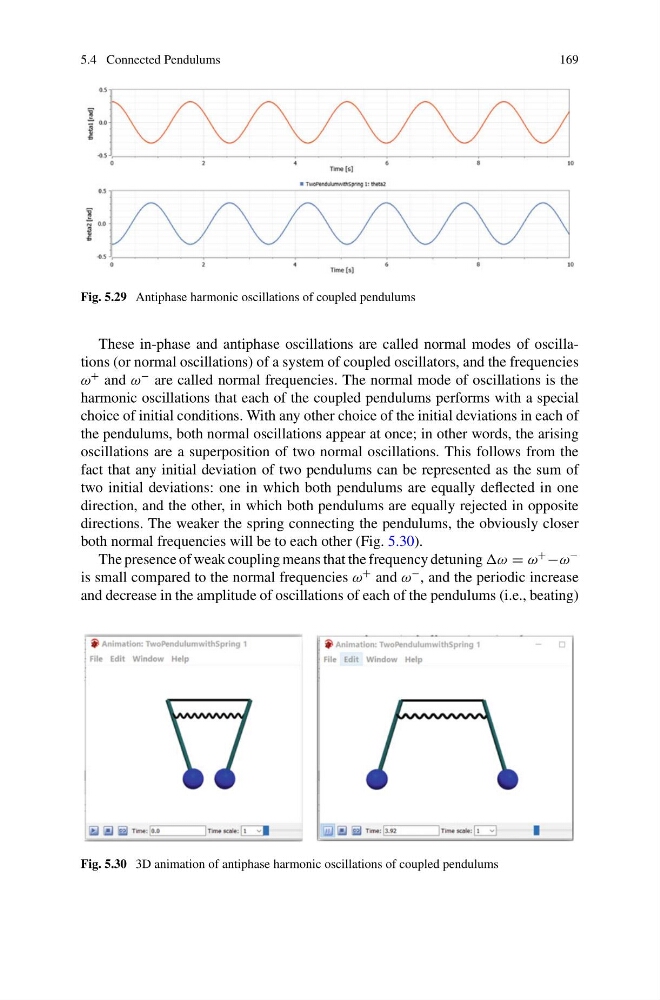
Fig. 5.29 Antiphase harmonic oscillations of coupled pendulums
These in-phase and antiphase oscillations are called normal modes of oscillations (or normal oscillations) of a system of coupled oscillators, and the frequencies
ω
+ and ω
− are called normal frequencies. The normal mode of oscillations is the
harmonic oscillations that each of the coupled pendulums performs with a special
choice of initial conditions. With any other choice of the initial deviations in each of
the pendulums, both normal oscillations appear at once; in other words, the arising
oscillations are a superposition of two normal oscillations. This follows from the
fact that any initial deviation of two pendulums can be represented as the sum of
two initial deviations: one in which both pendulums are equally deflected in one
direction, and the other, in which both pendulums are equally rejected in opposite
directions. The weaker the spring connecting the pendulums, the obviously closer
both normal frequencies will be to each other (Fig. 5.30).
The presence of weak coupling means that the frequency detuning ω = ω
+
−ω
−
is small compared to the normal frequencies ω
+ and ω
− , and the periodic increase
and decrease in the amplitude of oscillations of each of the pendulums (i.e., beating)
Fig. 5.30 3D animation of antiphase harmonic oscillations of coupled pendulums
169
Fig. 5.29 Antiphase harmonic oscillations of coupled pendulums
These in-phase and antiphase oscillations are called normal modes of oscillations (or normal oscillations) of a system of coupled oscillators, and the frequencies
ω
+ and ω
− are called normal frequencies. The normal mode of oscillations is the
harmonic oscillations that each of the coupled pendulums performs with a special
choice of initial conditions. With any other choice of the initial deviations in each of
the pendulums, both normal oscillations appear at once; in other words, the arising
oscillations are a superposition of two normal oscillations. This follows from the
fact that any initial deviation of two pendulums can be represented as the sum of
two initial deviations: one in which both pendulums are equally deflected in one
direction, and the other, in which both pendulums are equally rejected in opposite
directions. The weaker the spring connecting the pendulums, the obviously closer
both normal frequencies will be to each other (Fig. 5.30).
The presence of weak coupling means that the frequency detuning ω = ω
+
−ω
−
is small compared to the normal frequencies ω
+ and ω
− , and the periodic increase
and decrease in the amplitude of oscillations of each of the pendulums (i.e., beating)
Fig. 5.30 3D animation of antiphase harmonic oscillations of coupled pendulums