

4.3 Mathematical Pendulum with Spring
143
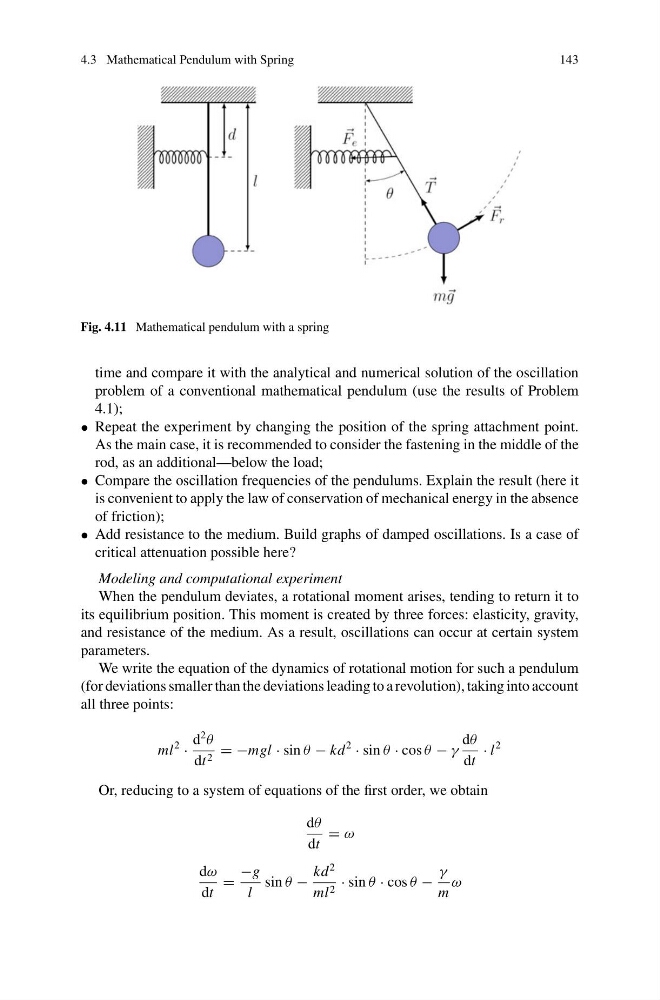
Fig. 4.11 Mathematical pendulum with a spring
time and compare it with the analytical and numerical solution of the oscillation
problem of a conventional mathematical pendulum (use the results of Problem
4.1);
• Repeat the experiment by changing the position of the spring attachment point.
As the main case, it is recommended to consider the fastening in the middle of the
rod, as an additional—below the load;
• Compare the oscillation frequencies of the pendulums. Explain the result (here it
is convenient to apply the law of conservation of mechanical energy in the absence
of friction);
• Add resistance to the medium. Build graphs of damped oscillations. Is a case of
critical attenuation possible here?
Modeling and computational experiment
When the pendulum deviates, a rotational moment arises, tending to return it to
its equilibrium position. This moment is created by three forces: elasticity, gravity,
and resistance of the medium. As a result, oscillations can occur at certain system
parameters.
We write the equation of the dynamics of rotational motion for such a pendulum
(for deviations smaller than the deviations leading to a revolution), taking into account
all three points:
ml
2
·
d
2
θ
dt 2 = −mgl · sin θ − kd
2
· sin θ · cos θ − γ
dθ
dt
· l
2
Or, reducing to a system of equations of the first order, we obtain
dθ
dt
= ω
dω
dt
=
−g
l
sin θ −
kd
2
ml 2 · sin θ · cos θ −
γ
m
ω
143
Fig. 4.11 Mathematical pendulum with a spring
time and compare it with the analytical and numerical solution of the oscillation
problem of a conventional mathematical pendulum (use the results of Problem
4.1);
• Repeat the experiment by changing the position of the spring attachment point.
As the main case, it is recommended to consider the fastening in the middle of the
rod, as an additional—below the load;
• Compare the oscillation frequencies of the pendulums. Explain the result (here it
is convenient to apply the law of conservation of mechanical energy in the absence
of friction);
• Add resistance to the medium. Build graphs of damped oscillations. Is a case of
critical attenuation possible here?
Modeling and computational experiment
When the pendulum deviates, a rotational moment arises, tending to return it to
its equilibrium position. This moment is created by three forces: elasticity, gravity,
and resistance of the medium. As a result, oscillations can occur at certain system
parameters.
We write the equation of the dynamics of rotational motion for such a pendulum
(for deviations smaller than the deviations leading to a revolution), taking into account
all three points:
ml
2
·
d
2
θ
dt 2 = −mgl · sin θ − kd
2
· sin θ · cos θ − γ
dθ
dt
· l
2
Or, reducing to a system of equations of the first order, we obtain
dθ
dt
= ω
dω
dt
=
−g
l
sin θ −
kd
2
ml 2 · sin θ · cos θ −
γ
m
ω