

132
4 Modeling of Mechanical Oscillatory Systems with One Degree …
4.1 Mathematical Pendulum
Formulation of the problem
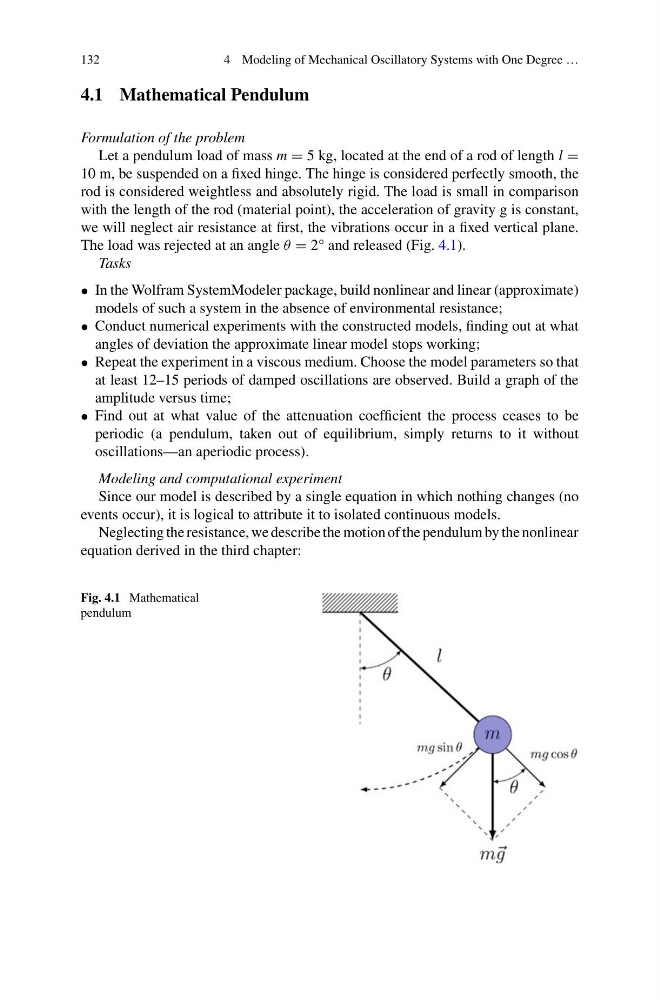
Let a pendulum load of mass m = 5 kg, located at the end of a rod of length l =
10 m, be suspended on a fixed hinge. The hinge is considered perfectly smooth, the
rod is considered weightless and absolutely rigid. The load is small in comparison
with the length of the rod (material point), the acceleration of gravity g is constant,
we will neglect air resistance at first, the vibrations occur in a fixed vertical plane.
The load was rejected at an angle θ = 2° and released (Fig. 4.1).
Tasks
• In the Wolfram SystemModeler package, build nonlinear and linear (approximate)
models of such a system in the absence of environmental resistance;
• Conduct numerical experiments with the constructed models, finding out at what
angles of deviation the approximate linear model stops working;
• Repeat the experiment in a viscous medium. Choose the model parameters so that
at least 12–15 periods of damped oscillations are observed. Build a graph of the
amplitude versus time;
• Find out at what value of the attenuation coefficient the process ceases to be
periodic (a pendulum, taken out of equilibrium, simply returns to it without
oscillations—an aperiodic process).
Modeling and computational experiment
Since our model is described by a single equation in which nothing changes (no
events occur), it is logical to attribute it to isolated continuous models.
Neglecting the resistance, we describe the motion of the pendulum by the nonlinear
equation derived in the third chapter:
Fig. 4.1 Mathematical
pendulum
4 Modeling of Mechanical Oscillatory Systems with One Degree …
4.1 Mathematical Pendulum
Formulation of the problem
Let a pendulum load of mass m = 5 kg, located at the end of a rod of length l =
10 m, be suspended on a fixed hinge. The hinge is considered perfectly smooth, the
rod is considered weightless and absolutely rigid. The load is small in comparison
with the length of the rod (material point), the acceleration of gravity g is constant,
we will neglect air resistance at first, the vibrations occur in a fixed vertical plane.
The load was rejected at an angle θ = 2° and released (Fig. 4.1).
Tasks
• In the Wolfram SystemModeler package, build nonlinear and linear (approximate)
models of such a system in the absence of environmental resistance;
• Conduct numerical experiments with the constructed models, finding out at what
angles of deviation the approximate linear model stops working;
• Repeat the experiment in a viscous medium. Choose the model parameters so that
at least 12–15 periods of damped oscillations are observed. Build a graph of the
amplitude versus time;
• Find out at what value of the attenuation coefficient the process ceases to be
periodic (a pendulum, taken out of equilibrium, simply returns to it without
oscillations—an aperiodic process).
Modeling and computational experiment
Since our model is described by a single equation in which nothing changes (no
events occur), it is logical to attribute it to isolated continuous models.
Neglecting the resistance, we describe the motion of the pendulum by the nonlinear
equation derived in the third chapter:
Fig. 4.1 Mathematical
pendulum