

3.3 Hierarchical Principles of Model Building
117
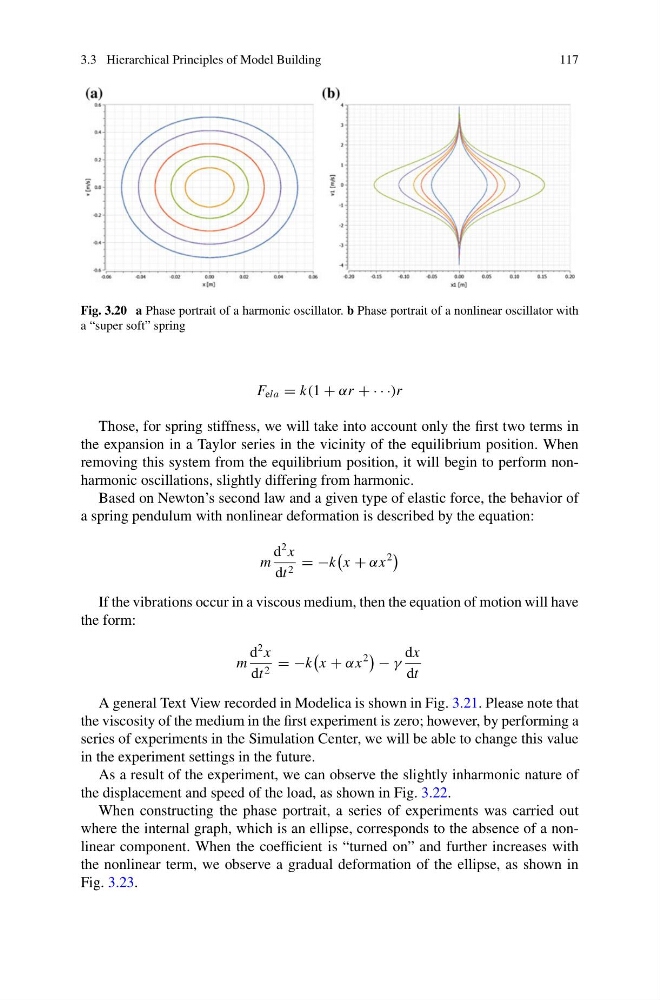
Fig. 3.20 a Phase portrait of a harmonic oscillator. b Phase portrait of a nonlinear oscillator with
a “super soft” spring
F ela = k(1 + αr + · · ·)r
Those, for spring stiffness, we will take into account only the first two terms in
the expansion in a Taylor series in the vicinity of the equilibrium position. When
removing this system from the equilibrium position, it will begin to perform nonharmonic oscillations, slightly differing from harmonic.
Based on Newton’s second law and a given type of elastic force, the behavior of
a spring pendulum with nonlinear deformation is described by the equation:
m
d
2 x
dt 2 = −k
x + αx
2
If the vibrations occur in a viscous medium, then the equation of motion will have
the form:
m
d
2 x
dt 2 = −k
x + αx
2
− γ
dx
dt
A general Text View recorded in Modelica is shown in Fig. 3.21. Please note that
the viscosity of the medium in the first experiment is zero; however, by performing a
series of experiments in the Simulation Center, we will be able to change this value
in the experiment settings in the future.
As a result of the experiment, we can observe the slightly inharmonic nature of
the displacement and speed of the load, as shown in Fig. 3.22.
When constructing the phase portrait, a series of experiments was carried out
where the internal graph, which is an ellipse, corresponds to the absence of a nonlinear component. When the coefficient is “turned on” and further increases with
the nonlinear term, we observe a gradual deformation of the ellipse, as shown in
Fig. 3.23.
117
Fig. 3.20 a Phase portrait of a harmonic oscillator. b Phase portrait of a nonlinear oscillator with
a “super soft” spring
F ela = k(1 + αr + · · ·)r
Those, for spring stiffness, we will take into account only the first two terms in
the expansion in a Taylor series in the vicinity of the equilibrium position. When
removing this system from the equilibrium position, it will begin to perform nonharmonic oscillations, slightly differing from harmonic.
Based on Newton’s second law and a given type of elastic force, the behavior of
a spring pendulum with nonlinear deformation is described by the equation:
m
d
2 x
dt 2 = −k
x + αx
2
If the vibrations occur in a viscous medium, then the equation of motion will have
the form:
m
d
2 x
dt 2 = −k
x + αx
2
− γ
dx
dt
A general Text View recorded in Modelica is shown in Fig. 3.21. Please note that
the viscosity of the medium in the first experiment is zero; however, by performing a
series of experiments in the Simulation Center, we will be able to change this value
in the experiment settings in the future.
As a result of the experiment, we can observe the slightly inharmonic nature of
the displacement and speed of the load, as shown in Fig. 3.22.
When constructing the phase portrait, a series of experiments was carried out
where the internal graph, which is an ellipse, corresponds to the absence of a nonlinear component. When the coefficient is “turned on” and further increases with
the nonlinear term, we observe a gradual deformation of the ellipse, as shown in
Fig. 3.23.