

3.3 Hierarchical Principles of Model Building
105
where
C =
F 0
k − mω
2
1
Knowing the spring oscillation frequency in the absence of external forces, or the
natural frequency of the system ω =
√
k/m, we obtain
C =
F 0
m
ω 2 − ω
2
1
As a result, for a general solution, we have
r (t) = A sin ωt + B cos ωt +
F 0
m
ω 2 − ω
2
1
sin ω 1 t
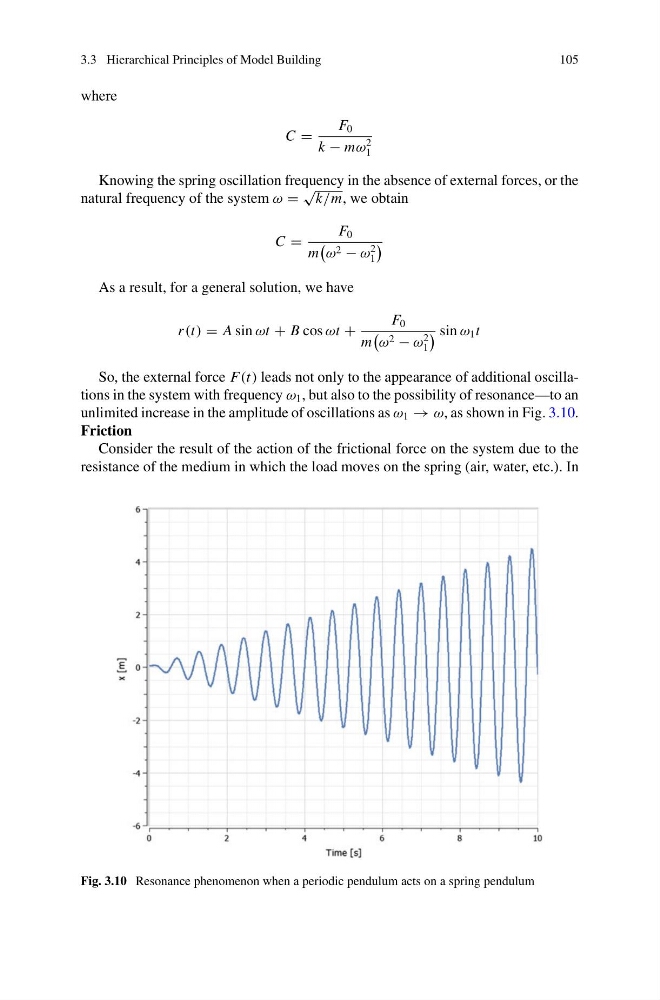
So, the external force F(t) leads not only to the appearance of additional oscillations in the system with frequency ω 1 , but also to the possibility of resonance—to an
unlimited increase in the amplitude of oscillations as ω 1 → ω, as shown in Fig. 3.10.
Friction
Consider the result of the action of the frictional force on the system due to the
resistance of the medium in which the load moves on the spring (air, water, etc.). In
Fig. 3.10 Resonance phenomenon when a periodic pendulum acts on a spring pendulum
105
where
C =
F 0
k − mω
2
1
Knowing the spring oscillation frequency in the absence of external forces, or the
natural frequency of the system ω =
√
k/m, we obtain
C =
F 0
m
ω 2 − ω
2
1
As a result, for a general solution, we have
r (t) = A sin ωt + B cos ωt +
F 0
m
ω 2 − ω
2
1
sin ω 1 t
So, the external force F(t) leads not only to the appearance of additional oscillations in the system with frequency ω 1 , but also to the possibility of resonance—to an
unlimited increase in the amplitude of oscillations as ω 1 → ω, as shown in Fig. 3.10.
Friction
Consider the result of the action of the frictional force on the system due to the
resistance of the medium in which the load moves on the spring (air, water, etc.). In
Fig. 3.10 Resonance phenomenon when a periodic pendulum acts on a spring pendulum