

3.2 Fundamental Principles for Mathematical Models Development
95
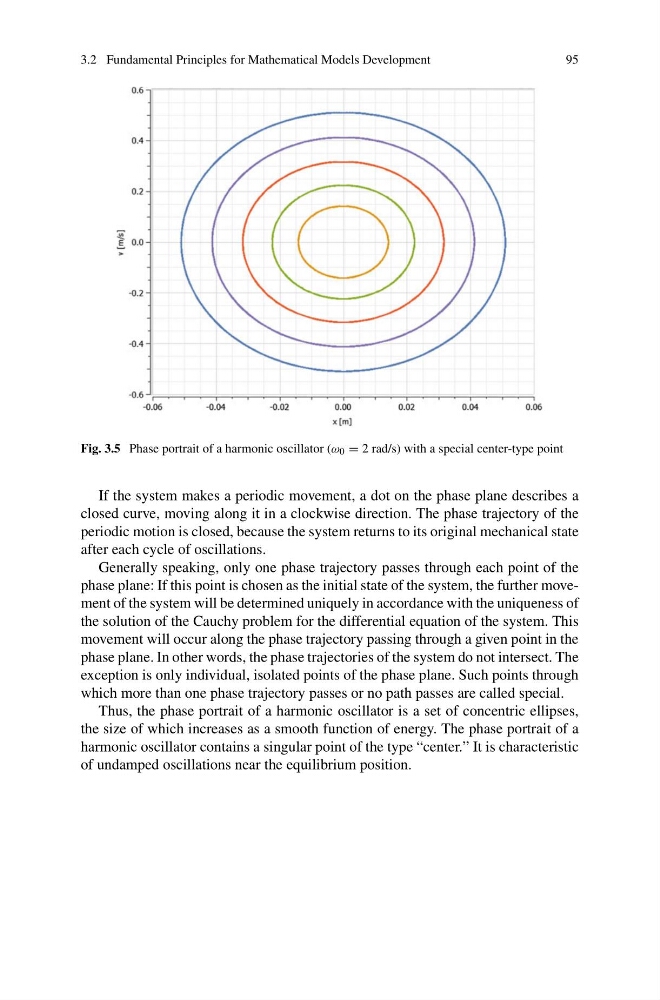
Fig. 3.5 Phase portrait of a harmonic oscillator (ω 0 = 2 rad/s) with a special center-type point
If the system makes a periodic movement, a dot on the phase plane describes a
closed curve, moving along it in a clockwise direction. The phase trajectory of the
periodic motion is closed, because the system returns to its original mechanical state
after each cycle of oscillations.
Generally speaking, only one phase trajectory passes through each point of the
phase plane: If this point is chosen as the initial state of the system, the further movement of the system will be determined uniquely in accordance with the uniqueness of
the solution of the Cauchy problem for the differential equation of the system. This
movement will occur along the phase trajectory passing through a given point in the
phase plane. In other words, the phase trajectories of the system do not intersect. The
exception is only individual, isolated points of the phase plane. Such points through
which more than one phase trajectory passes or no path passes are called special.
Thus, the phase portrait of a harmonic oscillator is a set of concentric ellipses,
the size of which increases as a smooth function of energy. The phase portrait of a
harmonic oscillator contains a singular point of the type “center.” It is characteristic
of undamped oscillations near the equilibrium position.
95
Fig. 3.5 Phase portrait of a harmonic oscillator (ω 0 = 2 rad/s) with a special center-type point
If the system makes a periodic movement, a dot on the phase plane describes a
closed curve, moving along it in a clockwise direction. The phase trajectory of the
periodic motion is closed, because the system returns to its original mechanical state
after each cycle of oscillations.
Generally speaking, only one phase trajectory passes through each point of the
phase plane: If this point is chosen as the initial state of the system, the further movement of the system will be determined uniquely in accordance with the uniqueness of
the solution of the Cauchy problem for the differential equation of the system. This
movement will occur along the phase trajectory passing through a given point in the
phase plane. In other words, the phase trajectories of the system do not intersect. The
exception is only individual, isolated points of the phase plane. Such points through
which more than one phase trajectory passes or no path passes are called special.
Thus, the phase portrait of a harmonic oscillator is a set of concentric ellipses,
the size of which increases as a smooth function of energy. The phase portrait of a
harmonic oscillator contains a singular point of the type “center.” It is characteristic
of undamped oscillations near the equilibrium position.