

94
3 Computer Simulation of Dynamic Systems
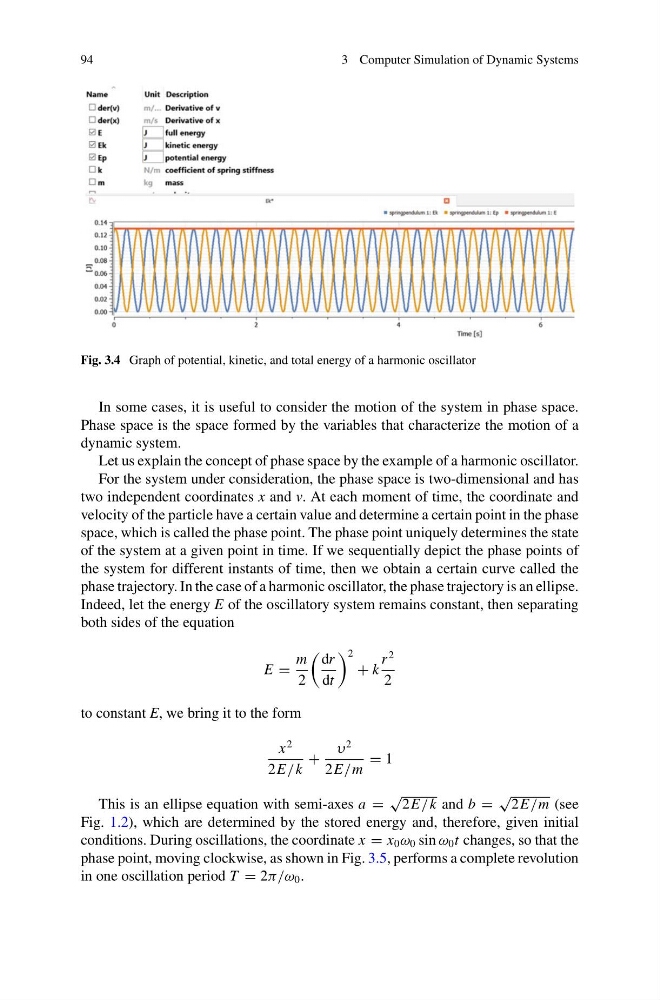
Fig. 3.4 Graph of potential, kinetic, and total energy of a harmonic oscillator
In some cases, it is useful to consider the motion of the system in phase space.
Phase space is the space formed by the variables that characterize the motion of a
dynamic system.
Let us explain the concept of phase space by the example of a harmonic oscillator.
For the system under consideration, the phase space is two-dimensional and has
two independent coordinates x and v. At each moment of time, the coordinate and
velocity of the particle have a certain value and determine a certain point in the phase
space, which is called the phase point. The phase point uniquely determines the state
of the system at a given point in time. If we sequentially depict the phase points of
the system for different instants of time, then we obtain a certain curve called the
phase trajectory. In the case of a harmonic oscillator, the phase trajectory is an ellipse.
Indeed, let the energy E of the oscillatory system remains constant, then separating
both sides of the equation
E =
m
2
dr
dt
2
+ k
r
2
2
to constant E, we bring it to the form
x
2
2E/k
+
υ
2
2E/m
= 1
This is an ellipse equation with semi-axes a =
√
2E/k and b =
√
2E/m (see
Fig. 1.2), which are determined by the stored energy and, therefore, given initial
conditions. During oscillations, the coordinate x = x 0 ω 0 sin ω 0 t changes, so that the
phase point, moving clockwise, as shown in Fig. 3.5, performs a complete revolution
in one oscillation period T = 2π/ω 0 .
3 Computer Simulation of Dynamic Systems
Fig. 3.4 Graph of potential, kinetic, and total energy of a harmonic oscillator
In some cases, it is useful to consider the motion of the system in phase space.
Phase space is the space formed by the variables that characterize the motion of a
dynamic system.
Let us explain the concept of phase space by the example of a harmonic oscillator.
For the system under consideration, the phase space is two-dimensional and has
two independent coordinates x and v. At each moment of time, the coordinate and
velocity of the particle have a certain value and determine a certain point in the phase
space, which is called the phase point. The phase point uniquely determines the state
of the system at a given point in time. If we sequentially depict the phase points of
the system for different instants of time, then we obtain a certain curve called the
phase trajectory. In the case of a harmonic oscillator, the phase trajectory is an ellipse.
Indeed, let the energy E of the oscillatory system remains constant, then separating
both sides of the equation
E =
m
2
dr
dt
2
+ k
r
2
2
to constant E, we bring it to the form
x
2
2E/k
+
υ
2
2E/m
= 1
This is an ellipse equation with semi-axes a =
√
2E/k and b =
√
2E/m (see
Fig. 1.2), which are determined by the stored energy and, therefore, given initial
conditions. During oscillations, the coordinate x = x 0 ω 0 sin ω 0 t changes, so that the
phase point, moving clockwise, as shown in Fig. 3.5, performs a complete revolution
in one oscillation period T = 2π/ω 0 .