

3.2 Fundamental Principles for Mathematical Models Development
91
3.2 Fundamental Principles for Mathematical Models
Development
3.2.1 Newton’s Laws and Conservation Laws
Undoubtedly, one of the easiest ways to obtain mathematical models of mechanical
systems is the use of fundamental laws of nature, such as Newton’s second law and
conservation laws (of matter, energy, momentum) [8].
Let us examine the application of these laws by example.
An ideal spring pendulum (an ideal oscillator) is a mechanical system consisting
of a spring with a given coefficient of elasticity (stiffness) k, one end of which is
rigidly fixed, and the second is attached to a load in the form of a material point with
a given mass m, making harmonic oscillations.
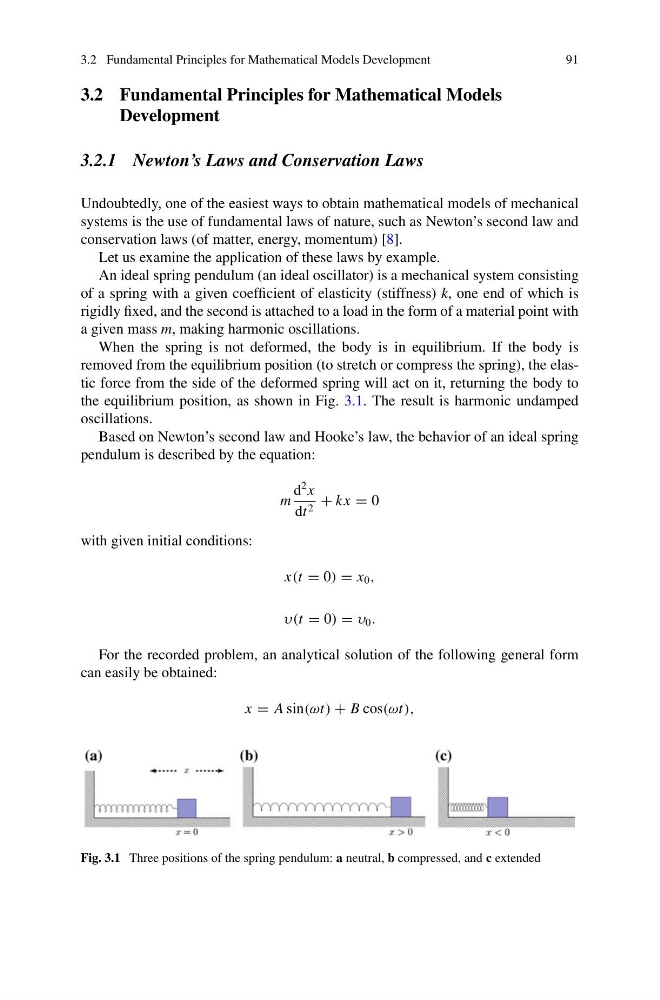
When the spring is not deformed, the body is in equilibrium. If the body is
removed from the equilibrium position (to stretch or compress the spring), the elastic force from the side of the deformed spring will act on it, returning the body to
the equilibrium position, as shown in Fig. 3.1. The result is harmonic undamped
oscillations.
Based on Newton’s second law and Hooke’s law, the behavior of an ideal spring
pendulum is described by the equation:
m
d
2 x
dt 2 + kx = 0
with given initial conditions:
x(t = 0) = x 0 ,
υ(t = 0) = υ 0 .
For the recorded problem, an analytical solution of the following general form
can easily be obtained:
x = A sin(ωt) + B cos(ωt),
Fig. 3.1 Three positions of the spring pendulum: a neutral, b compressed, and c extended
91
3.2 Fundamental Principles for Mathematical Models
Development
3.2.1 Newton’s Laws and Conservation Laws
Undoubtedly, one of the easiest ways to obtain mathematical models of mechanical
systems is the use of fundamental laws of nature, such as Newton’s second law and
conservation laws (of matter, energy, momentum) [8].
Let us examine the application of these laws by example.
An ideal spring pendulum (an ideal oscillator) is a mechanical system consisting
of a spring with a given coefficient of elasticity (stiffness) k, one end of which is
rigidly fixed, and the second is attached to a load in the form of a material point with
a given mass m, making harmonic oscillations.
When the spring is not deformed, the body is in equilibrium. If the body is
removed from the equilibrium position (to stretch or compress the spring), the elastic force from the side of the deformed spring will act on it, returning the body to
the equilibrium position, as shown in Fig. 3.1. The result is harmonic undamped
oscillations.
Based on Newton’s second law and Hooke’s law, the behavior of an ideal spring
pendulum is described by the equation:
m
d
2 x
dt 2 + kx = 0
with given initial conditions:
x(t = 0) = x 0 ,
υ(t = 0) = υ 0 .
For the recorded problem, an analytical solution of the following general form
can easily be obtained:
x = A sin(ωt) + B cos(ωt),
Fig. 3.1 Three positions of the spring pendulum: a neutral, b compressed, and c extended