

6.5 Lithium-Sulfur Battery
187
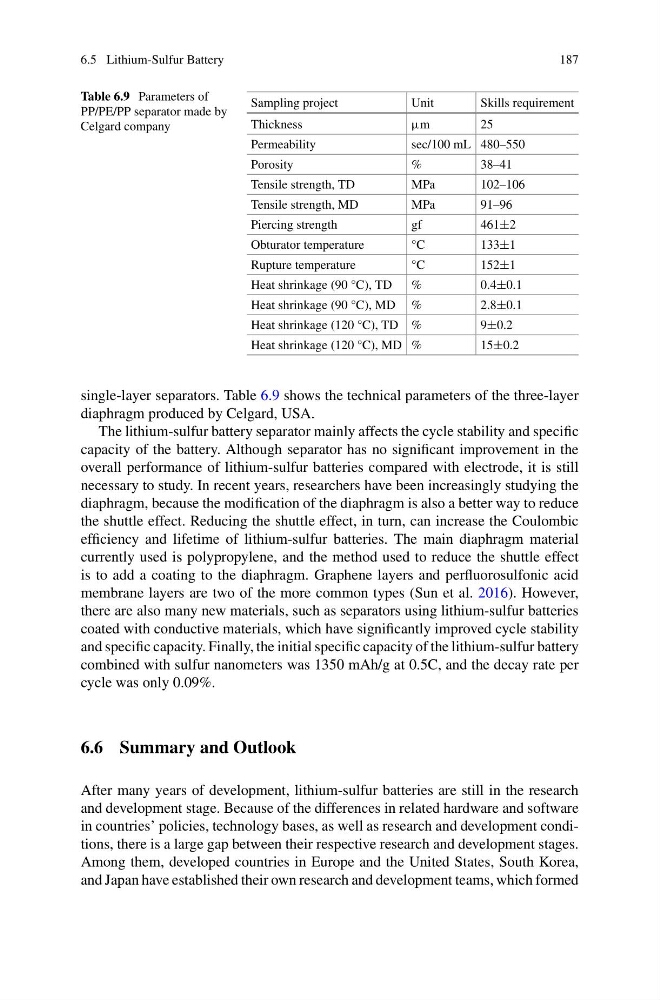
Table 6.9 Parameters of
PP/PE/PP separator made by
Celgard company
Sampling project
Unit
Skills requirement
Thickness
μm
25
Permeability
sec/100 mL 480–550
Porosity
%
38–41
Tensile strength, TD
MPa
102–106
Tensile strength, MD
MPa
91–96
Piercing strength
gf
461±2
Obturator temperature
°C
133±1
Rupture temperature
°C
152±1
Heat shrinkage (90 °C), TD
%
0.4±0.1
Heat shrinkage (90 °C), MD %
2.8±0.1
Heat shrinkage (120 °C), TD %
9±0.2
Heat shrinkage (120 °C), MD %
15±0.2
single-layer separators. Table 6.9 shows the technical parameters of the three-layer
diaphragm produced by Celgard, USA.
The lithium-sulfur battery separator mainly affects the cycle stability and specific
capacity of the battery. Although separator has no significant improvement in the
overall performance of lithium-sulfur batteries compared with electrode, it is still
necessary to study. In recent years, researchers have been increasingly studying the
diaphragm, because the modification of the diaphragm is also a better way to reduce
the shuttle effect. Reducing the shuttle effect, in turn, can increase the Coulombic
efficiency and lifetime of lithium-sulfur batteries. The main diaphragm material
currently used is polypropylene, and the method used to reduce the shuttle effect
is to add a coating to the diaphragm. Graphene layers and perfluorosulfonic acid
membrane layers are two of the more common types (Sun et al. 2016). However,
there are also many new materials, such as separators using lithium-sulfur batteries
coated with conductive materials, which have significantly improved cycle stability
and specific capacity. Finally, the initial specific capacity of the lithium-sulfur battery
combined with sulfur nanometers was 1350 mAh/g at 0.5C, and the decay rate per
cycle was only 0.09%.
6.6 Summary and Outlook
After many years of development, lithium-sulfur batteries are still in the research
and development stage. Because of the differences in related hardware and software
in countries’ policies, technology bases, as well as research and development conditions, there is a large gap between their respective research and development stages.
Among them, developed countries in Europe and the United States, South Korea,
and Japan have established their own research and development teams, which formed
187
Table 6.9 Parameters of
PP/PE/PP separator made by
Celgard company
Sampling project
Unit
Skills requirement
Thickness
μm
25
Permeability
sec/100 mL 480–550
Porosity
%
38–41
Tensile strength, TD
MPa
102–106
Tensile strength, MD
MPa
91–96
Piercing strength
gf
461±2
Obturator temperature
°C
133±1
Rupture temperature
°C
152±1
Heat shrinkage (90 °C), TD
%
0.4±0.1
Heat shrinkage (90 °C), MD %
2.8±0.1
Heat shrinkage (120 °C), TD %
9±0.2
Heat shrinkage (120 °C), MD %
15±0.2
single-layer separators. Table 6.9 shows the technical parameters of the three-layer
diaphragm produced by Celgard, USA.
The lithium-sulfur battery separator mainly affects the cycle stability and specific
capacity of the battery. Although separator has no significant improvement in the
overall performance of lithium-sulfur batteries compared with electrode, it is still
necessary to study. In recent years, researchers have been increasingly studying the
diaphragm, because the modification of the diaphragm is also a better way to reduce
the shuttle effect. Reducing the shuttle effect, in turn, can increase the Coulombic
efficiency and lifetime of lithium-sulfur batteries. The main diaphragm material
currently used is polypropylene, and the method used to reduce the shuttle effect
is to add a coating to the diaphragm. Graphene layers and perfluorosulfonic acid
membrane layers are two of the more common types (Sun et al. 2016). However,
there are also many new materials, such as separators using lithium-sulfur batteries
coated with conductive materials, which have significantly improved cycle stability
and specific capacity. Finally, the initial specific capacity of the lithium-sulfur battery
combined with sulfur nanometers was 1350 mAh/g at 0.5C, and the decay rate per
cycle was only 0.09%.
6.6 Summary and Outlook
After many years of development, lithium-sulfur batteries are still in the research
and development stage. Because of the differences in related hardware and software
in countries’ policies, technology bases, as well as research and development conditions, there is a large gap between their respective research and development stages.
Among them, developed countries in Europe and the United States, South Korea,
and Japan have established their own research and development teams, which formed