

186
6 Nanomaterials for Batteries
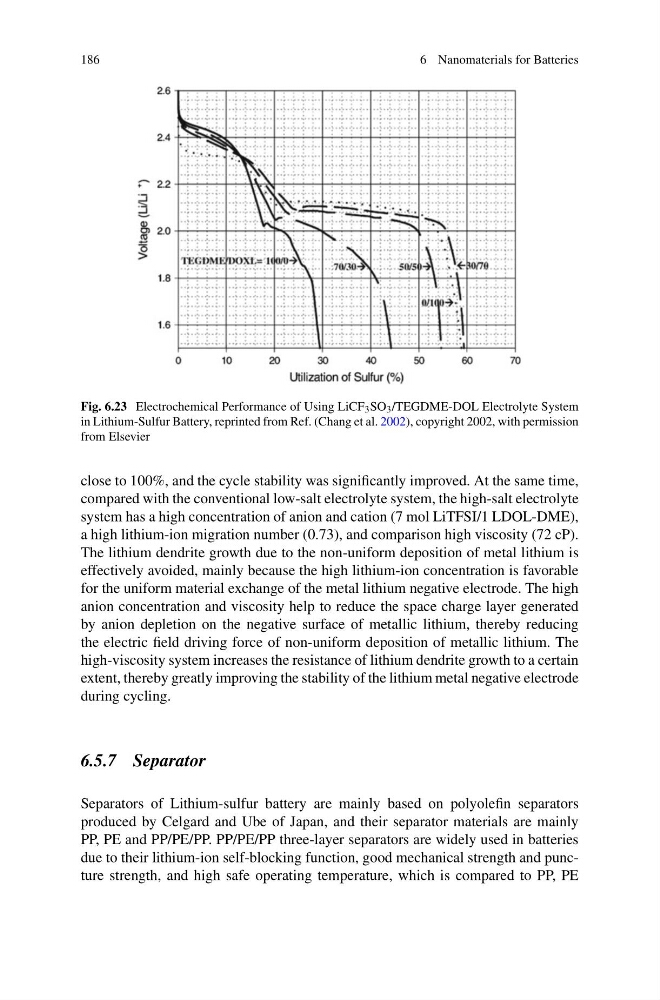
Fig. 6.23 Electrochemical Performance of Using LiCF 3 SO 3 /TEGDME-DOL Electrolyte System
in Lithium-Sulfur Battery, reprinted from Ref. (Chang et al. 2002), copyright 2002, with permission
from Elsevier
close to 100%, and the cycle stability was significantly improved. At the same time,
compared with the conventional low-salt electrolyte system, the high-salt electrolyte
system has a high concentration of anion and cation (7 mol LiTFSI/1 LDOL-DME),
a high lithium-ion migration number (0.73), and comparison high viscosity (72 cP).
The lithium dendrite growth due to the non-uniform deposition of metal lithium is
effectively avoided, mainly because the high lithium-ion concentration is favorable
for the uniform material exchange of the metal lithium negative electrode. The high
anion concentration and viscosity help to reduce the space charge layer generated
by anion depletion on the negative surface of metallic lithium, thereby reducing
the electric field driving force of non-uniform deposition of metallic lithium. The
high-viscosity system increases the resistance of lithium dendrite growth to a certain
extent, thereby greatly improving the stability of the lithium metal negative electrode
during cycling.
6.5.7 Separator
Separators of Lithium-sulfur battery are mainly based on polyolefin separators
produced by Celgard and Ube of Japan, and their separator materials are mainly
PP, PE and PP/PE/PP. PP/PE/PP three-layer separators are widely used in batteries
due to their lithium-ion self-blocking function, good mechanical strength and puncture strength, and high safe operating temperature, which is compared to PP, PE
6 Nanomaterials for Batteries
Fig. 6.23 Electrochemical Performance of Using LiCF 3 SO 3 /TEGDME-DOL Electrolyte System
in Lithium-Sulfur Battery, reprinted from Ref. (Chang et al. 2002), copyright 2002, with permission
from Elsevier
close to 100%, and the cycle stability was significantly improved. At the same time,
compared with the conventional low-salt electrolyte system, the high-salt electrolyte
system has a high concentration of anion and cation (7 mol LiTFSI/1 LDOL-DME),
a high lithium-ion migration number (0.73), and comparison high viscosity (72 cP).
The lithium dendrite growth due to the non-uniform deposition of metal lithium is
effectively avoided, mainly because the high lithium-ion concentration is favorable
for the uniform material exchange of the metal lithium negative electrode. The high
anion concentration and viscosity help to reduce the space charge layer generated
by anion depletion on the negative surface of metallic lithium, thereby reducing
the electric field driving force of non-uniform deposition of metallic lithium. The
high-viscosity system increases the resistance of lithium dendrite growth to a certain
extent, thereby greatly improving the stability of the lithium metal negative electrode
during cycling.
6.5.7 Separator
Separators of Lithium-sulfur battery are mainly based on polyolefin separators
produced by Celgard and Ube of Japan, and their separator materials are mainly
PP, PE and PP/PE/PP. PP/PE/PP three-layer separators are widely used in batteries
due to their lithium-ion self-blocking function, good mechanical strength and puncture strength, and high safe operating temperature, which is compared to PP, PE