

176
6 Nanomaterials for Batteries
conductivity, rich microporous structure, and high mechanical strength. Due to the
low viscosity of sulfur at 155 °C, sulfur and carbon nanotubes can be prepared
at 155 °C to obtain a good composite. Compared with the sulfur/carbon nanotube
composite positive electrode is prepared by simply mixing at room temperature, the
sulfur/carbon nanotube composite positive electrode mixed at 155 °C exhibits lower
charge transfer resistance and better cycling ability. Therefore, sulfur-coated carbon
nanotube composites (S@CNT) were obtained through heat treatment, which can
greatly improve the utilization rate and cycle stability of sulfur (Yuan et al. 2009).
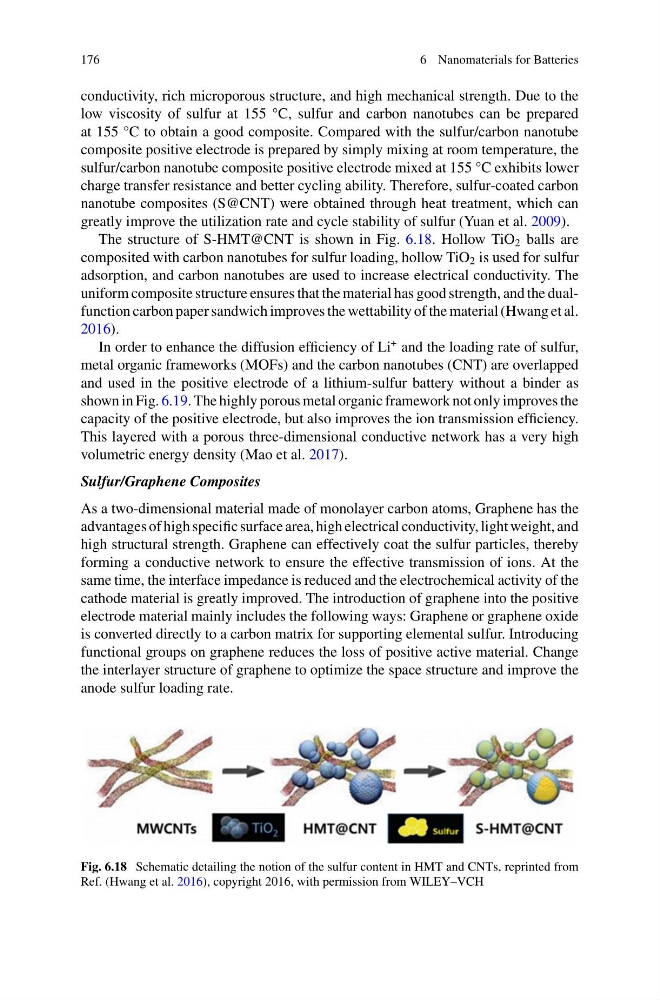
The structure of S-HMT@CNT is shown in Fig. 6.18. Hollow TiO 2 balls are
composited with carbon nanotubes for sulfur loading, hollow TiO 2 is used for sulfur
adsorption, and carbon nanotubes are used to increase electrical conductivity. The
uniform composite structure ensures that the material has good strength, and the dualfunction carbon paper sandwich improves the wettability of the material (Hwang et al.
2016).
In order to enhance the diffusion efficiency of Li
+ and the loading rate of sulfur,
metal organic frameworks (MOFs) and the carbon nanotubes (CNT) are overlapped
and used in the positive electrode of a lithium-sulfur battery without a binder as
shown in Fig. 6.19. The highly porous metal organic framework not only improves the
capacity of the positive electrode, but also improves the ion transmission efficiency.
This layered with a porous three-dimensional conductive network has a very high
volumetric energy density (Mao et al. 2017).
Sulfur/Graphene Composites
As a two-dimensional material made of monolayer carbon atoms, Graphene has the
advantages of high specific surface area, high electrical conductivity, light weight, and
high structural strength. Graphene can effectively coat the sulfur particles, thereby
forming a conductive network to ensure the effective transmission of ions. At the
same time, the interface impedance is reduced and the electrochemical activity of the
cathode material is greatly improved. The introduction of graphene into the positive
electrode material mainly includes the following ways: Graphene or graphene oxide
is converted directly to a carbon matrix for supporting elemental sulfur. Introducing
functional groups on graphene reduces the loss of positive active material. Change
the interlayer structure of graphene to optimize the space structure and improve the
anode sulfur loading rate.
Fig. 6.18 Schematic detailing the notion of the sulfur content in HMT and CNTs, reprinted from
Ref. (Hwang et al. 2016), copyright 2016, with permission from WILEY–VCH
6 Nanomaterials for Batteries
conductivity, rich microporous structure, and high mechanical strength. Due to the
low viscosity of sulfur at 155 °C, sulfur and carbon nanotubes can be prepared
at 155 °C to obtain a good composite. Compared with the sulfur/carbon nanotube
composite positive electrode is prepared by simply mixing at room temperature, the
sulfur/carbon nanotube composite positive electrode mixed at 155 °C exhibits lower
charge transfer resistance and better cycling ability. Therefore, sulfur-coated carbon
nanotube composites (S@CNT) were obtained through heat treatment, which can
greatly improve the utilization rate and cycle stability of sulfur (Yuan et al. 2009).
The structure of S-HMT@CNT is shown in Fig. 6.18. Hollow TiO 2 balls are
composited with carbon nanotubes for sulfur loading, hollow TiO 2 is used for sulfur
adsorption, and carbon nanotubes are used to increase electrical conductivity. The
uniform composite structure ensures that the material has good strength, and the dualfunction carbon paper sandwich improves the wettability of the material (Hwang et al.
2016).
In order to enhance the diffusion efficiency of Li
+ and the loading rate of sulfur,
metal organic frameworks (MOFs) and the carbon nanotubes (CNT) are overlapped
and used in the positive electrode of a lithium-sulfur battery without a binder as
shown in Fig. 6.19. The highly porous metal organic framework not only improves the
capacity of the positive electrode, but also improves the ion transmission efficiency.
This layered with a porous three-dimensional conductive network has a very high
volumetric energy density (Mao et al. 2017).
Sulfur/Graphene Composites
As a two-dimensional material made of monolayer carbon atoms, Graphene has the
advantages of high specific surface area, high electrical conductivity, light weight, and
high structural strength. Graphene can effectively coat the sulfur particles, thereby
forming a conductive network to ensure the effective transmission of ions. At the
same time, the interface impedance is reduced and the electrochemical activity of the
cathode material is greatly improved. The introduction of graphene into the positive
electrode material mainly includes the following ways: Graphene or graphene oxide
is converted directly to a carbon matrix for supporting elemental sulfur. Introducing
functional groups on graphene reduces the loss of positive active material. Change
the interlayer structure of graphene to optimize the space structure and improve the
anode sulfur loading rate.
Fig. 6.18 Schematic detailing the notion of the sulfur content in HMT and CNTs, reprinted from
Ref. (Hwang et al. 2016), copyright 2016, with permission from WILEY–VCH