

174
6 Nanomaterials for Batteries
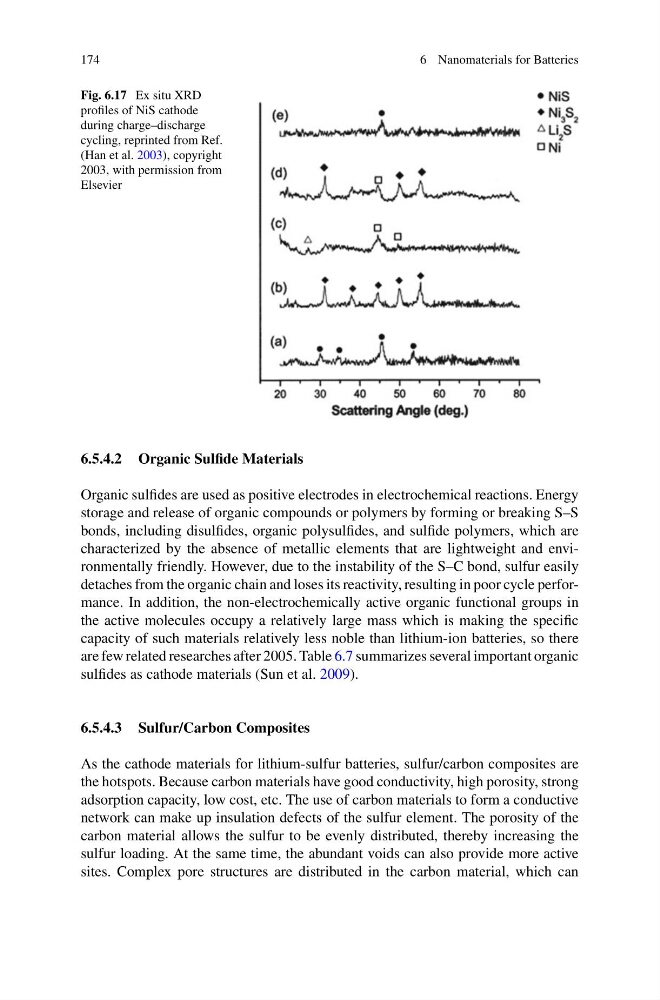
Fig. 6.17 Ex situ XRD
profiles of NiS cathode
during charge–discharge
cycling, reprinted from Ref.
(Han et al. 2003), copyright
2003, with permission from
Elsevier
6.5.4.2 Organic Sulfide Materials
Organic sulfides are used as positive electrodes in electrochemical reactions. Energy
storage and release of organic compounds or polymers by forming or breaking S–S
bonds, including disulfides, organic polysulfides, and sulfide polymers, which are
characterized by the absence of metallic elements that are lightweight and environmentally friendly. However, due to the instability of the S–C bond, sulfur easily
detaches from the organic chain and loses its reactivity, resulting in poor cycle performance. In addition, the non-electrochemically active organic functional groups in
the active molecules occupy a relatively large mass which is making the specific
capacity of such materials relatively less noble than lithium-ion batteries, so there
are few related researches after 2005. Table 6.7 summarizes several important organic
sulfides as cathode materials (Sun et al. 2009).
6.5.4.3 Sulfur/Carbon Composites
As the cathode materials for lithium-sulfur batteries, sulfur/carbon composites are
the hotspots. Because carbon materials have good conductivity, high porosity, strong
adsorption capacity, low cost, etc. The use of carbon materials to form a conductive
network can make up insulation defects of the sulfur element. The porosity of the
carbon material allows the sulfur to be evenly distributed, thereby increasing the
sulfur loading. At the same time, the abundant voids can also provide more active
sites. Complex pore structures are distributed in the carbon material, which can
6 Nanomaterials for Batteries
Fig. 6.17 Ex situ XRD
profiles of NiS cathode
during charge–discharge
cycling, reprinted from Ref.
(Han et al. 2003), copyright
2003, with permission from
Elsevier
6.5.4.2 Organic Sulfide Materials
Organic sulfides are used as positive electrodes in electrochemical reactions. Energy
storage and release of organic compounds or polymers by forming or breaking S–S
bonds, including disulfides, organic polysulfides, and sulfide polymers, which are
characterized by the absence of metallic elements that are lightweight and environmentally friendly. However, due to the instability of the S–C bond, sulfur easily
detaches from the organic chain and loses its reactivity, resulting in poor cycle performance. In addition, the non-electrochemically active organic functional groups in
the active molecules occupy a relatively large mass which is making the specific
capacity of such materials relatively less noble than lithium-ion batteries, so there
are few related researches after 2005. Table 6.7 summarizes several important organic
sulfides as cathode materials (Sun et al. 2009).
6.5.4.3 Sulfur/Carbon Composites
As the cathode materials for lithium-sulfur batteries, sulfur/carbon composites are
the hotspots. Because carbon materials have good conductivity, high porosity, strong
adsorption capacity, low cost, etc. The use of carbon materials to form a conductive
network can make up insulation defects of the sulfur element. The porosity of the
carbon material allows the sulfur to be evenly distributed, thereby increasing the
sulfur loading. At the same time, the abundant voids can also provide more active
sites. Complex pore structures are distributed in the carbon material, which can