

6.5 Lithium-Sulfur Battery
173
6.5.4.1 Binary Metal Sulfides Materials
Binary metal sulfide, a cathode material for lithium-sulfur battery, has got some
more researches in the early stage of development. The compound is simple in
preparation, and the metal powder is mixed with the sulfur powder by a mechanical
grinding method, a high temperature solid phase method, or an electrochemical
deposition method to generate a simple binary metal sulfide. At present, there are
many metal sulfides such as nickel, copper, and iron. As a cathode material for
lithium-sulfur batteries, binary metal sulfides generate lithium compounds or oxides
which are similar to oxides and Li 2 S during discharge, and some can further generate
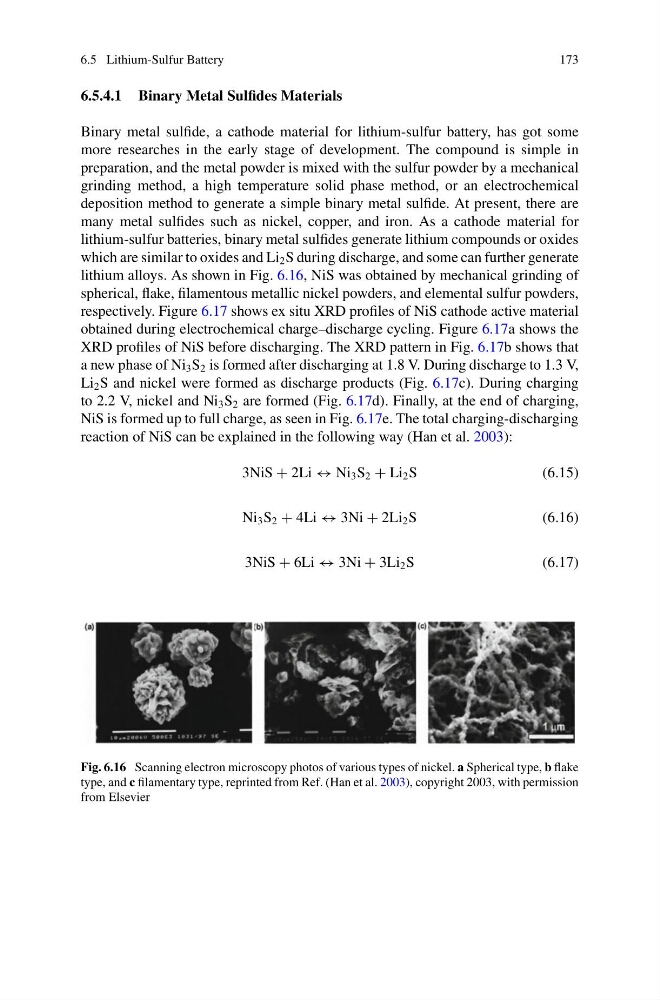
lithium alloys. As shown in Fig. 6.16, NiS was obtained by mechanical grinding of
spherical, flake, filamentous metallic nickel powders, and elemental sulfur powders,
respectively. Figure 6.17 shows ex situ XRD profiles of NiS cathode active material
obtained during electrochemical charge–discharge cycling. Figure 6.17a shows the
XRD profiles of NiS before discharging. The XRD pattern in Fig. 6.17b shows that
a new phase of Ni 3 S 2 is formed after discharging at 1.8 V. During discharge to 1.3 V,
Li 2 S and nickel were formed as discharge products (Fig. 6.17c). During charging
to 2.2 V, nickel and Ni 3 S 2 are formed (Fig. 6.17d). Finally, at the end of charging,
NiS is formed up to full charge, as seen in Fig. 6.17e. The total charging-discharging
reaction of NiS can be explained in the following way (Han et al. 2003):
3NiS + 2Li ↔ Ni 3 S 2 + Li 2 S
(6.15)
Ni 3 S 2 + 4Li ↔ 3Ni + 2Li 2 S
(6.16)
3NiS + 6Li ↔ 3Ni + 3Li 2 S
(6.17)
Fig. 6.16 Scanning electron microscopy photos of various types of nickel. a Spherical type, b flake
type, and c filamentary type, reprinted from Ref. (Han et al. 2003), copyright 2003, with permission
from Elsevier
173
6.5.4.1 Binary Metal Sulfides Materials
Binary metal sulfide, a cathode material for lithium-sulfur battery, has got some
more researches in the early stage of development. The compound is simple in
preparation, and the metal powder is mixed with the sulfur powder by a mechanical
grinding method, a high temperature solid phase method, or an electrochemical
deposition method to generate a simple binary metal sulfide. At present, there are
many metal sulfides such as nickel, copper, and iron. As a cathode material for
lithium-sulfur batteries, binary metal sulfides generate lithium compounds or oxides
which are similar to oxides and Li 2 S during discharge, and some can further generate
lithium alloys. As shown in Fig. 6.16, NiS was obtained by mechanical grinding of
spherical, flake, filamentous metallic nickel powders, and elemental sulfur powders,
respectively. Figure 6.17 shows ex situ XRD profiles of NiS cathode active material
obtained during electrochemical charge–discharge cycling. Figure 6.17a shows the
XRD profiles of NiS before discharging. The XRD pattern in Fig. 6.17b shows that
a new phase of Ni 3 S 2 is formed after discharging at 1.8 V. During discharge to 1.3 V,
Li 2 S and nickel were formed as discharge products (Fig. 6.17c). During charging
to 2.2 V, nickel and Ni 3 S 2 are formed (Fig. 6.17d). Finally, at the end of charging,
NiS is formed up to full charge, as seen in Fig. 6.17e. The total charging-discharging
reaction of NiS can be explained in the following way (Han et al. 2003):
3NiS + 2Li ↔ Ni 3 S 2 + Li 2 S
(6.15)
Ni 3 S 2 + 4Li ↔ 3Ni + 2Li 2 S
(6.16)
3NiS + 6Li ↔ 3Ni + 3Li 2 S
(6.17)
Fig. 6.16 Scanning electron microscopy photos of various types of nickel. a Spherical type, b flake
type, and c filamentary type, reprinted from Ref. (Han et al. 2003), copyright 2003, with permission
from Elsevier