

6.3 The Theory and Research Progress of Sodium-Ion Batteries
155
In addition to these liquid and solid electrolytes, there are also some ion exchange
membranes used in batteries to replace the traditional addition of inorganic salts such
as lithium salts or sodium salts.
6.4 Metal-Air Battery
The metal-air battery is a “half-fuel” battery that is between a primary battery and
a fuel cell and is a type of the chemical battery. The metal-air batteries use metals
as anode-active materials, and these electrode potentials are more negative (such as
magnesium, aluminum, zinc, or lithium) and oxygen or pure oxygen as a cathode
active material (Cheng and Chen 2012). Oxygen diffuses in form of gas to the gas–
liquid-solid three-phase interface and reacts with the metal anode to release electrical
energy. Metal-air battery generally uses alkaline electrolyte solution as electrolyte
solution, because lithium, sodium, and other more negative metals can react with
water, and it can only use non-aqueous organic electrolyte such as phenolic solid
electrolyte or inorganic electrolyte such as LiBF 4 salt solution. Metal-air batteries
not only have the advantages of batteries and fuel cells, but also have the characteristics of rich raw materials, high specific energy, long life, complete pollution-free,
no need for charging equipment, can quickly replace metal fuel and electrolyte, and
excellent shelf properties. It is considered as a new energy source with great development and application prospects in the future. Metal-air batteries have high massto-energy and volume-to-volume ratios. The most important thing is that cathode
materials are inexhaustible. Therefore, researchers and workers have made a lot of
effort to develop metal-air batteries. According to the different kinds of metal anodes,
metal-air batteries can be roughly divided into four categories: zinc-air batteries,
magnesium-air batteries, aluminum-air batteries, and lithium-air batteries. Scientists
have also studied iron-air batteries, but because of the lower discharge voltage, massto-energy ratio, and the higher development and use costs, there are relatively few
studies on such batteries. The following will describe the development of the four
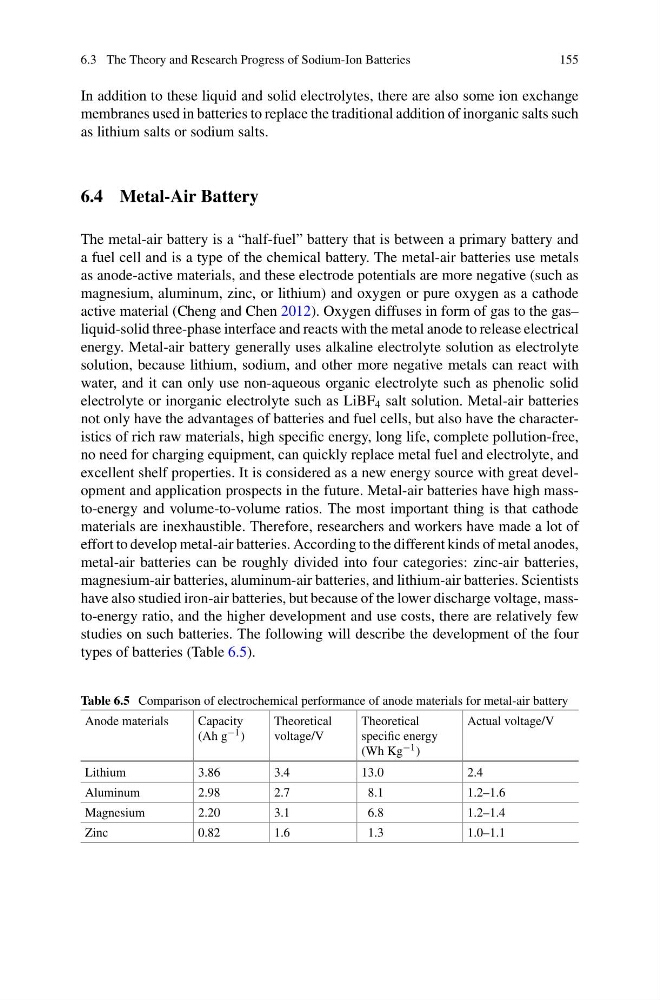
types of batteries (Table 6.5).
Table 6.5 Comparison of electrochemical performance of anode materials for metal-air battery
Anode materials
Capacity
(Ah g −1 )
Theoretical
voltage/V
Theoretical
specific energy
(Wh Kg −1 )
Actual voltage/V
Lithium
3.86
3.4
13.0
2.4
Aluminum
2.98
2.7
8.1
1.2–1.6
Magnesium
2.20
3.1
6.8
1.2–1.4
Zinc
0.82
1.6
1.3
1.0–1.1
155
In addition to these liquid and solid electrolytes, there are also some ion exchange
membranes used in batteries to replace the traditional addition of inorganic salts such
as lithium salts or sodium salts.
6.4 Metal-Air Battery
The metal-air battery is a “half-fuel” battery that is between a primary battery and
a fuel cell and is a type of the chemical battery. The metal-air batteries use metals
as anode-active materials, and these electrode potentials are more negative (such as
magnesium, aluminum, zinc, or lithium) and oxygen or pure oxygen as a cathode
active material (Cheng and Chen 2012). Oxygen diffuses in form of gas to the gas–
liquid-solid three-phase interface and reacts with the metal anode to release electrical
energy. Metal-air battery generally uses alkaline electrolyte solution as electrolyte
solution, because lithium, sodium, and other more negative metals can react with
water, and it can only use non-aqueous organic electrolyte such as phenolic solid
electrolyte or inorganic electrolyte such as LiBF 4 salt solution. Metal-air batteries
not only have the advantages of batteries and fuel cells, but also have the characteristics of rich raw materials, high specific energy, long life, complete pollution-free,
no need for charging equipment, can quickly replace metal fuel and electrolyte, and
excellent shelf properties. It is considered as a new energy source with great development and application prospects in the future. Metal-air batteries have high massto-energy and volume-to-volume ratios. The most important thing is that cathode
materials are inexhaustible. Therefore, researchers and workers have made a lot of
effort to develop metal-air batteries. According to the different kinds of metal anodes,
metal-air batteries can be roughly divided into four categories: zinc-air batteries,
magnesium-air batteries, aluminum-air batteries, and lithium-air batteries. Scientists
have also studied iron-air batteries, but because of the lower discharge voltage, massto-energy ratio, and the higher development and use costs, there are relatively few
studies on such batteries. The following will describe the development of the four
types of batteries (Table 6.5).
Table 6.5 Comparison of electrochemical performance of anode materials for metal-air battery
Anode materials
Capacity
(Ah g −1 )
Theoretical
voltage/V
Theoretical
specific energy
(Wh Kg −1 )
Actual voltage/V
Lithium
3.86
3.4
13.0
2.4
Aluminum
2.98
2.7
8.1
1.2–1.6
Magnesium
2.20
3.1
6.8
1.2–1.4
Zinc
0.82
1.6
1.3
1.0–1.1