

6.2 Lithium Batteries and Lithium-Ion Batteries
133
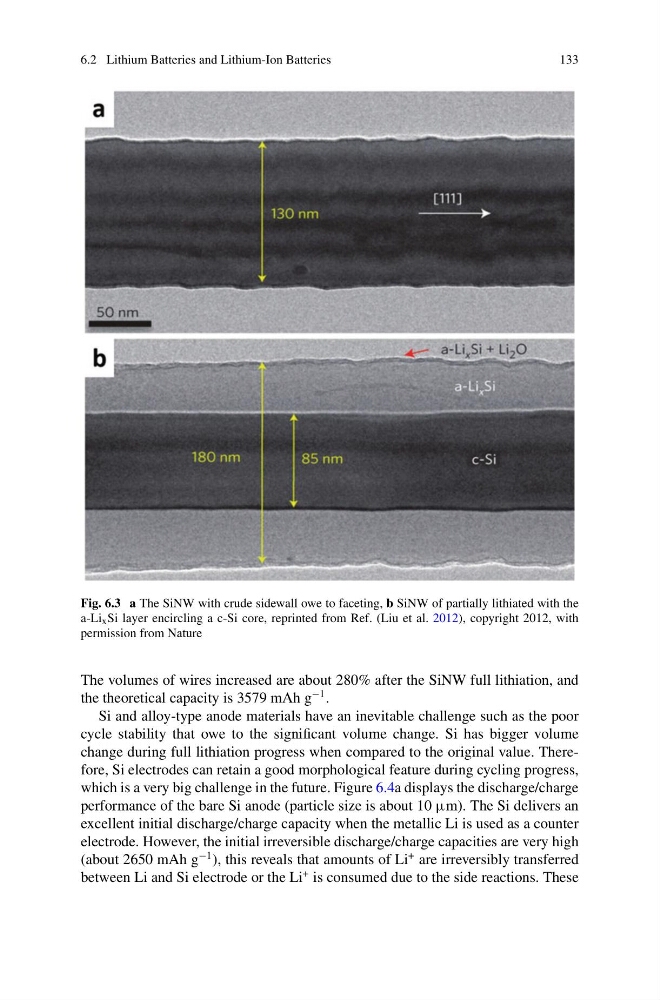
Fig. 6.3 a The SiNW with crude sidewall owe to faceting, b SiNW of partially lithiated with the
a-Li x Si layer encircling a c-Si core, reprinted from Ref. (Liu et al. 2012), copyright 2012, with
permission from Nature
The volumes of wires increased are about 280% after the SiNW full lithiation, and
the theoretical capacity is 3579 mAh g
−1 .
Si and alloy-type anode materials have an inevitable challenge such as the poor
cycle stability that owe to the significant volume change. Si has bigger volume
change during full lithiation progress when compared to the original value. Therefore, Si electrodes can retain a good morphological feature during cycling progress,
which is a very big challenge in the future. Figure 6.4a displays the discharge/charge
performance of the bare Si anode (particle size is about 10 μm). The Si delivers an
excellent initial discharge/charge capacity when the metallic Li is used as a counter
electrode. However, the initial irreversible discharge/charge capacities are very high
(about 2650 mAh g
−1 ), this reveals that amounts of Li
+ are irreversibly transferred
between Li and Si electrode or the Li
+ is consumed due to the side reactions. These
133
Fig. 6.3 a The SiNW with crude sidewall owe to faceting, b SiNW of partially lithiated with the
a-Li x Si layer encircling a c-Si core, reprinted from Ref. (Liu et al. 2012), copyright 2012, with
permission from Nature
The volumes of wires increased are about 280% after the SiNW full lithiation, and
the theoretical capacity is 3579 mAh g
−1 .
Si and alloy-type anode materials have an inevitable challenge such as the poor
cycle stability that owe to the significant volume change. Si has bigger volume
change during full lithiation progress when compared to the original value. Therefore, Si electrodes can retain a good morphological feature during cycling progress,
which is a very big challenge in the future. Figure 6.4a displays the discharge/charge
performance of the bare Si anode (particle size is about 10 μm). The Si delivers an
excellent initial discharge/charge capacity when the metallic Li is used as a counter
electrode. However, the initial irreversible discharge/charge capacities are very high
(about 2650 mAh g
−1 ), this reveals that amounts of Li
+ are irreversibly transferred
between Li and Si electrode or the Li
+ is consumed due to the side reactions. These